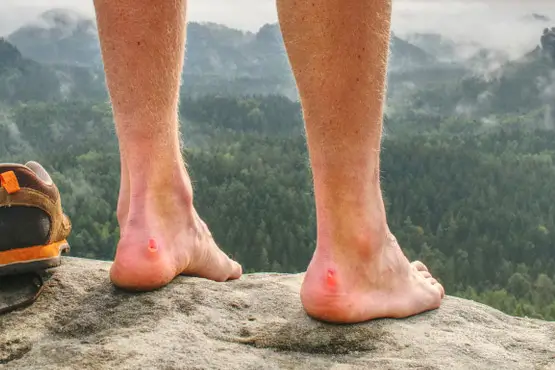
Most cases of running blisters aren’t medical emergencies, but shouldn’t be ignored — especially when they’re too painful. Find out how to treat them!
Run long enough, and blisters are bound to pop up. There’s no way around that.
But… What’s a running blister?
Blisters are the annoying little bumps caused by continuous friction, forcing the outer layers of the skin to rub together, break apart, and fill with gross fluid.
Anything that makes the friction worse exacerbate running blisters, including improper running shoes (too tight or too loose), bad running form, and foot anomalies, like hammertoes, and heel spurs.
For more on blisters and the science behind treatment, check the following scientific articles:
How to Prevent Running Blisters
Want to avoid running blisters in the future? Here’s my tips:
Minimize Friction
Shoes are often the source of the blisters for most runners. Begin by running in proper running shoes.
As a rule, leave enough wiggle room inside of the shoe — but not too much.
Shoot for at least a thumb’s width of space between your longest toes and the end of the shoe.
What’s more? Try out different pairs before you make your mind!
Shoe Lacing Technique
Here's a quick and easy way to ensure your shoes are securely locked down at the heel, providing a snug fit that prevents slippage, blisters, and even painful black toenails, which are common concerns for runners.
By following this simple technique, you can enhance your overall comfort and stability during your runs, reducing the risk of injury and allowing you to focus on your performance rather than worrying about your feet.
Keep your feet dry
Make sure that your feet, socks, and shoes are properly dry before you gear up for a run.
Especially in Ultra distance events, regular sock changes will help to reduce the chances of your skin reaching the kind of moisture levels that lead to blister formation.
Choose Running Socks
Proper running socks offer extra support for your feet, stave off moisture, and can reduce the friction that causes those nasty blisters.
Start by avoiding cotton socks as these soak up sweat and moisture, increasing blister risk.
Instead, go for blister-free socks.
I’d recommend this anti-blister socks on Amazon, I'm using them and I haven't any blister foor a while.
Running-specific socks help wick moisture away from your skin faster than cotton material.
Do you have a bad history of blisters? Try doubling up on the socks to be double sure.
When you wear two pairs of socks, the rubbing occurs amid the socks instead of between the sock and your own skin.
Apply Lubricants
Another thing you can do to prevent running blisters is to moisten your feet before a run.
Lubricants help you minimize the friction that can lead to blisters.
These provide a protective, un-intrusive barrier between your skin and your trainers, keeping you blister-free from your first step to the last.
Apply these lubricants regularly, especially on trouble areas. I’m talking about dry skin or skin with cracks.
I personally prefer to use petroleum jelly because it’s cheap and easy to find.
Popular running friendly brands include, Runners Lube, Body Glide, Chamois, and Sports Shield. You take your pick.
Just slather on too much, or else your feet slide around in your shoes.
I hope after reading this you won't have any more problems with blisters during and after your runs!
How to Treat Blisters
Most cases of running blisters aren’t medical emergencies, but shouldn’t be ignored — especially when they’re too painful.
In fact, some blisters can get infected if you don’t take care of them early and properly.
To properly and safely drain a running blister do the following:
- Wash your hands. Don’t withhold on the water and soap.
- Wipe a needle with alcohol to sterilize it. Option, use 1cc medical syringe to suck the fluid in a sterile way.
- Cautiously pierce the blister in several spots. Choose spots close to the blister’s edge.
- Drain the fluid out with a clean piece of gauze or cotton but leave the skin covering the blister behind. This is an important defensive skin layer that helps prevent infection.
- Apply antiseptic cream on the wound, then cover it with a second skin (a product such as Band-Aid Blister Block) to stave off bacteria.
- Never peel the excessive skin. Let it peel on its own by the time. The moment you peel it, the more surface prone to infection.
Conclusion
running blisters are common and caused by friction. To treat them, sterilize a needle, drain carefully, and apply antiseptic cream.
To prevent blisters, wear well-fitted shoes, keep feet dry, use proper running socks, and apply lubricants like petroleum jelly.
These steps can help you run comfortably without blisters.