9 Rookie Mistakes That Ruin First Marathons (And How to Avoid Them)
Nine first-marathon mistakes coaches see every single year, from training and nutrition to race-day pacing. Learn each one before your start line.

Learn how pacers assist runners in reaching their goals, from personal bests to world records. Discover their key role, characteristics, and how technology like WaveLight enhances pacing.

If you've ever participated in a marathon, half marathon, or even a 5K or 10K race, you’ve likely seen those runners with colorful balloons or flags attached to their shirts, running alongside groups of athletes matching their pace
These runners aren’t competing to win the race, they’re there to help others achieve their goals.
Who are they? They’re called pacers!
In the world of running, a pacer (or "pacemaker" or "hare") is an athlete whose job is to set and maintain a steady pace for a group of runners to help them reach a specific time goal. This could be anything from an amateur runner’s personal best to even a world record for elite athletes.
Pacing isn't a new concept in track and field.
The first major use of pacers in a race came in 1954 when Chris Brasher and Chris Chataway helped Roger Bannister become the first person to run the mile in under four minutes!
But perhaps the most famous modern example of pacers in action was when Eliud Kipchoge made history in October 2019 by becoming the first person to run a marathon in under two hours (1:59:40) in Vienna, with the help of 41 pacers working in shifts to help maintain the target pace of 2:50 per kilometer.
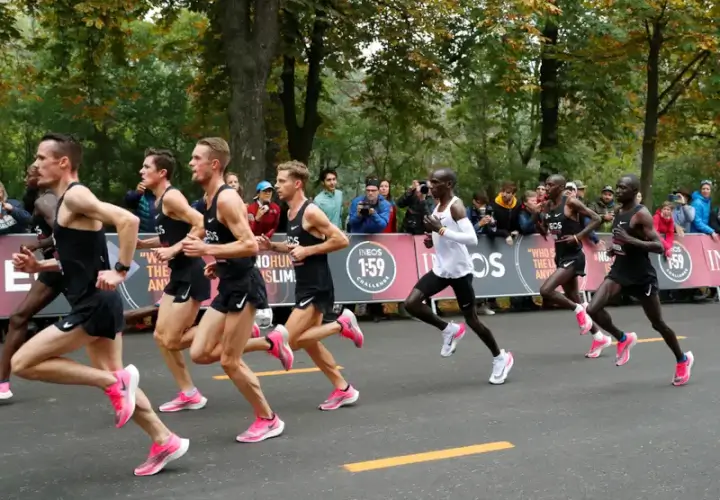
The most important quality a pacer must possess is the ability to maintain a consistent pace with minimal variation, typically within 1 or 2 seconds per kilometer.
This helps the runners they’re pacing to focus purely on the physical effort required to achieve their goals without worrying about their pace.
- For elite athletes, pacers typically run at maximum capacity for a portion of the race, usually around three-quarters, and then let the athlete handle the final stretch.
- For amateur runners, however, pacers are usually slightly faster—about 10 to 15 seconds per kilometer faster—running the entire race while offering guidance on pacing, strategy, and even assistance at water stations (much like drafting in cycling).
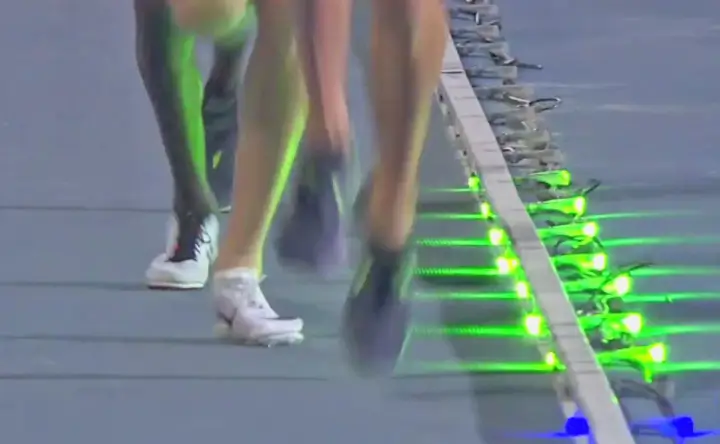
In recent years, technology has enhanced the pacing experience. One such innovation is WaveLight, a system of LED lights placed along the track that flash in sequence to create a visual rhythm for runners to follow.
With approximately 400 lights spaced one meter apart, this system offers unparalleled precision, although it doesn't provide the aerodynamic benefits of running behind a pacer.
Have you ever trained with someone faster than you or used pacers in a race? If so, you know the benefits of following a steady pace set by another runner.
It helps you conserve energy by taking the mental load off pacing, allowing you to focus entirely on maintaining your rhythm and giving your best physical effort.
Following a pacer often feels less tiring, as your mind isn't preoccupied with managing your pace.
However, if you’re counting on a pacer to help you achieve a personal best, make sure you choose the right one.
It’s important to train with them beforehand to assess not only their pacing ability but also how compatible their rhythm is with your own.
Even a few seconds of difference in pace can be the deciding factor between success and failure.
Ready to break your limits? Get yourself a pacer, and let them help you take your running to the next level!
Start your running journey today!
No spam. Cancel anytime.