
Built for the Burn: The Best Running Gear for Hot Weather
The best running gear for hot weather, from sun-blocking caps and breathable shirts to hydration vests, cooling sleeves, and electrolytes that keep summer miles safe and fast.

Is your watch lying to you about your heart rate? We tested the "Gold Standard" Polar H10 to see if the chest strap is still the king of accuracy for serious runners in 2026.

In the world of running tech, we are obsessed with data.
We track cadence, vertical oscillation, and ground contact time. But the most critical metric remains your heart rate.
While modern GPS watches have improved their optical wrist sensors, they still struggle with interval training, cold weather, and high-intensity sprints.
Enter the Polar H10.
Often called the "Gold Standard" of heart rate monitoring, this chest strap promises ECG-level accuracy.
I strapped it on for my last marathon training block to see if it really makes a difference compared to just using a watch. Here is the verdict.
The main reason to buy the H10 is simple: trust. Wrist-based sensors can lag behind when your heart rate spikes quickly, like during 400m repeats or hill sprints.
The Polar H10 uses electrical signals rather than optical light, meaning the data is instantaneous.
During my testing, the H10 caught every peak and valley of my intervals perfectly.
There were no weird spikes at the start of the run and no dropouts when things got sweaty. If you are training by zones, this accuracy isn't just a luxury.
It is a necessity to ensure you aren't training too hard on easy days or too easy on hard days.
One of the H10's strongest features is its versatility. It supports both ANT+ and Bluetooth connections simultaneously.
This means you can pair it with your Garmin/Coros/Apple Watch and your treadmill or Zwift setup at the exact same time. It connects instantly.
I never had to fiddle with settings or restart the sensor. It just works every single time you put it on.

Let's be honest. Nobody loves wearing a chest strap. However, the Polar "Pro Strap" is arguably the most comfortable one on the market.
It features a soft textile material and silicone dots that prevent it from slipping down, even when you are drenched in sweat.
The buckle is secure and easy to snap on. Once you start running, you honestly forget ZWIFT is there after the first mile.
It doesn't chafe or dig into the skin, provided you adjust the size correctly and rinse it after use.
The H10 has built-in memory for one training session.
This is a cool feature if you want to run without your phone or watch (perhaps for a race where you don't want distractions) but still want to record your heart rate data to analyze later in the Polar Beat app.
It is also fully waterproof (30m), so if your running routes take you through heavy rain or if you cross-train with swimming, the H10 handles it without issues.
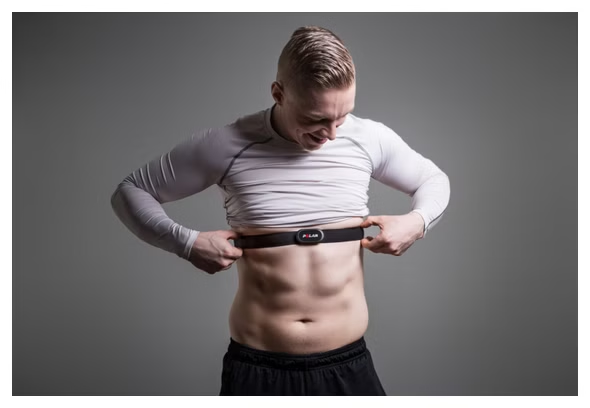
The undisputed champion of accuracy. Every serious runner should have one in their kit.
Ready to stop guessing and start training with precision? You can pick up the Polar H10 Heart Rate Monitor directly on Amazon.
It is currently available with fast shipping options, meaning you could have it ready to go for your next long run.
Check the link to see the latest price, read more user reviews, and choose the color that matches your kit.
If you are a casual jogger, your watch is probably fine.
But if you are a runner who cares about specific training zones, accurate calorie burn, or monitoring recovery, the Polar H10 is an essential piece of gear.
It bridges the gap between guessing your effort and knowing your effort. For the price, it is the best investment you can make to "level up" your training data reliability.
Start your running journey today!
No spam. Cancel anytime.
.webp)


