
The 10 Strength Exercises Top Coaches Want Every Runner Doing (And 3 They Should Skip)
The right strength work makes you a faster, more durable runner. The wrong lifts eat into recovery without giving anything back.

Your mile time is your speed fingerprint: a simple benchmark that reveals your current fitness and unlocks faster 5Ks, steadier 10Ks, and easier long runs with consistent training and smart, targeted speed work.

Curious where you stand or quietly plotting a faster mile? Either way, your one-mile time is more than just a number.
It’s your baseline, your reference point, your personal “speed fingerprint.” Improve it, and everything else tends to follow. Your 5K feels lighter, your 10K steadier, and even long distances begin to unfold with less resistance.

But here’s the thing. Your mile time isn’t dictated by age or sex alone. It’s shaped by your experience, your fitness level, your training habits, and how consistently you show up.
A beginner runner will naturally be slower than someone with years of training behind them. That’s not a flaw. That’s simply the starting line.
A mile is 1609 meters, or roughly 1.6 kilometers. On a standard 400-meter track, that translates to four laps plus a small extra stretch that always feels longer than it should.
The fastest mile times are typically set on tracks, where conditions are controlled and surfaces are predictable.
The idea of a “good” mile time depends heavily on who you are comparing yourself to.
For elite runners, a good mile lives in a completely different universe than for recreational runners. For most people, a good mile time is not about records.
It is about progress.
For intermediate runners, a solid benchmark sits around 6 minutes and 38 seconds for men and 7 minutes and 44 seconds for women.
These are not beginner numbers.
They reflect a level of consistent training and developed endurance.
If you are new to running, your mile time will likely fall between 10 and 12 minutes, sometimes even slower. And that is completely normal. Many beginners start in the 12 to 15 minute range.
The important part is not where you start, but whether you keep moving forward.
Age, sex, and training level all influence how fast you can run a mile. The table below translates those patterns into clear benchmarks across different age groups and ability levels.
These are not strict limits, more like reference points to help you understand where you are and where you could go next.
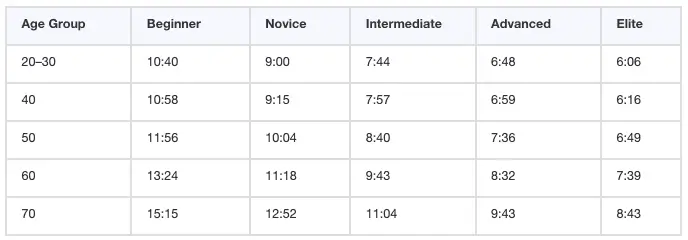
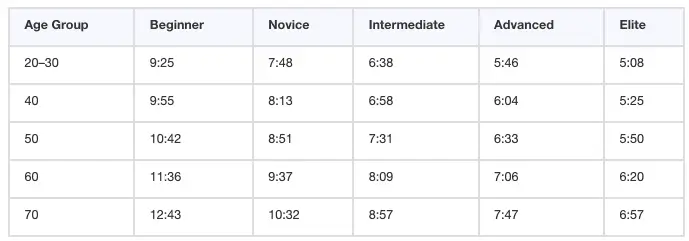
These numbers show a clear pattern, but not a limitation.
Yes, performance tends to decline gradually with age, but the shift is far less dramatic than most people expect.
With consistent training, runners in their 40s, 50s, and beyond can still achieve strong and competitive mile times.
Treat this table less like a scoreboard and more like a map. It shows where others have been, but your route is still entirely your own.
Your mile time is shaped by a mix of biology, environment, and training choices. Some factors are within your control, while others are simply part of your starting point.
Sex plays a role, largely due to differences in muscle mass and the distribution of fast-twitch fibers, which are crucial for speed.
Age also has an impact, but it is often overstated.
Studies have shown that performance remains relatively stable until the mid-30s, after which it declines gradually. Even then, the yearly slowdown is modest.
Biomechanics can influence efficiency, but they are often less important than people think. While running form matters, it is rarely the main limiting factor for most runners.
Strength, endurance, and consistency usually have a greater impact.
Some runners have unconventional styles and still perform exceptionally well, which suggests that perfection is not required.
Terrain changes everything. A mile on a smooth track is not the same as a mile on a trail. Uneven surfaces slow you down, demand more from stabilizing muscles, and disrupt rhythm. Weather conditions also play a role.
Wind can either assist or resist your effort, while heat and humidity can drain your energy faster than expected.
Elevation adds another layer. Running downhill can dramatically improve your time, while uphill running will slow you down significantly.
At higher altitudes, reduced oxygen availability makes it harder for your body to perform at its usual level, which can make even familiar paces feel challenging.
Improving your mile time is not about one breakthrough session. It is about building a system that supports speed over time.
If you are new to running, the most effective strategy is simple consistency. Run regularly, increase your weekly distance gradually, and build a foundation.
Strength training, especially exercises that target your legs and core, can support this process and reduce the risk of injury.
Once you have several months of consistent running behind you, you can begin to introduce more structured speed work. This is where things start to shift.
Interval training is one of the most effective ways to improve mile speed. Short bursts of faster running, such as 200 or 400 meters, train your body to handle higher intensities. These sessions should be balanced with easier runs and rest days to allow recovery.
Hill running is another powerful tool.
Running uphill forces your body to work harder, improving both strength and cardiovascular capacity. Over time, this translates into greater power and efficiency on flat terrain.
Cadence, or the number of steps you take per minute, can also influence speed. Increasing cadence slightly can improve running efficiency.
Short bursts of faster, relaxed running, often called strides, can help you develop this without adding excessive strain.
Explosive strength exercises, such as jump training, can further enhance your ability to generate power. These movements build the kind of strength that translates directly into faster running.
Finally, competition has a unique effect. Running alongside others often brings out a level of effort that is difficult to access alone.
Whether it is a local race, a group run, or a casual event, the presence of others can push you beyond your usual limits.
Improving your mile time is not just about the mile itself. It is about raising your overall running capacity.
When your baseline speed improves, everything else becomes more manageable. Longer distances feel steadier, pacing becomes easier, and your confidence grows.
There is also a psychological shift. Running faster changes how you experience effort. A pace that once felt challenging begins to feel controlled.
What used to demand focus becomes something you can sustain.
At the end of the day, your mile time is not a judgment. It is a snapshot. A moment in your running journey that can always evolve.
With the right mix of consistency, structure, and patience, that number will move. And when it does, you will feel it not just in your times, but in the way you run.
Start your running journey today!
No spam. Cancel anytime.