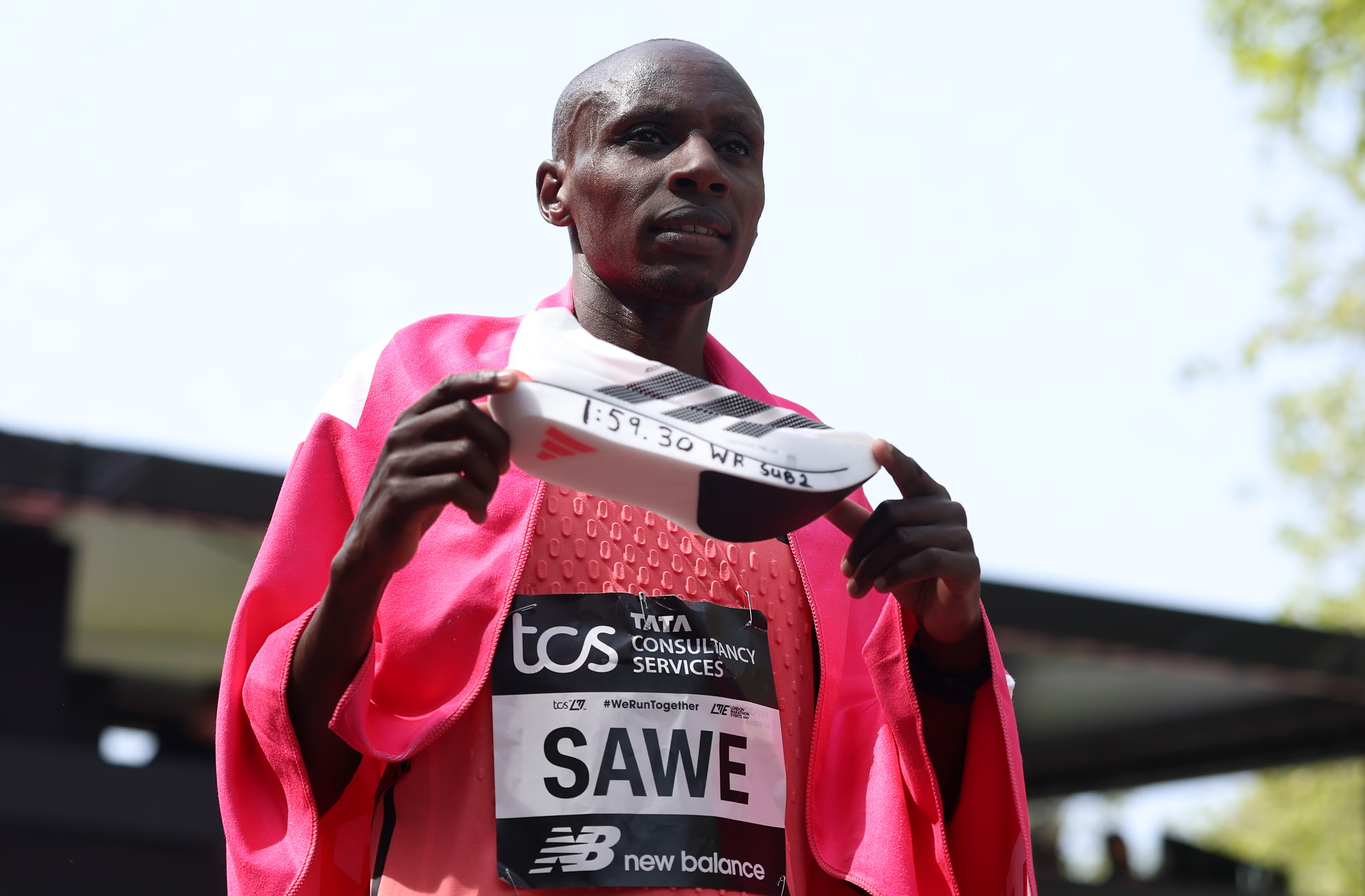
Kenyan runner Sebastian Sawe did what generations of athletes, scientists, and coaches believed was virtually impossible: he crossed the finish line of the London Marathon in 1 hour, 59 minutes and 30 seconds.
On April 26, 2026, the streets of London became the stage for the greatest athletic achievement in the history of human endurance. Sebastian Sawe, a 31-year-old Kenyan runner, crossed the finish line at The Mall in a time of 1:59:30 shattering the two-hour barrier in a fully official, competitive race for the very first time.
A Moment Decades in the Making
For as long as marathon running has existed as a modern competitive sport, the two-hour barrier has loomed like an unclimbable mountain. Scientists debated whether human physiology could even support it. Coaches whispered about it in training camps. Athletes trained for it with laser-like precision. And fans dreamed about the day someone would finally do it for real.
In 2019, Eliud Kipchoge came agonizingly close, running 1:59:40 during the INEOS 1:59 Challenge in Vienna but that effort, brilliant as it was, didn't count as an official world record due to the controlled race conditions, rotating pacemakers, and non-competitive format. It was a proof of concept. A prototype of the impossible.
What Sebastian Sawe did today in London was the real thing. No special lab. No rotating pacemakers. No controlled environment. Just a Kenyan athlete, 42.195 kilometers of London streets, and an unbreakable will.
Who Is Sebastian Sawe?
Full name: Sabastian Kimaru Sawe Date of birth: March 16, 1995 Nationality: Kenyan
Sawe is a product of Iten, Kenya the legendary high-altitude town that has produced some of the greatest distance runners in history. Born in 1995, he developed his endurance base through cross-country and road racing before making an explosive marathon debut in Valencia in December 2024, winning in 2:02:05 immediately placing himself among the five fastest marathoners in history at the time.
What followed was nothing short of a dynasty in the making:
Valencia 2024: 2:02:05 (debut win)
London 2025: 2:02:27 (course second-fastest ever at the time)
Berlin 2025: 2:02:16 (another dominant win)
London 2026: 1:59:30 (World Record first official sub-2 in history)
Sawe had never lost a marathon in his career before today. Every single start line he crossed, he crossed it first. But nothing absolutely nothing came close to what he did today.
A Masterclass in Controlled Aggression
John Walton - PA Images//Getty Images
The 2026 TCS London Marathon men's elite race was one for the ages. From the outset, the pace was ferocious, with the peloton moving through the first half of the race in a stunning 1:00:29 at the halfway point.
It was after the 30-kilometer mark that the race truly ignited. Sawe, moving with the kind of fluid power that separates legends from great runners, broke away with Ethiopian Yomif Kejelcha. The two men pushed each other to the absolute limit of human performance.
Then, with two kilometers to go, Sawe made his move. A decisive, solo surge that left even Kejelcha who went on to finish in an incredible 1:59:41, the second sub-2-hour marathon in history on the very same day grasping at empty space.
Sawe crossed the finish line on The Mall in 1:59:30, arms raised, having just written his name permanently into the history books.
The second half of the race? He ran it in 59 minutes and 1 second a negative split that defies belief. Think about that: the second half of a marathon, run faster than 60 minutes, after already running 21 kilometers at world-record pace.
"What comes today is not for me alone, but for all of us today in London." Sebastian Sawe
The numbers behind this legendary performance
Breaking Down Sawe's Historic 1:59:30:
For those who live and breathe running data, here is every jaw-dropping figure from the most extraordinary marathon performance in human history.
1:59:30: Sawe's official, fully ratified finish time. The first sub-2-hour marathon ever recorded in a competitive race.
4:33 per mile / 2:50 per kilometer, his average pace across all 42.195 kilometers. To put that in perspective: most recreational runners never hit that speed in a 5K, let alone sustain it for over 26 miles.
13.16 mph (21.19 km/h), his average speed. He was essentially sprinting, for two hours straight.
14:10, his average 5K split throughout the race. Five kilometers, over and over again, in under fifteen minutes.
1 minute and 5 seconds, the margin by which he destroyed Kelvin Kiptum's previous official world record of 2:00:35, set at the Chicago Marathon in 2023. In marathon world records, a 65-second improvement is seismic.
10 second, how much faster Sawe ran than Eliud Kipchoge's legendary 1:59:40 at the INEOS 1:59 Challenge in Vienna (2019) which, unlike today's performance, did not count as an official world record due to its controlled, non-competitive format.
27:36, Sawe's split from the 30K to the 40K mark. The point in a marathon where most runners are simply trying to survive, Sawe was still accelerating.
1:00:29, his first half marathon split. A blistering start that already had the athletics world holding its breath.
59:01 his second half marathon split, making this a negative split race, meaning he ran the second half faster than the first.
For context, 59:01 is faster than the American half marathon record of 59:17 set by Conner Mantz. Sawe ran the back half of a full marathon quicker than America's best ever half marathon.
2:02:05 his previous personal best, set at the 2024 Valencia Marathon on his debut. In less than two years, he went from a stunning debut to rewriting the limits of human endurance entirely.
The previous official world record of 2:00:35 was set by the late Kelvin Kiptum at the Chicago Marathon in 2023. Sawe didn't just beat it he obliterated it by over a minute, a margin almost unthinkable in marathon world record progressions. Sawe also ran 10 seconds faster than Kipchoge's unofficial Vienna time from 2019.
The Shoes: Adidas Adizero Adios Pro Evo 3
Alex Davidson (Getty Images)
Behind every great performance, there is technology pushing the boundaries of what feet can do. For Sawe, that technology came in the form of the brand-new Adidas Adizero Adios Pro Evo 3 a shoe so fresh it had only been publicly revealed days before the race.
What makes the Evo 3 so special?
Weight: Averaging just over 97 grams the lightest racing shoe Adidas has ever produced
30% lighter than its predecessor, the Evo 2
1.6% improvement in running economy compared to the Evo 2
39mm stack height, maximizing cushioning and energy return
Carbon fiber plate embedded for propulsion
LIGHTSTRIKE Pro Evo foam for next-level energy return
The result of three years of intensive R&D at Adidas, the Evo 3 is not just a shoe it's a piece of engineering that helped a man make history.
Notably, second-placed Kejelcha also wore the Evo 3, making this the shoe that powered both sub-2-hour finishes on the same day.
Sawe had been a loyal Adidas athlete throughout his marathon career, wearing the Evo 2 to win Berlin 2025 in 2:02:16.
The upgrade to the Evo 3 lighter, more efficient, with greater stack height may well have been worth those precious extra seconds.
Standing on the Shoulders of Giants
It would be incomplete to tell this story without mentioning the athletes who paved the way. Eliud Kipchoge, the Kenyan legend who won multiple London Marathons and Olympic golds, proved in Vienna in 2019 that the human body could go sub-2. His INEOS 1:59 Challenge planted the seed in the collective imagination of runners worldwide.
And then there was Kelvin Kiptum the young Kenyan prodigy who set the official world record of 2:00:35 in Chicago in 2023, tragically taken from the world too soon. His record stood until today. In a poetic way, the torch of Kenyan marathon greatness passed through Kipchoge, to Kiptum, and now burns brightest in the hands of Sebastian Sawe.
A New Era Begins
What Sebastian Sawe achieved on April 26, 2026 is not just a sports story. It is a human story.
A story about the refusal to accept limits, about the quiet, brutal discipline of training at altitude in Kenya, about a sport that keeps redefining what the human body can do.
The sub-2-hour marathon was once the stuff of science fiction. Today, it is reality and its author is a 31-year-old man from Iten, Kenya, wearing a 97-gram shoe, who ran through the streets of London and into immortality.
The barrier is broken. The impossible is done. And running will never be the same again.