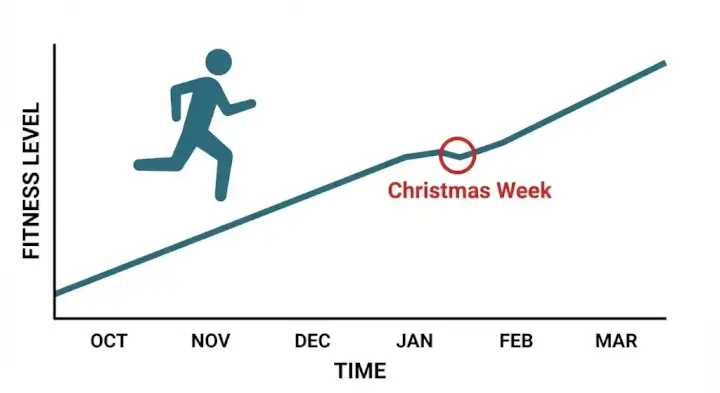
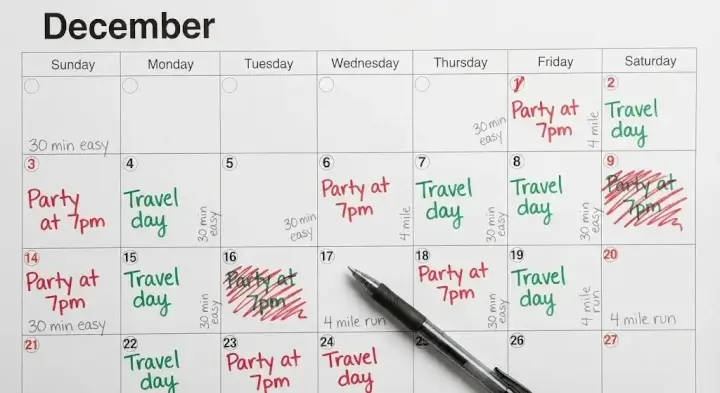
You don't need to train like an Olympian in December to keep your hard-earned fitness. Here is the ultimate guide to maintaining your running momentum during the holidays without being a festive Grinch.
For runners, the holiday season presents a unique paradox.
We finally have time off work, which should theoretically mean more time to run.
Yet, the reality is often a chaotic blend of travel, family obligations, rich food, endless socializing, and, depending on your hemisphere, challenging weather conditions.
Suddenly, that scheduled 10-mile long run feels impossible when squeezed between opening presents and preparing a festive feast.
The guilt sets in. You worry about "losing everything" you worked for over the autumn.
Here is the liberating truth: December is not the time to peak; it is the time to maintain.
You do not need to set personal records during the holidays to ensure you are ready for January.
You just need a strategy that prioritizes consistency over intensity and flexibility over rigidity.
By understanding the science of fitness loss and adopting a "minimum effective dose" mindset, you can enjoy every mince pie and keep your running legs under you.
The Science of "Detraining": Why You Don't Need to Panic
The fear of losing fitness often called "detraining" is what drives many runners to stress-run on Christmas morning. We often feel that missing three days of running will erase three months of progress.
Fortunately, physiology doesn't work that fast.
While it is true that cardiovascular fitness is "use it or lose it," it takes longer to lose than most people realize
According to established research in exercise physiology, significant reductions in VO2 max (your body's maximum ability to utilize oxygen) generally don't begin until about two weeks of complete inactivity.
A pivotal study published in the Journal of Applied Physiologyfamously showed that while highly trained athletes do see drops in enzyme activity and glycogen storage within a week of cessation, significant structural changes to the heart and muscle mitochondria take longer to manifest.
What does this mean for your Christmas?
thIt means taking December 25th and 26th completely off will have zero physiological impact on your long-term fitness.
The real danger isn't a few missed days; the danger is letting a few missed days turn into a completely sedentary month.
The goal of holiday running isn't to gain fitness; it's to provide enough stimulus to remind your body that it’s still a runner.
Mindset Shift: The Art of Maintenance
The biggest obstacle to holiday running isn't time; it's perfectionism. We often fall into the "all-or-nothing" trap: "If I can't do my scheduled 8-mile tempo run, there's no point in running at all."
This mindset must change during the festive period. You need to shift from a "training to improve" mindset to a "training to maintain" mindset.
The Minimum Effective Dose
Ask yourself: What is the absolute minimum amount of running I need to do to feel sane and keep my legs turning over?
During high-stress, busy weeks, research suggests that you can maintain a significant amount of aerobic fitness by reducing your volume by up to 50%, provided you maintain some intensity.
Don't aim for perfect training weeks. Aim for "good enough."
A 20-minute run is infinitely better than a zero-minute run. It keeps the neuromuscular pathways active, it boosts your mood through endorphin release, and it maintains the habit of lacing up your shoes.
Practical Strategies for Festive Running
Knowing the science is one thing; executing it when the house is full of relatives is another. Here are actionable strategies to keep you moving.
1. The Early Bird Gets the Run (and the Shower)
During the holidays, the hours between 8:00 AM and 8:00 PM are rarely your own.
The only time you can guarantee uninterrupted freedom is before the household wakes up.
This requires discipline, especially when it's dark and cold outside, and warm inside.
But the payoff is immense. By finishing your run before breakfast, you eliminate the anxiety of trying to squeeze it in later.
You also get to enjoy the rest of the festive day guilt-free, knowing your work is done. Set your gear out the night before; remove every barrier between you and the door.
2. Embrace the "Run Streak" Concept
If finding 60 minutes is impossible, try finding 15 minutes every single day.
Some runners adopt a "holiday run streak," committing to running at least one mile (1.6km) every day from roughly December 20th to January 1st.
A single mile is manageable regardless of how busy the schedule is.
You can do it in street clothes if necessary. You can do it before festive dinner sits down.
While one mile won't build marathon endurance, the daily consistency keeps your muscles engaged and, crucially, keeps your mind geared toward being an active person.
3. Be Ruthlessly Flexible with Your Plan
If your training plan says "Tuesday: Intervals," but Tuesday involves traveling across the country to visit in-laws, change the plan.
Swap the hard workout for an easy recovery run. Move the long run from Sunday to Friday if Sunday is booked with family events.
The specific day you do a workout matters far less than getting the workout done eventually. Don't be a slave to a spreadsheet; make the spreadsheet work for your life
Navigating Nutrition and Hydration
You cannot out-run a bad diet, and Christmas tests this theory to its limit.
The influx of sugar, processed fats, and alcohol can lead to inflammation and lethargy, making running feel much harder than usual.
We are not suggesting you skip the Christmas pudding. However, mindful consumption is key to maintaining a running routine.
Hydration is Your Secret Weapon
The biggest enemy during the holidays isn't food; it's often dehydration, usually exacerbated by alcohol and central heating.
Dehydration increases perceived exertion meaning your easy run will feel hard, making you less likely to want to do it again tomorrow.
Make a rule: for every alcoholic drink or sugary coffee you consume, drink a large glass of water.
Ensure you are exceptionally well-hydrated before you go to bed on Christmas Eve if you plan on a Christmas morning jog.
Fueling Strategically
Try to sandwich your runs around your best nutritional choices.
If you know midday will be an enormous, heavy meal, do your run in the morning on an empty stomach or after a light banana.
Don't try to run two hours after a massive roast dinner; digestion takes a massive amount of blood flow away from your muscles, leading to sluggishness and cramping.
Alternative Ways to Keep the Engine Running
Sometimes, running just isn't possible. Perhaps you are traveling somewhere without safe routes, or an ice storm has made the pavements dangerous.
Do not treat these days as zero days.
If you cannot run, cross-train. The goal is to elevate your heart rate and work your muscles.
Living Room Strength: A 20-minute bodyweight circuit (squats, lunges, push-ups, planks) requires zero equipment and maintains muscle tension.
The Festive Walk: Never underestimate the power of walking. A brisk 60-minute walk with the family burns calories and aids digestion. It's "active recovery."
Skating or Swimming: If you have access to a rink or a pool, these are fantastic cardio alternatives that give your running joints a break.
Any movement beats no movement.
Conclusion: The Gift of Movement
The holidays are a time for joy, connection, and relaxation. Your running should enhance those feelings, not detract from them.
By letting go of the need for perfection and embracing a "maintenance mindset," you can navigate this busy season successfully.
Remember the science: you won't lose your fitness overnight. A few short, consistent runs are enough to bridge the gap to January.
Be kind to yourself if you miss a workout.
Enjoy the food, enjoy the company, and squeeze in a run when you can. If you can arrive on January 2nd feeling refreshed, injury-free, and eager to start training again, you have had a successful holiday running season.