Run for time, keep most runs at an easy effort you can talk through (about RPE 4–5), and use run-walk intervals to build endurance without burnout.
At some point during the first few weeks of running, most beginners start asking the same question: am I getting faster, or am I just getting tired?
(Credit: Getty Images)
It usually begins innocently. You finish a run, glance at your watch, and suddenly your mood depends on a number you barely cared about a month earlier. If the pace looks slow, it feels discouraging. If it looks faster, the instinct is to push harder next time.
That is where many runners run into trouble.
Pace is one of the worst things to chase when your body is still adapting to running. Early progress rarely comes from forcing speed. It comes from building consistency at an effort your body can sustain.
In the beginning, the real goal is simple: run regularly, keep the effort manageable, and allow your body to adapt. When that foundation is in place, pace improves naturally in the background.
Focusing on effort, time, and habit first allows runners to improve without burnout, injury, or the mental pressure of constantly checking the watch.
Run for Time Instead of Distance
One of the easiest ways to remove pressure from your training is to run for time rather than distance.
Instead of planning a three mile run, plan to run for twenty five minutes. This small shift changes the objective. The goal becomes finishing the time rather than reaching a specific distance or pace.
The distance will naturally increase over time.
For example, you might cover two miles during a twenty five minute run today. A few weeks later you may cover two and a half miles in the same time. Your pace improved, but you never had to chase it.
Many beginners build endurance simply by gradually increasing the time they spend running. Adding five minutes every couple of weeks is often enough to create steady progress.
A simple structure could look like this:
1. Start with twenty to thirty minutes of easy running or run walk intervals. 2. Note the distance covered. 3. Repeat the same time during your next run and observe whether the distance increases naturally.
The key point is consistency. Pace improvements are usually the byproduct of regular training rather than the result of pushing harder every session.
Use Effort Instead of Pace as Your Guide
Many runners rely on simple internal cues instead of constantly checking their watch. Two of the most useful methods are the talk test and the rate of perceived effort.
The talk test is straightforward. If you can comfortably speak in full sentences while running, the effort level is appropriate. If you can only say one or two words before needing to breathe, the pace is likely too intense for regular training.
Another practical method is the Rate of Perceived Effort, often abbreviated as RPE. This scale measures how difficult a run feels on a scale from one to ten.
For most runs, staying around RPE four to five is ideal. This effort level develops aerobic endurance and allows the body to recover effectively.
Over time something interesting happens. The pace that once felt like a five begins to feel like a three or four. That change means your fitness has improved.
Run Walk Intervals Can Build Endurance Faster
Run walk intervals are one of the most effective tools for beginner runners. Despite the misconception, they are not a sign of weakness. They are a structured way to build stamina without overwhelming the body.
The concept is simple. Instead of running continuously until exhaustion, alternate between short running segments and walking recovery periods.
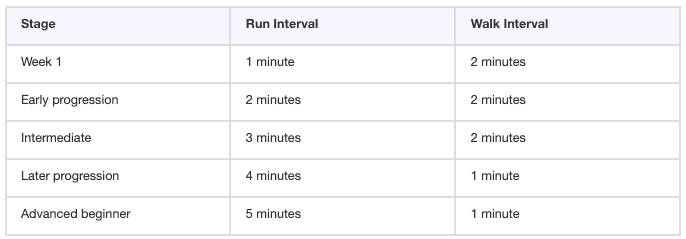
For example, a beginner might run for one minute and then walk for two minutes, repeating the pattern for about twenty minutes. As endurance improves, the running segments gradually become longer while the walking breaks become shorter.
A simple progression could look like this:
This structure works because the walk breaks provide short recovery periods that allow the body to continue moving longer overall.
Many runners discover that they can cover more distance using intervals than by attempting to run continuously and exhausting themselves early.
The running segments should always feel controlled. If a one minute run leaves you completely exhausted, the pace is probably too fast.
With time the running segments naturally extend. Eventually many runners realize they can run a full mile or more without stopping.
Track Progress Without Becoming Obsessed With Data
Tracking your runs can be helpful and motivating. Running apps and fitness watches allow you to record distance, time, route, and pace automatically.
Looking back over several weeks often reveals steady improvement.
However, there is an important difference between tracking progress and becoming controlled by numbers.
Constantly checking pace during a run can create unnecessary pressure.
Sleep, hydration, stress, and weather can all influence performance on any given day. A slower run does not necessarily mean you are losing fitness.
Many runners benefit from focusing on effort instead of data during the run. Some even hide the pace display on their watch to avoid overthinking.
Consistency matters far more than perfect statistics.
Consistency Is What Improves Pace
Pace is ultimately a reflection of fitness. It improves as endurance, strength, and running efficiency develop over time.
Trying to force speed too early often leads to fatigue or injury. Instead, the most reliable strategy is to run regularly at a manageable effort and gradually extend the duration of your training.
A good run usually ends with the feeling that you could continue for a little longer.
Improvement in running rarely happens suddenly. It builds gradually through repeated sessions, steady effort, and patience.
Eventually the pace that once felt difficult becomes comfortable. At that point the watch simply confirms what your body already knows.