
Jensen Huang Did 100 Push-Ups Every Night at Age Nine, and Runners Should Steal the Habit
Jensen Huang did 100 push-ups every night at age nine. Here is what the science says push-ups do for runners, and how to build the habit safely.

Jensen Huang tells graduates to run, don't walk. Here is what his favorite line teaches new runners, and why just 5 to 10 minutes a day can count.

Jensen Huang has a line he keeps coming back to, and it fits running perfectly.
In May 2026, the Nvidia founder told graduating students at Carnegie Mellon University, "So run. Don't walk."
He was talking about the opportunities opening up in technology, according to IBTimes. He has used the same three words before, and they translate almost perfectly to anyone thinking about taking up running.
If you have been putting off your first run, this one is for you.
Huang did not invent the phrase, but he has made it his own. He used it in two commencement speeches three years apart.
In May 2023, Huang gave the commencement address at National Taiwan University. He urged graduates to chase whatever they wanted to build.
"Whatever it is, run after it like we did. Run, don't walk," he said, according to a transcript of the speech.
Then he added a line that went viral, "Remember, either you're running for food or you are running from being food."
Three years later, at Carnegie Mellon, he came back to the same idea. "We are all standing at the same starting line," he told graduates.
Then came the now-familiar "So run. Don't walk."
That starting line image is a gift to any new runner. Everyone begins somewhere, and almost nobody begins fast.
Huang's message is about urgency, not jogging. He means do not wait, do not drift, and do not hold back until everything feels perfect.
But that is exactly what stops most people from running. They wait for better weather, a new pair of shoes, or the day they finally feel fit enough to start.
The good news is that you do not have to run far or fast for running to count. Two large studies make that clear.
A 2014 study in the Journal of the American College of Cardiology followed more than 55,000 adults for an average of 15 years. Runners had a 30 percent lower risk of death from all causes and a 45 percent lower risk of dying from heart disease than non-runners, according to the study abstract.
The surprise was how little running it took. Running just 5 to 10 minutes a day, even at slow speeds under 6 miles per hour, was linked to those benefits.
A 2020 review in the British Journal of Sports Medicine pooled data on more than 232,000 people. Running was linked to a 27 percent lower risk of death from all causes, according to the review abstract.
The researchers concluded that any amount of running, even once a week, is better than none. Both studies are observational, so they show links rather than proof, but the message is hard to ignore.

Here is where the slogan needs a footnote. For a brand-new runner, walking is part of running.
"Run, don't walk" works best as a way to think, not a literal rule for your first session. Taking planned walk breaks is how most beginners build up safely, and it is how many experienced marathoners race.
A structured plan like this 8-week walk-to-run program builds from short jogs to continuous running. The Jeff Galloway run-walk method uses the same idea for longer distances.
Even at the marathon level, walking breaks can make runners faster, not slower. The key is that the walks are planned, not a sign you have given up.
Huang's line is really about starting now. Here is how to turn that into your first few weeks of running.
You will never feel completely ready, and that is normal. Put a short run in your calendar for this week, not next month.
Remember the 5 to 10 minute finding. A short run you finish feeling good beats a long one that leaves you sore and discouraged.
Most new runners go out far too fast. If you cannot speak in full sentences, slow down, and this guide on why you run out of breath explains why it happens.
Doing too much too soon is the most common way beginners get hurt. These common beginner runner mistakes are worth reading before your first week.
A goal makes the habit stick. Running your first 5K without stopping is a perfect first finish line.
You do not need a complicated plan to begin. Three short sessions in your first week is plenty.
Walk briskly for five minutes to warm up. Then alternate one minute of easy jogging with two minutes of walking, six times over.
Rest, or go for an easy walk. Your legs, joints, and tendons need time to adapt, even when your lungs feel fine.
This is the step most eager beginners skip, and it is the one that keeps you injury-free long enough to build the habit.
Repeat the day one session, and add a jogging minute when it starts to feel easy. Small steps each week add up faster than you expect.
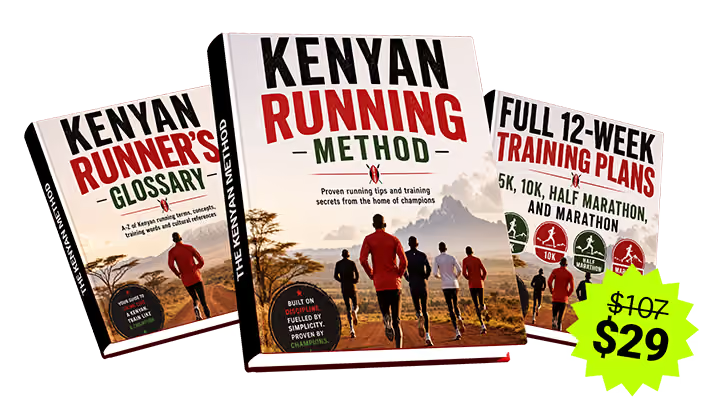
Discover the authentic training methods of Kenyan runners and start improving your running faster than you ever thought possible.
Learn More About The Method →Limited-time reader discount available
Huang's most famous line was about survival in business. For runners, it can be read more kindly.
Find your food, the thing you are running toward. It might be better sleep, a calmer head, more energy for your kids, or a race medal with your name on it.
You do not need to be fast, and you do not need to be ready.
You just need to start, so run, don't walk, even if your first run includes plenty of walking.
Start your running journey today!
No spam. Cancel anytime.


