Run4Wales has confirmed a participant died after the 2026 Cardiff Half Marathon. What the organisers said, what the medical response looked like, and what the research shows about cardiac arrest at mass-participation races.
A participant has died after taking part in the 2026 Cardiff Half Marathon, event organiser Run4Wales confirmed on Monday.
The runner's identity has not been released at the family's request. Run4Wales said no further details would be shared out of respect for their wishes.
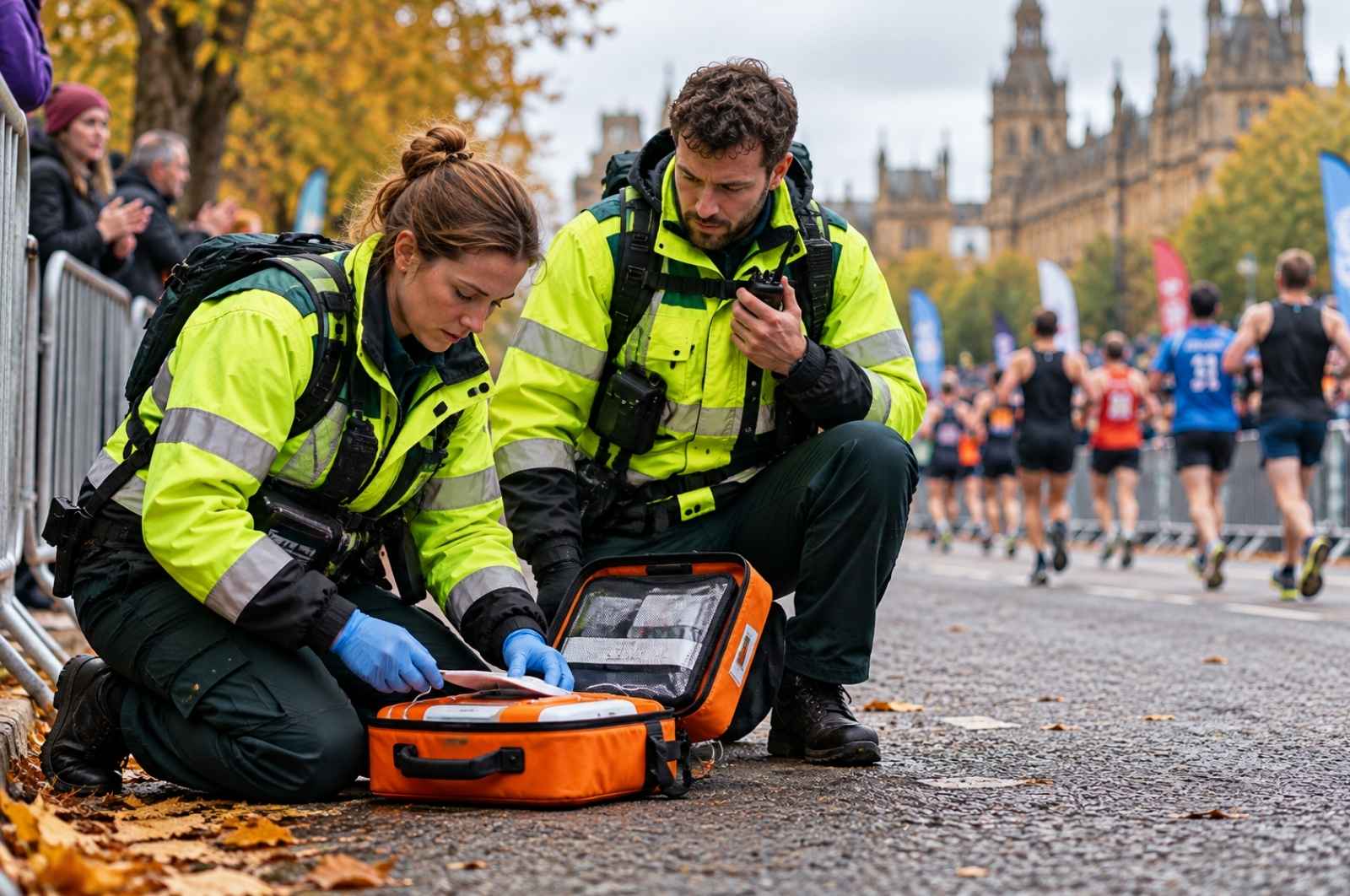
The organisers highlighted the speed of the medical response in their statement, saying the course and hospital teams reacted with "great speed and professionalism".
What Run4Wales has confirmed so far
The statement issued on Monday read, in part: "We'd like to acknowledge the event and hospital medical teams who reacted with great speed and professionalism."
"Our deepest sympathies go out to the runner's family and friends," the organisers added.
Run4Wales said no further details would be released in respect of the family's wishes.
A record field through central Cardiff
This year's edition of the Cardiff Half Marathon was the biggest in its 23-year history.
More than 29,000 runners took to the start line in front of Cardiff Castle on a cool, bright autumn morning, with entry capped by a public ballot for the first time after more than 60,000 applications.
The 13.1-mile course runs past the Principality Stadium and Cardiff City Stadium, out to Penarth, across the Cardiff Bay barrage, and finishes at the Civic Centre.
It is a flat, fast layout that holds a World Athletics Elite Road Race Label and was headlined this year by former world-record holder Joyciline Jepkosgei in the women's elite field.
The medical plan the organisers used
Mass-participation half marathons in the UK run to a defined medical plan agreed in advance with the local health board.
The Cardiff Half uses a layered setup: mobile cycle responders and foot patrols along the route, static treatment points roughly every two miles, strategically positioned automated external defibrillators (AEDs), and a tiered link into the Welsh Ambulance Service for anything beyond on-course care.
That layered design is the reason organisers were able to say the response reached the participant in seconds.
What the research shows about cardiac events at mass-participation races
The exact cause of this participant's death has not been released.
For context on how rare and how survivable sudden cardiac events are at modern road races, the clearest dataset is the RACER study (Race Associated Cardiac Arrest Event Registry) led by Dr Jonathan Kim at Emory.
The original 2012 RACER paper looked at every US marathon and half marathon from 2000 to 2010 and found cardiac arrest occurred at a rate of roughly 0.54 per 100,000 participants. The published paper is available on PMC via the National Library of Medicine. A follow-up update published in 2025, looking at nearly 30 million finishers from 2010 to 2023, found the incidence essentially unchanged at 0.60 per 100,000, but the survival rate has jumped sharply, with the share of victims who died falling from 71 percent in the earlier cohort to 34 percent in the newer one.
The researchers credited that improvement to bystander CPR, fast AED access, and well-drilled race-course emergency action plans. In other words, the exact design the Cardiff Half uses.
Half marathon risk vs full marathon
The newer RACER data also broke the figure down by distance. Full marathoners experienced roughly 1.04 arrests per 100,000 finishers, while half marathoners sat at 0.47 per 100,000.
Men accounted for the vast majority of cases across both distances, and coronary artery disease was the single most common underlying cause.
The warning signs runners are told to watch for
Sudden cardiac arrest during exercise is, in most cases, not sudden in the clinical sense.
Cleveland Clinic's patient guidance on cardiac arrest lists a cluster of warning signs that often appear in the days or weeks before an event: unusual chest discomfort, unexpected shortness of breath on routine effort, palpitations, fainting or near-fainting during exertion, and sudden drops in exercise tolerance. None of those symptoms belongs in a taper week.
If any of them show up in the weeks before a goal race, the right move is to see a doctor and get cleared before the start line, not to push through.
The finish line is a specific risk point
One underexplored piece of the race-day picture is the final kilometre.
A Paris-based study of mass-participation events found a statistically significant spike in cardiac arrest risk in the finish-chute surge, with the mechanism likely tied to adrenaline, dehydration, and a sudden rise in effort over the last few hundred metres. Our full breakdown is in our Paris finish-line surge coverage. The practical takeaway for a half marathon field is unglamorous: do not sprint the final 400 metres unless you have been training sprint finishes, and keep drinking all the way to the mat.
What a bystander runner can actually do
The reason modern race-day survival rates have doubled is not better hospitals. It is the first two minutes.
If a runner collapses next to you on the course and is unresponsive and not breathing normally, the sequence is call for help, start chest compressions, and shout for an AED.
Compressions do not have to be perfect to help. The research is unambiguous that any CPR is dramatically better than none in the minutes before paramedics arrive.
Course marshals carry radios tied directly to the medical plan, and in a city centre event like Cardiff an AED is almost never more than a minute away.
The event itself
The 2026 Cardiff Half Marathon raised money for a long list of partner charities, including the British Heart Foundation, Noah's Ark Children's Hospital, and Ty Hafan.
Run4Wales said tribute arrangements would be led by the family.