The Training Change Every Woman Runner Over 45 Is Getting Wrong
A 2025 clinical study of women in perimenopause and postmenopause found a training change that outperformed extra mileage. Most running plans still miss it.

Runners get higher cumulative UV exposure than the general population. Here is when sunscreen matters, what SPF actually works when you sweat, and what to do about it.

The short answer is yes.
If you run outside for more than about twenty minutes at any point between spring and autumn, you almost certainly need sunscreen.
The longer answer is more useful, because it explains why running is a genuinely higher-risk activity for UV damage, and what to do about it without turning every run into a chemistry lab.
Outdoor athletes accumulate more ultraviolet radiation than almost anyone else in their neighbourhood. Multiple studies have shown that outdoor exercisers routinely exceed recommended daily UV limits, and in summer the excess can be several times the daily guideline.
That matters because UV exposure is cumulative. Your body does not reset the counter at the end of each run.
Every hour you spend on the road, the trail, or the track adds to a running total that raises your lifetime risk of skin cancer, premature ageing, and sun-driven eye damage.
Olympic marathoner Deena Kastor has spoken publicly about being treated for melanoma three separate times. She has also been treated for basal cell and squamous cell skin cancers on multiple occasions.
That is the same Deena Kastor who ran a 2:19:36 marathon, and she is not an outlier because she is lax about protection.
She now speaks openly about sun protection precisely because runners tend to skip it.
Dermatologists agree. Surveys have found that fewer than 25 percent of surveyed athletes report using sunscreen regularly, according to one review flagged in the outdoor-endurance community.
The honest calibration matters, because every run is not the same UV problem.
The American Academy of Dermatology, and the general dermatology consensus, boils it down to three questions.
If you are running with your face, ears, neck, arms, hands, or legs bare to open sky, the answer is sunscreen or clothing. UV goes through cloud, mesh singlets, and thin summer fabric.
On a fully overcast day, up to 80 percent of UV radiation still reaches ground level. Cloud cover is not a moisturiser.
The rule of thumb from dermatologists is that a 20-minute run in a high-UV location can produce a sunburn, particularly in fair skin. Longer runs stack the risk quickly.
Anything over about 40 minutes in mid-day summer sun is the point at which not wearing sunscreen becomes a deliberate choice.
UV intensity peaks between about 10 in the morning and 4 in the afternoon. Running outside those hours is not exemption, but the daily dose is meaningfully lower.
The classic runner’s hack of moving longer runs to the shoulders of the day still helps, provided the route is not fully exposed for the whole session.
This is where most runners get vague guidance. Here is the specific version.
You want broad-spectrum SPF 30 or higher. Broad-spectrum matters because it covers both UVA and UVB, and both do meaningful damage.
Water-resistant labels typically hold their claim for 80 minutes of activity. After that, if you have been sweating heavily, the protective film is compromised.
For a long run, a stick or spray for reapplication at the turnaround is a small operational win. It removes the excuse of hands full of sunscreen goo mid-run.
Apply the first coat 15 to 20 minutes before you head out. Sunscreen needs a bit of time on the skin to bond and activate.
The most commonly missed spots are the ears, the back of the neck, and the scalp along the hairline and part. Lips need SPF balm too.
Hands, too, because they swing at an angle that catches direct sun for the entire run.
A hat with a 2 to 3 inch brim covers most of the face and ears, and a UV-blocking sunglass helps protect the thin skin around the eyes.
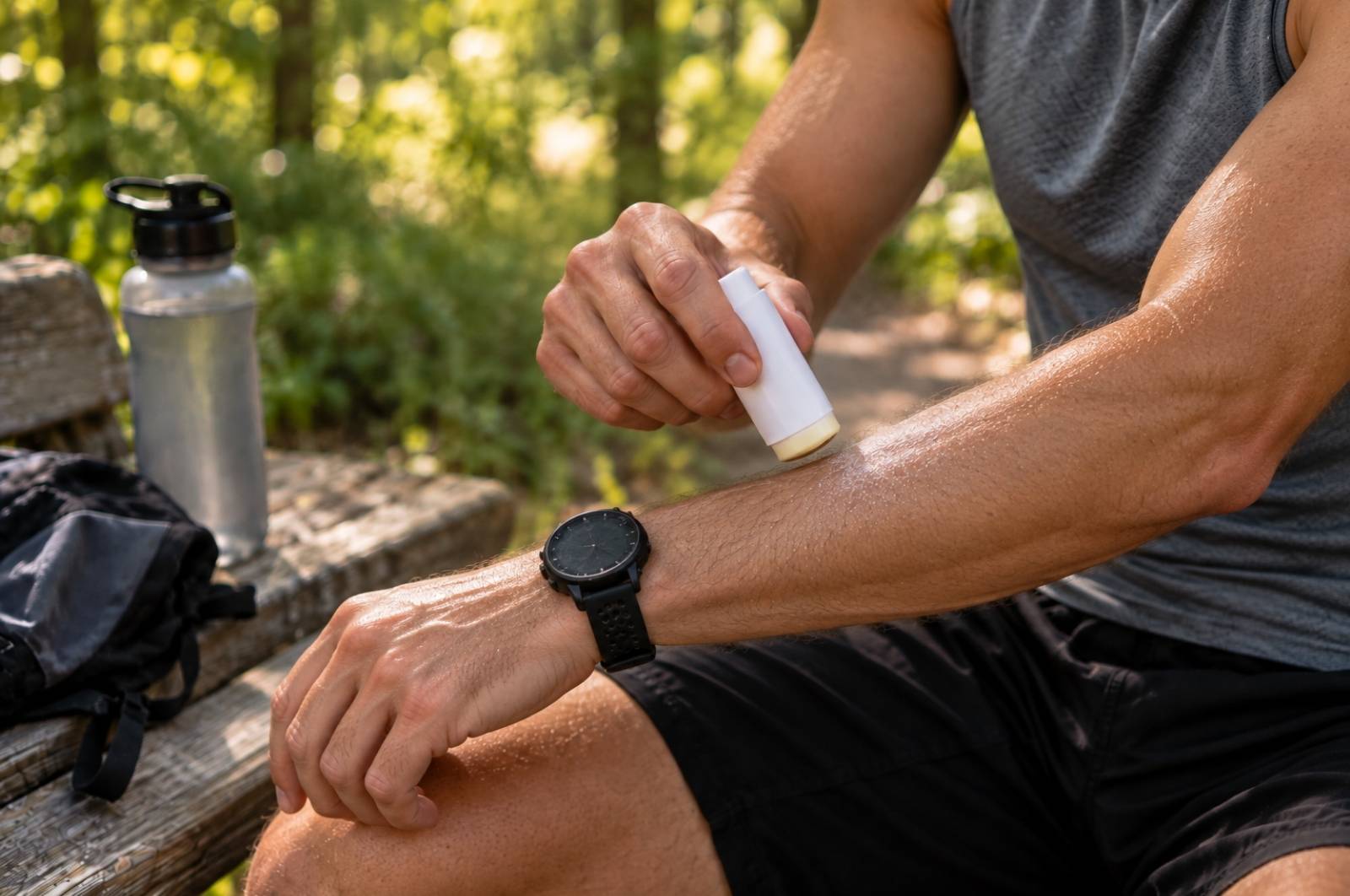
UPF clothing is a legitimate shortcut. Running tops rated UPF 50 or higher block the vast majority of UV where the fabric covers, and unlike sunscreen they do not wash off or wear out over a run.
That is why arm sleeves have quietly become a runner’s summer staple in high-UV geographies. They cover the arms without adding heat load the way a full long-sleeve top would.
For a broader look at how to dress for hot conditions, this guide to the best running gear for hot weather is a good next read.
The heat side of the same problem is here: this piece on how to prevent heat stroke when running in the summer covers hydration, timing, and pacing.

Discover the authentic training methods of Kenyan runners and start improving your running faster than you ever thought possible.
Learn More About The Method →Limited-time reader discount available
A couple of stubborn misconceptions still float around at group runs. Both are worth killing on the spot.
It does not. A tan is your skin’s stress response to UV damage, not armour against future damage.
Dermatologists are unanimous on this point. There is no safe way to build a tan without absorbing the UV dose that raises long-term skin cancer risk.
Skin cancer is less common in darker skin tones. It still happens.
When it does, it is often diagnosed at later stages, when treatment is harder, per the American Academy of Dermatology. That is a strong argument for daily protection regardless of skin tone.
Boiled down to five moves you can apply from tomorrow.
One: Apply broad-spectrum SPF 30 or higher 15 to 20 minutes before you head out.
Two: Cover the missed spots. Ears, neck, hands, lips with SPF balm, scalp along the part if it is exposed.
Three: For runs over 80 minutes, carry a stick or spray and reapply at the turnaround.
Four: Wear a 2 to 3 inch brim hat and UV-blocking sunglasses whenever the sun is up.
Five: If a route is a full exposed slog in mid-day summer, either shift the run to shoulders of the day or use UPF clothing to cover most of the surface area.
None of this changes your pace or your training plan. All of it reduces the tax the sun charges you for running outside every single week.
The point of running is a long, healthy life doing it. Skin cancer is one of the small number of things that can actually take that away.
Wear the sunscreen.
Start your running journey today!
No spam. Cancel anytime.