Are Protein Supplements Really Necessary for Distance Runners?
Protein is important for distance runners, but protein supplements are not a must-have.

Marathon hydration isn’t one-size-fits-all: Samuel Cheuvront’s approach is to start normally hydrated, drink to your sweat rate, keep carbs at 30–60 g/hour, and use sodium only when heat, duration, or salty sweat demands it.

For something that seems so simple, hydration can feel like advanced calculus for runners.
How much should you drink over 42.2 km? How many carbs per hour? Do you need extra sodium or is that just marketing?
Let’s turn to one of the most respected experts in heat, hydration, and performance: Samuel Cheuvront, PhD, RD.
Cheuvront spent nearly 20 years in the US Army’s Thermal and Mountain Medicine Division, has published more than 150 scientific papers, and has advised the Boston Marathon since 2012.
In short, he’s the kind of person who measures sweat with the seriousness of a lab technician and the pragmatism of a coach.
Here is what marathon hydration really looks like according to him.
There is no universal hydration formula that works for every runner.
The old 8×8 rule is outdated for many active people. A better estimate scales with body weight and activity level.
What keeps one runner thriving might leave another dehydrated or overhydrated.
Your needs shift with body weight, running pace, temperature and humidity, sweat rate, carbohydrate fueling strategy, and how much sodium you lose in sweat.
The idea that everyone simply needs “eight glasses a day” is rooted more in convenience than physiology, and even major nutrition sources emphasize that daily fluid needs vary widely based on activity level, body size, and climate.
In fact, estimated adequate intakes for adults (including water from all foods and fluids) are roughly 2.0 - 2.7 liters for women and 2.5 - 3.7 liters for men, but those figures are population medians and not individualized prescriptions.
For athletes (especially runners) those baseline guidelines are only a starting point.

Sweating during training and racing accelerates water and electrolyte loss well beyond what a sedentary person experiences.
In endurance contexts, research on exercise and fluid balance highlights that both dehydration and overhydration can impair performance and health.
Too little fluid reduces blood volume and heat tolerance, while too much fluid without matching sodium can dilute blood sodium, a risk factor for hyponatremia in endurance athletes.
Below are approximate daily fluid needs in moderate temperatures, not including the ~20% of water you get from food.
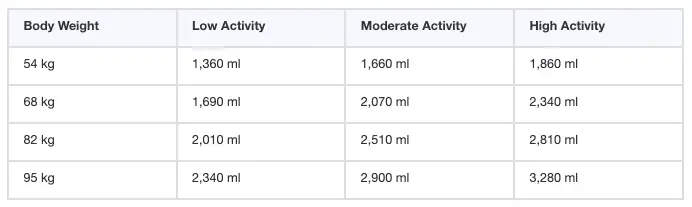
These are starting points, not commandments.
In practice, experienced runners and sports hydration experts increasingly recommend tailoring fluid intake to your personal sweat rate and conditions.
Tools like pre- and post-run weighing help quantify how much fluid you lose in a session, which you can then use to adjust your daily hydration and race-day fueling.
Instead of following a fixed rule, hydration is something you measure and practice.
You’re likely well hydrated if:
These are the simple rules that work.
The American College of Sports Medicine recommends avoiding more than 2% body weight loss from dehydration during endurance events.
If you weigh 68 kg, losing up to about 1.3–1.4 litres during a marathon keeps you within the commonly recommended 2% dehydration threshold.
In other words, you do not need to replace every drop of sweat in real time. But go much beyond 2-3%, and performance starts slipping. And in a marathon even small margins matter.
In the hours leading up to the race, the goal is simple: arrive at the start line normally hydrated, not overloaded and not playing catch-up.
Several hours before the start, drink about 475 ml of fluid. This gives your body time to absorb what it needs and eliminate the excess.
Then, around 30 minutes before the gun, have a small top-off of approximately 120 to 240 ml. This helps ensure you begin the race with adequate fluid reserves without feeling heavy or sloshy.
Spacing intake this way also allows time for one final bathroom stop before the start.
Your hourly fluid needs depend on several interacting factors: your body weight, your pace, the race-day temperature, and your individual sweat rate.
Two runners standing side by side at the start line may have completely different fluid requirements once the race begins.
In practical terms, some runners may need around 400 ml per hour, while others may require 800 ml per hour or more, especially in hot conditions. The difference can be substantial, and temperature is only part of the equation.
Drinking “to thirst” can work in many training situations. However, for a marathon effort, a personalized plan is more reliable than instinct alone.
Before race day, you should know how much fluid you typically lose during a long run.
The simplest method is weighing yourself before and after training sessions.
You should also understand where aid stations are located, what beverage will be provided, and whether you plan to supplement with gels or other carbohydrate sources.
Carbohydrates are not optional in a marathon.

The evidence-based recommendation for most runners is: 30 to 60 grams per hour.
That’s what traditional sports drinks are designed to provide when consumed in appropriate volumes.
You may have heard about elite athletes consuming 90 to 120 grams per hour. That research typically involves runners finishing marathons in just over two hours. Their metabolic turnover is far higher.
Midpack and recreational runners generally do not need extreme carbohydrate intakes.
For most marathon runners, additional sodium supplementation is not necessary.

Standard sports drinks already contain sodium in amounts designed to support endurance performance, and most people consume adequate salt in their normal daily diet.
In a typical marathon under moderate conditions, the sodium included in sports drinks, combined with baseline dietary intake, is sufficient to maintain balance.
There are exceptions.
Extra sodium may be useful if you are racing in hot conditions, where sweat losses are higher.
It may also be appropriate during very long events such as ultramarathons, where total sweat and electrolyte losses accumulate over many hours.
Another group to consider is so-called “salty sweaters.”
If your sweat tastes noticeably salty or leaves visible white salt crystals on your clothing or skin after training, you may lose more sodium than average and could benefit from additional intake.
For everyone else, deliberate sodium loading is usually unnecessary. More is not automatically better. In most marathon scenarios, steady fluid intake with a standard sports drink is enough.
Rehydration should be gradual rather than aggressive. After a good run, your body is not a dry sponge that needs to be flooded. The kidneys regulate fluid balance more effectively when intake is steady and combined with food, which helps restore both water and electrolytes.

One of the most practical tools for managing recovery hydration is a scale. Weigh yourself before and after long runs to estimate how much fluid you have lost. The difference gives you a useful approximation of your sweat loss.
For example, if you lose 1 kg during a run, you should aim to replace at least 1 litre of fluid over the following several hours. Spacing this intake out, ideally alongside meals or snacks, supports more effective and sustained rehydration.
Also, slow, steady replacement works better than rapid chugging.
Not every race requires the same hydration strategy.
For a 5K or 10K, in-race hydration is usually unnecessary. These events are typically short enough that significant dehydration does not occur, provided you start well hydrated.
Fluid stations are more about comfort than physiological necessity.
A half marathon sits in the middle. Total sweat loss is lower than in a full marathon because the duration is shorter, so fluid intake can generally be reduced to about half of what you would plan for 42.2 km.
However, carbohydrate intake still matters. A target of 30 to 60 grams of carbohydrate per hour remains appropriate, especially if you are racing at higher intensity.
During training runs, most easy or shorter sessions require little to no fluid during the run itself. You can rehydrate afterward without issue.
Long runs are different. These are your opportunity to rehearse race-day fueling and hydration, including the fluids, carbohydrates, and sodium you plan to use in competition.
Start your running journey today!
No spam. Cancel anytime.