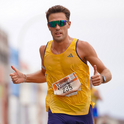
Natalie Villalobos, 29, finished the 2026 IRONMAN 70.3 World Championship in Nice at 21 weeks pregnant, qualifying before she knew she was expecting.
Pictures from IRONMAN Triathlon, Instagram
Natalie Villalobos, a 29-year-old American triathlete, crossed the finish line of the 2026 IRONMAN 70.3 World Championship in Nice, France at 21 weeks pregnant.
She covered the 1.2-mile swim, the 56-mile ride through the hills above the Côte d'Azur, and the 13.1-mile run along the Promenade des Anglais in 8 hours, 9 minutes, 48 seconds, then held an ultrasound photo of her daughter above her head as she entered the chute.
She had qualified for the race one month before she found out she was pregnant.
A qualifier earned, a positive test one month later
Villalobos is a certified pre- and postnatal fitness specialist who had been racing long-course triathlon for several seasons.
In March 2026 she locked in her slot for the 70.3 World Championship. In April, she took a pregnancy test and it came back positive.
That same month, while already in her first trimester, she completed a full IRONMAN (2.4-mile swim, 112-mile bike, full marathon) in 12 hours, 36 minutes, 44 seconds.
Across the summer, she documented every training week on Instagram: the belly growth beside the bike fit changes, the slower long runs, the reduced heat exposure, and the ongoing clearance from her obstetrician.
What the 70.3 Worlds course asks of any athlete
The 2026 IRONMAN 70.3 World Championship was held on October 12, 2026, in Nice, with a 1.9-kilometer swim in the Mediterranean, a 90-kilometer ride into the hills above the city, and a 21.1-kilometer run on the seafront.
The bike is the hard part. The course climbs away from the coast through the villages of the Alpes-Maritimes, with ramps that touch 12 percent gradient and almost 1,500 meters of elevation gain.
That profile is already a stiff ask for a non-pregnant qualifier. Carrying a second-trimester bump through it is a different problem again.
Villalobos told followers the added weight on the climbs and the shifting center of gravity on technical descents were the two biggest adjustments she had to make.
How her race day actually broke down
She swam the 1.9 kilometers in warm water with the age-group waves, took a controlled transition, and settled into an endurance pace on the bike with heart rate as her primary gauge rather than power.
On the run she walked the aid stations, drank at every one, and kept effort below conversational threshold. She crossed the mat in 8:09:48, then held her baby's ultrasound photo above her head for the finish-line camera.
What the science actually says about racing through pregnancy
The headline is dramatic. The underlying guidance is not new.
The American College of Obstetricians and Gynecologists (ACOG) updated its position in 2020 and recommends that healthy pregnant women accumulate at least 150 minutes of moderate aerobic activity per week, and that athletes who were already active before pregnancy can continue, including running, with obstetric clearance.
Published guidance makes a clear point: when there are no complications, physical activity in pregnancy is safe and carries measurable benefits. For a referenced overview, see the MotherToBaby exercise fact sheet on NIH Bookshelf.
The caveats that matter for an endurance athlete still apply, hard. Contact sports, altitude above 6,000 feet, scuba diving, and anything with a meaningful fall risk are off the table.
The 70.3 bike leg in Nice is a controlled closed-road course. Villalobos rode it as a steady endurance effort, not as a race.
Why qualifying before you know changes the calculation
Villalobos earned her slot the way every age-grouper does, by racing a qualifier at a fitness level that reflected months of specific training.
Her baseline aerobic engine was already there when the pregnancy began. That matters, because ACOG and most sports-medicine physicians draw a bright line between maintaining prior activity and initiating a new high-volume habit mid-pregnancy.
A trained athlete finishing a long race she had already prepared for sits firmly in the first category. A sedentary person signing up for a half-iron in the second trimester would not.
The physical adjustments she talked openly about
A few concrete changes showed up again and again in her training logs.
Pace by effort, not by watch. On every run she let heart rate and perceived exertion drive the session instead of goal pace.
Shorter long runs. Weekly long-run volume was capped and broken up, with walk breaks built in.
More fueling, more hydration. Pregnancy raises resting metabolic rate and blood volume, and she ate and drank well above her pre-pregnancy race-day baseline.
Pelvic floor and core work twice a week. This was non-negotiable for her as a prenatal fitness specialist, because long-distance running loads the pelvic floor every single step.
What this looks like for a non-elite runner
The Villalobos race is not a template. It is an extreme case built on years of base, specialist knowledge, and medical oversight.
For most pregnant runners already in a routine, the practical version of the same approach is simpler. Keep moving, hold effort in the easy-conversational range, drop goal paces, respect your obstetrician's calls, and get a pelvic floor assessment early in the second trimester.
What a pregnant mother's training may give the baby
There is a parallel research thread worth knowing about if the Villalobos finish line is making you reconsider training through pregnancy.
Recent work in Medicine & Science in Sports & Exercise points to a mechanism called fetal programming, where the physical activity of a pregnant mother appears to influence the developing baby's vascular and mitochondrial density in utero.
That evidence is covered in more detail in our write-up of the mitochondrial inheritance research, and it reframes the pregnancy-training conversation away from pure risk management and toward something closer to a shared adaptation.
The ultrasound at the finish line
The image that spread across triathlon social media was simple. A woman holding a prenatal ultrasound of her daughter above her head on the Promenade des Anglais, visor on, race bib 1468 pinned to the chest of her trisuit.
The caption on the repost that went viral read talk about a race-day buddy. The comments were a mix of applause and alarm, which is the typical shape of any public conversation about elite exercise and pregnancy.
The medical consensus Villalobos operated inside of is the quieter story under the headline. It is also the one worth reading twice.