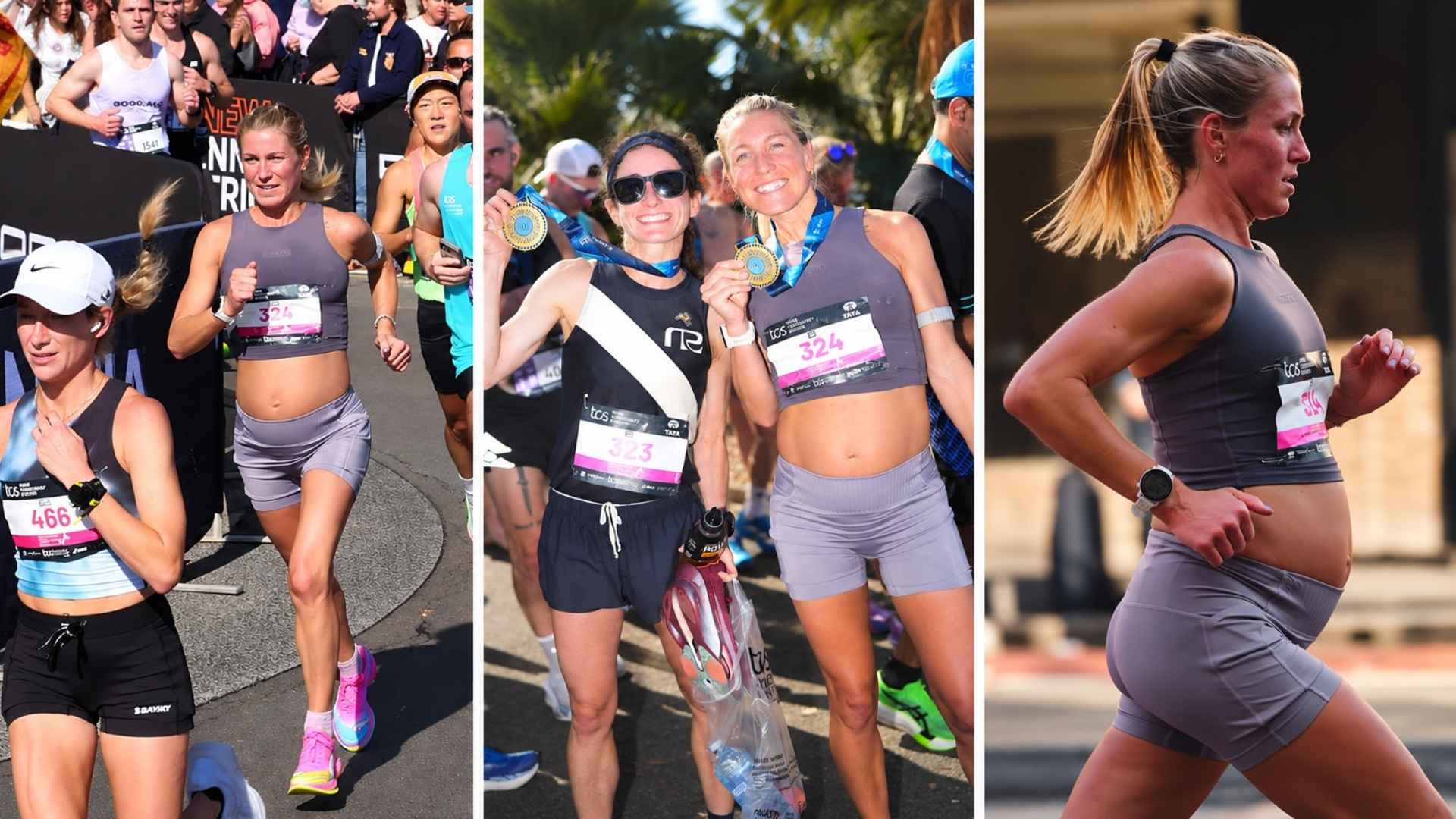
Ali Anderson ran 2:59:43 at the Sydney Marathon at 32 weeks pregnant, her second marathon while pregnant this year. What the ACOG guidelines actually say.
Ali Anderson ran 2:59:43 at the Sydney Marathon on Sunday.
She is 29, from Oklahoma, and she was 32 weeks pregnant when she crossed the line.
That time puts her inside the roughly 1 percent of women who break three hours for the marathon distance.
She ran it with seventeen seconds to spare.
It was her second marathon of the pregnancy. At Boston in April, at 13 weeks, she ran a 2:41:58 personal best and announced the news afterward.
The arc from Boston to Sydney
Sydney was Anderson's seventh marathon overall and her fourth World Marathon Major. She entered before she knew she was pregnant.
Sydney's race organizers offered her a way out.
Their 2026 pregnancy and postpartum policy let a pregnant entrant defer her spot to 2027, 2028, or 2029 on a doctor's letter.
The deadline passed at 5pm AEST on August 14. She let it slide.
She told News24 Australia she saw no reason to give up the start. She joined a record 40,000 entrants running from North Sydney to the Opera House.
The pace math is worth pausing on. A sub-3 marathon requires roughly 6:51 per mile.
Anderson held that pace and little more, running about 41 seconds per mile slower than her Boston best.
She has said this is the last marathon before the birth. In her words, "I have put her through two marathons now and that is enough for her."
What the ACOG guidelines actually permit
The American College of Obstetricians and Gynecologists updated its guidance in 2020, and it is more permissive than most people assume.
Vigorous-intensity exercise into the third trimester appears to be safe for most healthy pregnancies, according to the ACOG committee opinion. That includes running.
The guidelines also acknowledge that competitive athletes are a distinct category.
Elite athletes, defined loosely as women who train year-round at a high level, tend to maintain more strenuous training and resume high-intensity work sooner postpartum than the general population.
The caveats every pregnant runner should know
ACOG names four specific concerns for competitive athletes during pregnancy: avoiding hyperthermia, maintaining hydration, sustaining calorie intake to prevent weight loss, and staying under close medical supervision.
There is one intensity ceiling the research keeps returning to. Fetal heart rate decelerations have been reported when maternal effort exceeds roughly 90 percent of max heart rate.
Anderson's Sydney pace was under her own limit by design. She left seventeen seconds of buffer, not seventeen minutes.
What actually happens to the running body in the third trimester
Three physiological shifts define third-trimester running.
Center of gravity moves forward as the bump grows, and joint laxity increases as relaxin peaks.
The energy cost of running rises by roughly 10 to 15 percent.
None of that is dangerous, but all of it changes the effort-to-pace ratio.
That is the mechanical explanation for Anderson's roughly six-minute drop from Boston to Sydney. It was not fitness loss, it was carrying more, in a differently shaped frame, in warmer air.
What a study of 60 elite and recreational athletes actually found
A recent descriptive study followed 60 women who exercised through pregnancy above the standard guidelines. Ten were elite athletes averaging 11.6 hours of training per week, and 50 were recreational athletes at 7.0 hours per week.
Most resumed exercise within six weeks postpartum.
Most had spontaneous onset of labor and vaginal deliveries at term.
The mean birthweight was 3,487 grams, which is inside the normal healthy range.
Two of the elite athletes were diagnosed with gestational diabetes and two with hypertension during pregnancy.
The Sydney Marathon course is not gentle. It carries 313 meters of climbing against a net drop of 83 meters, which converts to roughly 1,027 feet up and 272 feet down.
That is more vertical than most World Marathon Majors offer.
Anderson also ran it in her seventh marathon start, on a body carrying an extra 20 or so pounds of gestational weight.
Anderson is not claiming pregnant women should race marathons.
She is not a physiologist and her interviews have been careful.
What she is doing is quieter. She is showing that the assumption of complete rest through pregnancy, still the default advice most women get, is not what the current medical guidelines actually say for someone who was already training at a high level going in.
She had a third marathon booked for December and had planned an attempt at the American Olympic Marathon Trials standard. USATF has set that at 2:37:00 for women in 2028.
Her Boston time sits 4 minutes and 58 seconds outside it.
She has time.
The wider category she now belongs in
Anderson is not the first athlete to race deep into a pregnancy, and she will not be the last.
The precedents span every distance from track to ultra.
What makes her case land differently is the specificity of the numbers: a 2:59:43 at 32 weeks, five months after a 2:41:58 personal best at 13 weeks.
That is a training log, not an anecdote.
She joins a small but growing catalog of runners who have stayed inside their own effort envelope while their body changed around them
The clock in the Sydney Opera House forecourt read 2:59:43 as Anderson came through.
She had entered the race before she knew she was pregnant.
She raced it anyway, stayed inside the guidelines she was working with, and left the door open on a Trials standard she has almost three years to chase.
Seventeen seconds under three hours, at 32 weeks, on a course most people find punishing sober.
That is the story, and the story does not require any interpretation to land.