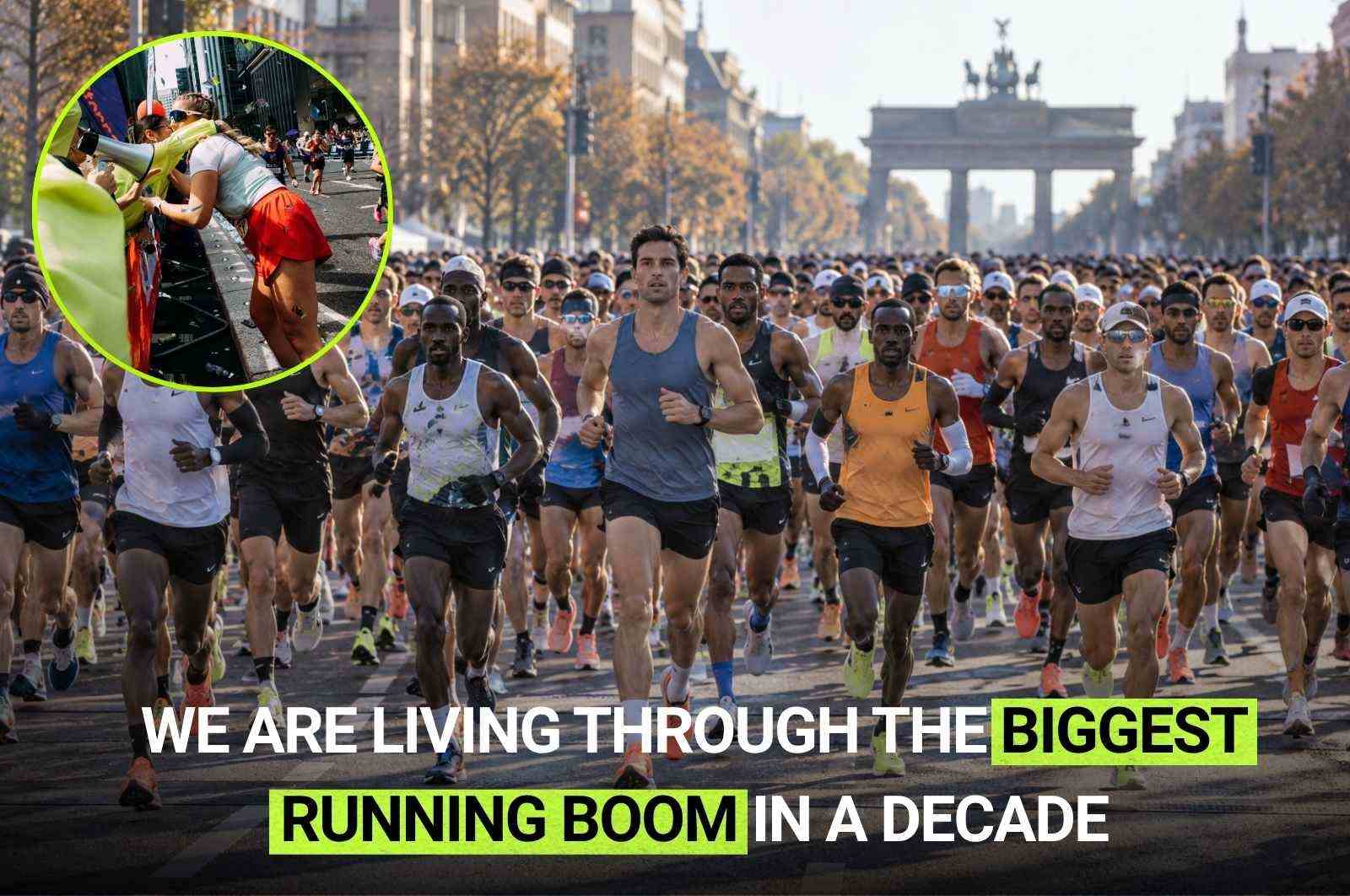
Marathon fields are up 14.6%, half marathons up 20.9%, and young runners are flooding back into races. The 2026 running boom is not a rebound. It is a re-founding.
Race directors spent the years after 2020 quietly bracing for a permanent shrinkage of the sport.
The pandemic gutted mass-participation events, older runners drifted away, and the under-30 pipeline that fills every 5K and 10K seemed to evaporate.
None of that turned out to be true.
The 2026 data now paints an almost embarrassing rebound, with every distance up, the young runners back, and the sport arguably in its healthiest shape since the mid-2010s.
The headline numbers
Start with the raw finisher counts. Across 135 surveyed marathons worldwide in 2024, participation surged 14.6 percent year over year, with 1,144,630 finishers crossing the line.
The half marathon jumped even harder. Across 190 surveyed half marathon events, finishers were up 20.9 percent at 1,513,531.
In the United States specifically, marathon finishers reached 432,562 in 2024, a 5.0 percent gain over pre-pandemic 2019, according to RunRepeat's State of US Marathons report covering roughly 97 percent of US marathon results.
Combined, the 2024 surge marks the strongest year of running participation since the pre-pandemic peak.
The 2025 to 2026 continuation
The rebound did not stop at 2024. US race participation grew across the 5K, 10K, half marathon, and marathon distances in 2025 versus 2024, according to Running USA.
Michael Clemons, Running USA's Director of Operations, put it bluntly: participation is strong and the sport's momentum is real. RunSignup's most recent report puts per-race US participation growth at roughly 5 percent in 2025 over 2024.
A generation nobody expected to see back
The single most surprising number in the whole dataset concerns young adults.
Under-25 marathon runners had been in a slow decline before the pandemic, and everyone assumed 2020 would finish the trend.
Instead, the under-25 share of US marathon finishers grew from 9.2 percent in 2016 to 12.1 percent in 2024. In the first half of 2026, 21.8 percent of RunSignup race participants were aged 18 to 29.
The comparison at the New York City Marathon is even more striking.
Set 2025 New York finishers next to 2015, and the 18 to 29 bracket shows 86 percent more men and 91 percent more women crossing the line.
Nearly a doubling of young-adult finishers at the world's largest marathon inside a decade.
Why this boom is different from the last one
The US had a big participation peak in 2014, when 496,178 people finished a marathon. The 2024 figure is still 12.8 percent below that ceiling, so this is not yet a record boom in the US on paper.
Look at where the growth is coming from, though, and the composition is entirely different from 2014. The last boom rode on the barefoot and minimalist shoe fad plus a wave of first-time recreational endurance racers.
This one is younger, more female, and more global
Women are now roughly 50.2 percent of all runners globally across 107.9 million analyzed race results. In sub-ultra trail races, female participation is running at 46.8 percent versus 53.2 percent for men, close to parity.
That is a genuinely new profile for the sport.
Female race participation was closer to 20 percent in the 1980s.
The half marathon is quietly eating the calendar
13.1 is now the fastest-growing distance in the world. Roughly 60 percent of US half marathon finishers are women.
Sellouts and capacity caps are becoming routine in major US markets, and demand has genuinely outrun supply in most of the biggest cities heading into the 2026 race calendar.
The behavioral evidence: it is not just registrations
Registrations can be gamed by heavy marketing, so it helps to look at what runners actually do. On that measure the trend is even more encouraging.
Race churn, meaning the share of events over 500 participants that fail to return the following year, has stayed near record lows.
For context: pre-pandemic churn was 5 to 7 percent
So more events are surviving, more people are registering, and the age curve is broadening from both ends at once.
That is what the industry calls a healthy boom rather than a top-heavy one.
The under-40 crowd is entering. The over-60 crowd is staying.
The other things this boom is quietly doing
Runners are also getting faster on average, which is a strong signal that the sport is retaining runners long enough for training to compound. The global average marathon time dropped from 4:39 in 2019 to 4:34 in 2024.
US men finished 2.2 percent quicker in 2024 than in 2019, and US women 1.1 percent quicker. Neither number is dramatic on its own, but they run against the widely-repeated prediction that a post-pandemic surge would lower the average pace.
The Gen Z entry is behaving differently
The interesting nuance in the data is that the young cohort is treating 26.2 miles as a bucket-list social event rather than a competitive endpoint. That is not necessarily bad.
What could still slow the boom
Two things worth watching. First: race prices continue climbing, with marathon entry fees up 5.2 percent in 2026 alone, and that will eventually price out the entry-level runners the industry needs.
Second: while women dominate half marathons and shorter distances, their marathon share has slipped slightly from a 2017 peak. That is the trend organizers are trying hardest to reverse right now.
The verdict
Every serious indicator points the same way. The sport is not just recovering, it is broadening.
It is younger, more female, and more geographically spread than the last boom, and it is happening at every distance from the 5K to the marathon.
Anyone who spent 2021 wondering whether running would come back has their answer. The bigger question now is what the sport does with all these new runners once it has them.