
Tom Evans Beat Tom Pidcock and His Mountain Bike to the Top of Snowdon
Red Bull sent ultrarunner Tom Evans and double Olympic MTB champion Tom Pidcock up 7km of Yr Wyddfa. Once the trail turned steep, only one of them could stay on his feet.
The calf strain that ends a runner’s season starts as a small grab. Here are the real causes, the treatment sequence that works, and what actually prevents a repeat.

You feel it before you understand it.
A sudden grab low in the back of your leg, a step where the ground feels wrong, a sharp pull in the muscle behind your shin. That is a calf strain, and it is one of the most common serious injuries in running.
The good news: with the right treatment, most runners are back on the road inside a few weeks.
The bad news: the strongest predictor of your next calf strain is your last one, and most runners get the return-to-running phase wrong.
Your calf is not one muscle, it is two.
The gastrocnemius is the visible outer bulge behind your shin, and it crosses two joints, the knee and the ankle. Underneath it sits the soleus, a deeper muscle that crosses only the ankle.
Both attach into the Achilles tendon at your heel. Together, they extend from behind your knee down to your heel, per the Cleveland Clinic.
A strain is what happens when either of them is overstretched. Small tears open in the muscle fibres, the tissue bleeds slightly, and everything downstream stops working properly for a few days at minimum.
Runners tend to lump them together as calf pain. Clinicians do not.
Gastrocnemius strains tend to hurt when you push off hard at speed, when you sprint, or when you drive up a hill. Because the muscle crosses the knee, pain often shows up during a straight-knee calf raise.
Soleus strains are stealthier.
They tend to ache during steady, longer efforts, they hurt during a bent-knee calf raise, and the pain reads as deeper, duller, and more stubborn than a gastrocnemius grab.
Injuries to the medial head of the gastrocnemius are the most common in runners, particularly masters athletes. Injuries younger runners get around the same tissue tend to show up as Achilles tendinopathy instead.
The mechanics are unforgiving.
The gastrocnemius is high in fast-twitch fibres, and any rapid contraction or sudden overstretch can pop a few of them.
The most common trigger sequences look like this.
A sudden jump in speed or hills. Back-to-back hard sessions, a race surge, or a new hill route on a body that has been doing steady miles.
An under-loaded soleus. The soleus is the workhorse for distance running, and if it is undertrained relative to your weekly volume, it fails first when hills or fast finishes are added.
Gait and cadence habits. Overstriding and a low cadence increase calf demand at push-off on every stride, and stride counts add up quickly.
A footwear change. An abrupt jump in heel-to-toe drop, or a switch out of a maximally cushioned shoe, changes calf loading overnight.
Sleep, stress, and nutrition. Under-recovered tissue tears more easily, and no strength program will out-run a chronic sleep deficit.
A previous calf strain. According to a 2022 systematic review on calf muscle strain injuries, a prior injury is the single strongest predictor of a future one when strength is not properly restored during rehab.
The pattern that traps most runners is subtle. A calf that feels unusually tight on an easy run is often the first sign that the tissue is heading somewhere bad.
For a fuller look at the difference between tightness that means nothing and tightness that means something, this piece on tight calves and calf pain while running covers the early-warning triage.

The classic RICE protocol has been quietly retired by sports medicine for soft-tissue injuries. The replacement, promoted by a 2020 British Journal of Sports Medicine editorial, is called PEACE and LOVE.
The acronym is annoying. The content is not.
Protect. Stop running, walk short and easy, and avoid hills, sprints, and long strides.
Elevate. Get the leg above the heart when you can, especially on day one.
Avoid anti-inflammatories in the first few days. Fresh evidence suggests they can slow the tissue-healing response.
Compress. A compression sleeve or wrap reduces swelling and gives the tissue a bit of external support.
Educate. Understand the injury, do not push through pain that reads above a 2 out of 10 during activity, and do not chase aggressive stretching in the first week.
After a few days, the focus shifts to loading and confidence.
Load. Reintroduce gentle, pain-guided activity, with isometric calf holds as a common early loading choice.
Optimism. Runners who fear-avoid the injury often prolong it, because the tissue needs load to remodel.
Vascularisation. Get the heart rate up through pain-free cross-training such as cycling, swimming, or upper-body work.
Exercise. Rebuild strength, capacity, and range of motion progressively before returning to running.
For a broader look at the return-to-running arc after a soft-tissue setback, this guide to returning to running training after an injury is a solid map.
Most mild calf strains resolve with sensible self-management. Some do not.
See a clinician if you cannot bear weight, if you heard or felt a pop, if there is significant swelling or bruising, or if the pain has not improved after several days.
Those signs suggest a more serious tear that needs imaging and structured rehab. Getting it wrong at this stage can turn a three-week problem into a three-month one.
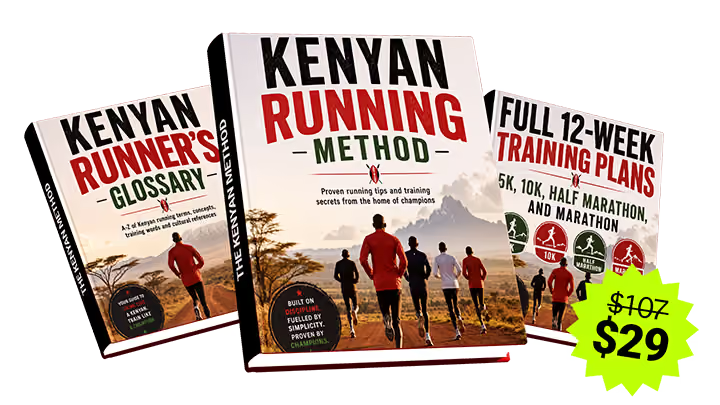
Discover the authentic training methods of Kenyan runners and start improving your running faster than you ever thought possible.
Learn More About The Method →Limited-time reader discount available
The prevention conversation is really a strength conversation.
A calf that has been strained once will strain again if the underlying capacity is not rebuilt. Simple twice-a-week loading is usually enough.
Straight-knee calf raises, three sets, targeting the gastrocnemius. Slow eccentrics, controlled tempo.
Bent-knee calf raises, three sets, targeting the soleus. Often skipped, usually the missing piece.
Single-leg variations eventually, because running is a single-leg activity, and bilateral raises will always mask the weak side.
Cadence check every few weeks. If you have drifted below 170 steps per minute at your easy pace, your push-off is doing more work than it needs to.
Progressive volume changes. No more than roughly a 10 percent jump in weekly mileage, and no simultaneous jump in intensity and volume.
The calf is not a fragile muscle group. It is one of the strongest in the body, engineered for millions of ground contacts, and it only becomes fragile when it is asked to do more than it has been trained to do.
Respect the grab. Treat it early, load it back up patiently, and the injury that ended your last season does not have to end this one.
Start your running journey today!
No spam. Cancel anytime.