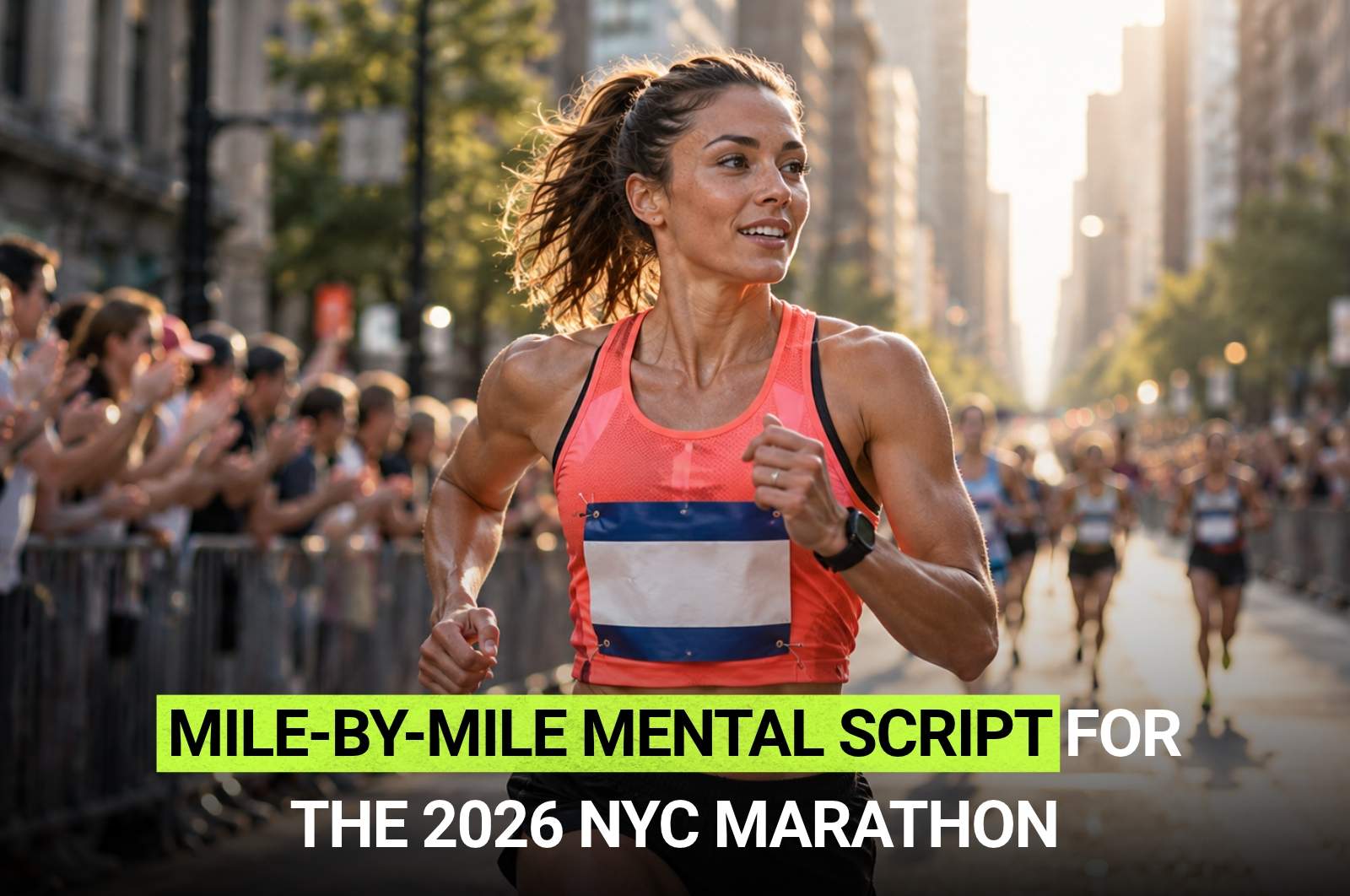
A mental cue for every borough of the 2026 NYC Marathon. What to think about on the Verrazzano, First Avenue, Fifth Avenue, and the Central Park finish.
The 2026 TCS New York City Marathon takes place Sunday, November 1.
The physical race is 26.2 miles long.
The mental race is just as long, and it is usually what decides your finish time.
This is a borough-by-borough mental script. One cue, one thought, one mantra for each stretch of the course.
Read it before Sunday, pack it with you, and pull from it when the autopilot starts to fail.
Staten Island, The Start Line Before the Race
Mental Cue. You Earned This Line.
You stood in the cold for hours. The ferry, the bag drop, the long walk to the corral.
Before the gun goes off, remind yourself that most people on earth could not have done what you already did to get here.
The gun goes off. You are already a success.
Miles 1 to 2, The Verrazzano
Mental Cue. Stay Boring.
The bridge is majestic. The pace feels easy.
Both of those feelings are traps.
Those are the ones who felt amazing on the Verrazzano and spent 20 extra seconds on the downhill.
Repeat to yourself.
Boring is fast. Patient is fast.
Right now, boring is the whole plan.
Miles 3 to 12, Brooklyn
Mental Cue. The Crowd Is Not Your Pacer.
Fourth Avenue is loud. Lafayette Avenue is louder.
The temptation to match the energy of the crowd is enormous.
The crowd is not running the race. You are.
Hold your effort at exactly the pace you rehearsed. Let the roar wash over you without pulling you forward.
Smile and wave. Then come back to your watch.
Mile 13, The Pulaski Bridge
Mental Cue. You Are Halfway. That Is All.
The Pulaski into Queens is the exact halfway point. Resist the urge to celebrate here.
Resist the equal urge to despair.
You are halfway. The second half is where the race starts.
Miles 14 to 15, Queens and the Approach to the Queensboro
Mental Cue. Soften Everything.
The crowd thins. The route turns toward the Queensboro.
The next two miles are the quietest of the race.
Soften your shoulders, your jaw, your grip.
Running tight is the fastest way to burn energy you do not have.
Miles 15 to 16, The Queensboro Bridge
Mental Cue. The Silence Is the Point.
There are no spectators on the Queensboro. First-timers interpret the silence as a bad omen.
Veterans use it as a reset.
This is the only quiet mile on the course. Use it.
Reset your breathing. Reset your form.
Think about the second half, not the pain.
Mile 16, Entering First Avenue
Mental Cue. The Loudest Mile Is the Deadliest Mile.
You come off the bridge and the wall of sound hits. First Avenue is the loudest crowd in marathon running.
Everything in your body wants to surge. Do not.
Miles 17 to 20, Through the Bronx
Mental Cue. The Race Starts Now.
Mile 20 is where New York gets honest. Legs cash in whatever cheques you wrote in Brooklyn.
There is a pacer saying worth memorising. The first 20 miles are a shakeout.
The last 10K is the race.
Decide now. You came here to run every one of these miles.
Not the easy ones. All of them.
Miles 22 to 24, Fifth Avenue
Mental Cue. Shorter, Not Harder.
The climb up Fifth Avenue is subtle and relentless. The temptation is to muscle up it by stretching your stride.
Do the opposite. Shorten your stride.
Lift the cadence. Breathe.
A short, quick stride on an incline is almost always more efficient than a long, forced stride. A good hill climb looks small from a distance.
Miles 24 to 26, Central Park
Mental Cue. One Mile at a Time, No Further.
The park looks like the finish line but is still two miles out. There are small, punchy climbs through the entire stretch.
Do not look at the full distance. Do not even look at your watch.
Pick a landmark 200 metres ahead and run to it. Pick the next one.
Pick the next one.
This is the moment where risk-based pacing earns its keep. Spend your remaining energy in deliberate chunks, not in one hopeful surge. The Last 400 Metres, Columbus Circle to the Finish Line
Mental Cue. You Already Won.
You turned the corner. The finish line is in sight.
Do not kick. Hold form.
Lift the chin. Open the chest.
Take the last steps of a marathon you came to New York to run, and run them like a human being who finished something extraordinary.
Cross the line. Stop your watch.
You are a New York City Marathon finisher.
After the Line
Pack this script into your race bib. Fold it.
Pin it to your shirt if you have to.
The script works because New York is not one race.
It is nine small races in a row. The runner who treats it that way is the one who finishes strong.