
The 10 Strength Exercises Top Coaches Want Every Runner Doing (And 3 They Should Skip)
The right strength work makes you a faster, more durable runner. The wrong lifts eat into recovery without giving anything back.

German HYROX athlete Kevin Ociepka covered a full marathon in burpee broad jumps in 155:44:51, cutting nearly a day off the previous mark. Here is what he actually did.
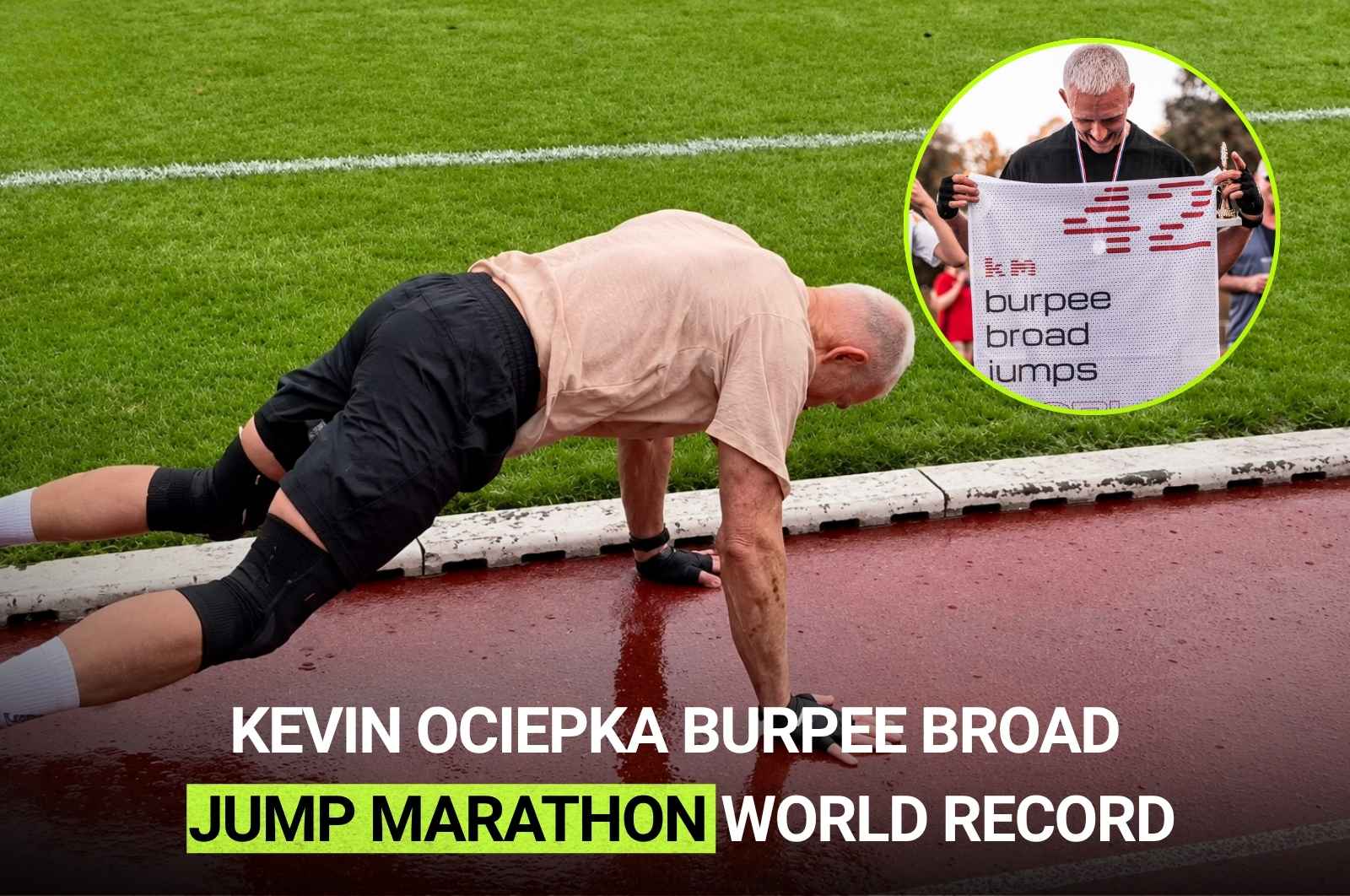
Get to the floor, push back up, and jump forward.
Now do that thirty thousand times without stopping the clock, until you have covered 42.195 kilometres on an athletics track.
On September 8, in the small central German town of Baunatal, that is exactly what a 31-year-old HYROX athlete named Kevin Ociepka finished doing.
The final time on the clock read 155 hours, 44 minutes, 51 seconds. Six and a half days of near-continuous burpee broad jumps.
It is now the fastest anyone has ever done it.
The event is called a burpee broad jump marathon, and it is exactly what the name says.
Each repetition is a full burpee, chest and hips to the ground, followed by an explosive forward broad jump.
Feet must leave the ground together, and they must land together in a level stance.
The movement covers roughly 1.4 metres per rep on average.
The maths that follows is uncomfortable.
To cover the full marathon distance, Ociepka needed about 30,000 repetitions.
His route was 108 laps of the 400-metre track at Parkstadion Baunatal.
He started on September 2, and finished on September 8.
His crew called the final time at 155:44:51.
That is roughly six days and eleven hours of stopping, dropping, and jumping, with brief cycles of sleep and refuelling folded in.
For scale, most recreational runners cover a marathon on foot in four to five hours.
Ociepka needed the equivalent of running roughly thirty consecutive marathons in wall-clock time to complete his one.
The previous world mark belonged to Mann Sharma of India, who became the first person to complete the challenge in October 2025 at the Jawaharlal Nehru Stadium in New Delhi.
His attempt took roughly 197 hours.
In July 2026, Australian Norman Eigl went next, at Woree State High School in Cairns, and cut the mark to 180:36:05. He was raising money for the homelessness charity Rosies.
Ociepka has now taken another 24 hours and 51 minutes off Eigl’s figure.
All three men have completed the challenge inside the last eleven months.
Here is the strange part. Guinness World Records does not recognise the distance at all.
Guinness ratifies burpee broad jumps at 100 metres, where Italian Mario Silvestri set the mark at 2:14 in March 2025.
It also ratifies the one-mile version, where Britain’s Travis Owles clocked 1:00:44 in September 2024.
There is no marathon category.
Sharma’s mark was logged with the World Book of Records, a London-based body with no connection to Guinness, and Eigl’s was logged with the Australian Book of Records, per French endurance outlet u-Trail.
Ociepka’s 155:44:51 is, for now, the time his crew called at the finish. Ratification, if it comes, will come later.
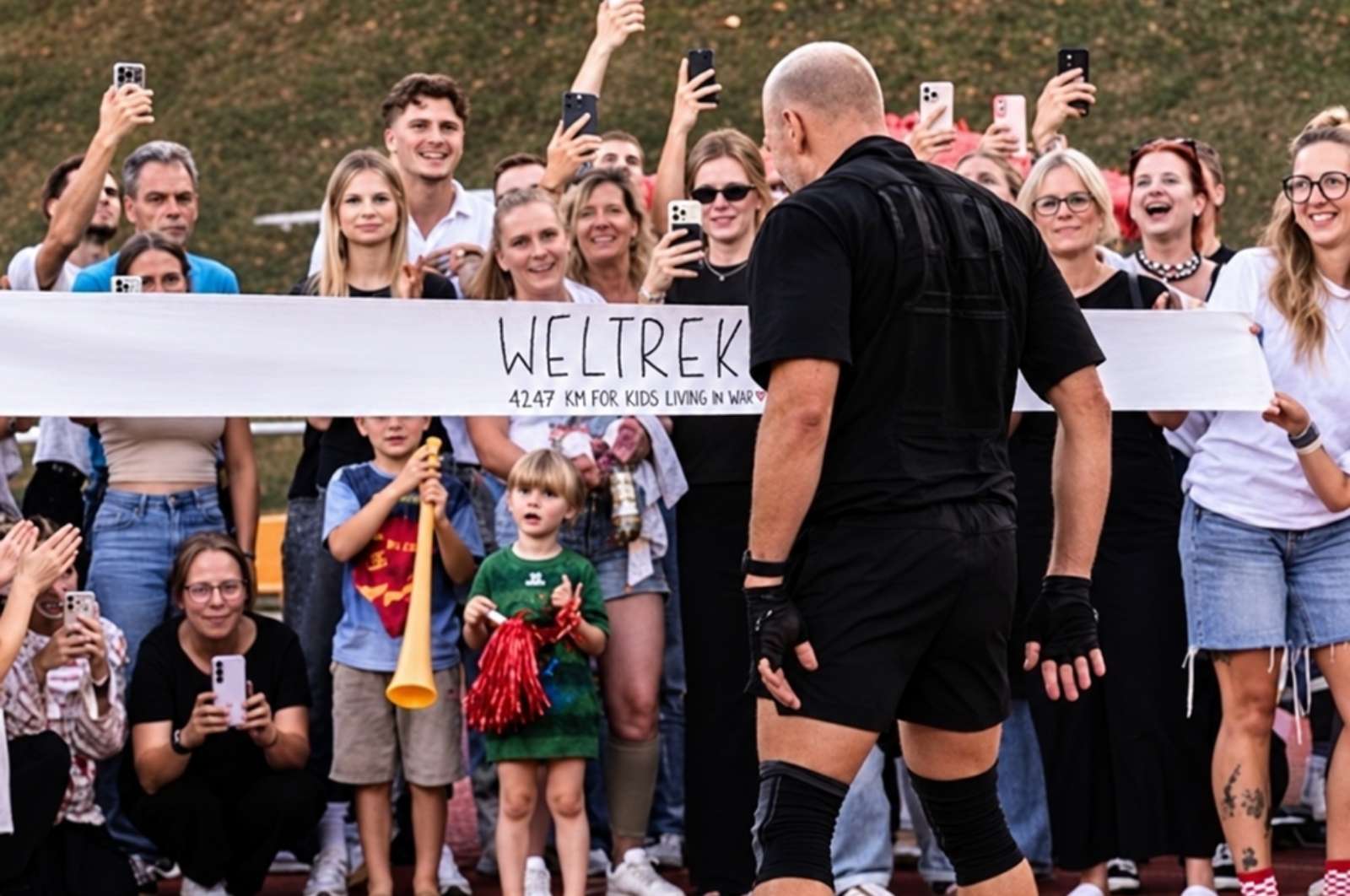
Ociepka is not a novelty attempter.
He is a professional HYROX athlete who is also a working physiotherapist.
The burpee broad jump is the fourth station at every HYROX race, and it is widely regarded as the most hated of the eight stations on the course.
Athletes cover 80 metres of the movement between two 1-kilometre runs.
Most participants finish the station in five to six minutes.
Ociepka has consistently gone through it in well under three minutes across the 17 HYROX races he has competed in.
The obvious problem is not cardio. It is repeated, single-plane compression through the ankles, knees, and hips.
Every rep is an eccentric landing followed by a concentric take-off. Across 30,000 reps, connective tissue eats a serious cumulative load.
That is why the challenge sits somewhere between running and something else entirely.
It borrows the aerobic base required for ultra-endurance work and adds the repeated impact profile you normally see in plyometric training.
For runners looking to understand why cross-modal work like this belongs in a training plan, this guide to the best cross-training for runners covers the categories that actually transfer.
The attempt was not just an ego project. Ociepka used it to promote physical activity and raise money for the Kinder Krebs Stiftung, a German children’s cancer charity.
That charity throughline is not incidental.
All three burpee-marathon holders have attached the attempt to a cause.
Sharma raised money for the One Friend NGO, and Eigl raised money for Rosies.
The distance is meaningless without the vehicle. Without the cause, it is just a very slow six days on a track.
The other reason this story matters is what it reflects about endurance culture in 2026.
Ten years ago, records like this did not exist. Nobody had thought to burpee-broad-jump a marathon, and nobody had thought to build a certifying body around it.
Now three men have done it inside a year, across three continents, on official athletics tracks, with camera crews and physio teams.
The genre has a name, an emerging record book, and an audience.
If you want to see where that pipeline of endurance-plus-strength thinking comes from at the training level, the case for a 30-minute at-home strength session that cuts injury risk in half is a reasonable starting point.

Discover the authentic training methods of Kenyan runners and start improving your running faster than you ever thought possible.
Learn More About The Method →Limited-time reader discount available
No.
Not until you have thought hard about your Achilles tendons, your patellar tendons, your lumbar spine, and the six days of your life you would need to give up.
The three men who have completed the challenge are all specialists in high-volume, high-load movement.
They come to the attempt with support crews, medical staff, and years of training that has built the tissue capacity to survive it.
What Ociepka’s finish does prove is a quieter point.
The human body, prepared correctly and paced correctly, can chain the same simple movement together for six and a half days and still be walking upright at the end of it.
That is not clickbait. That is just what happened on a track in Baunatal last week.
Start your running journey today!
No spam. Cancel anytime.