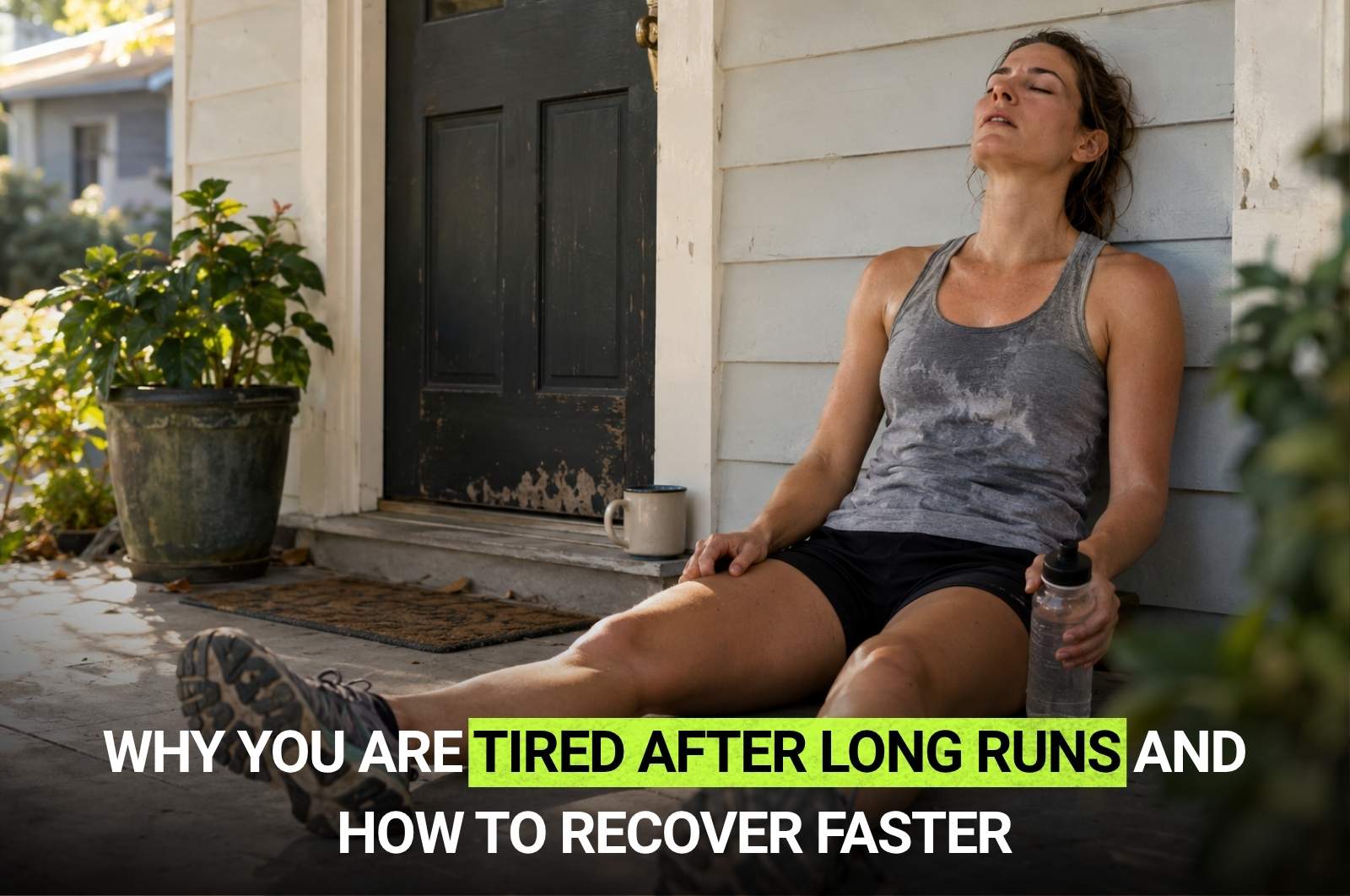
Why Long Runs Wreck You for Three Days and What Actually Speeds Up Recovery
Long runs cause three specific kinds of damage that take days to repair. Here is what the science says about faster recovery for runners.

Long slow runs quietly wreck your form. Here is the cadence rule and the four other cues that keep your stride together and cut your injury risk.

The last thirty minutes of your long slow run is where most injuries are born.
Not because you are running too hard. Because your form quietly falls apart as you tire, and the fatigue-broken stride is the one your body is repeating for hours.
Fix that and you cut injury risk while getting more benefit from every mile.
Here is what actually works.
The single most researched fix for form breakdown on long runs is a small bump in cadence, which is the number of steps you take per minute.
A landmark 2011 study by biomechanist Bryan Heiderscheit found that increasing cadence by 5 to 10 percent above your habitual rate reduces ground reaction forces, decreases knee load, and shifts your foot contact closer to your center of mass.
A 2025 systematic review published on the National Library of Medicine pooled follow-up research and confirmed the injury-prevention benefit is real, though the magic-number of 180 steps per minute is not universal.
Cadence is personal. Height, leg length, and running speed all shift it.
Most efficient recreational runners land somewhere between 170 and 185 steps per minute.
Very few injury-free runners come in under 165.
The old 180 SPM benchmark is closer to folk wisdom than a hard rule, though it is a reasonable target for most.
For the fuller argument, is 180 steps per minute really the magic cadence unpacks where the number came from.
Do not try to lift your cadence in a single session. Aim for a 5 percent increase over four weeks.
If your current cadence is 160 SPM, target 168. If you are at 168, aim for 176.
Most sports watches display cadence live on a data screen. Put it there and glance at it once a mile.
Slouching is the first thing to go when you tire.
A collapsed torso reduces lung capacity, which forces you to breathe shallower and get less oxygen.
It also shifts your hips backward, which pushes your foot in front of your body and turns every step into a small brake.
The cue is simple. Imagine a string pulling you up from the top of your head.
Efficient runners lean forward slightly, but the lean comes from the ankles.
Bending forward at the waist is a compensation for a weak core and tight hips. It looks like effort but it is actually a leak of forward momentum.
For the visual, the beginner's guide to running form has side-by-side examples.

Arms that cross the midline of the body twist the trunk and waste force sideways.
Elbows should bend at around 90 degrees. Hands should stay relaxed, not fisted.
The swing goes front to back like a pendulum, driven from the shoulder rather than the hand.
Shallow chest breathing is another sign your form is unraveling.
Deep belly breathing keeps oxygen flowing and calms the nervous system, which is doing more work than you think.
If breathing is a persistent issue on long runs, how to breathe while running covers the specific patterns coaches teach.
Discover the authentic training methods of Kenyan runners and start improving your running faster than you ever thought possible.
Learn More About The Method →Limited-time reader discount available
Elite coaches often program short pickups in the last few miles of a long run.
These are 20 or 30 second efforts at a slightly faster pace, not a sprint. The goal is not fitness, it is to drill good form under fatigue.
Your body defaults to whatever pattern it repeats most. Late-run pickups make the good pattern the one it remembers.
Every 20 minutes on a long run, spend one minute checking form.
Shoulders down and away from the ears. Spine tall.
Arms swinging straight back, elbows behind you. Feet turning over quick and light under the hips.
That is the whole checklist. Run through it once and then let the pattern hold.
Then relax and let the pattern hold on its own for the next 20 minutes.
The classic signs are overstriding, a heavy heel slap, and a visible bounce in the trunk.
Each of those is a load that adds up mile after mile.
For the full audit, the 9 red flags of bad running form is the checklist to compare yourself against.
Long slow runs are where the biggest fitness gains and the most injuries come from at the same time.
Get the cadence right, run tall, lean from the ankles, swing your arms front to back, and breathe deep. Do a one-minute reset every twenty minutes and finish with a short pickup or two.
That is the whole practice. Do it and the last thirty minutes stops being where injuries are born and starts being where fitness is built.
Start your running journey today!
No spam. Cancel anytime.