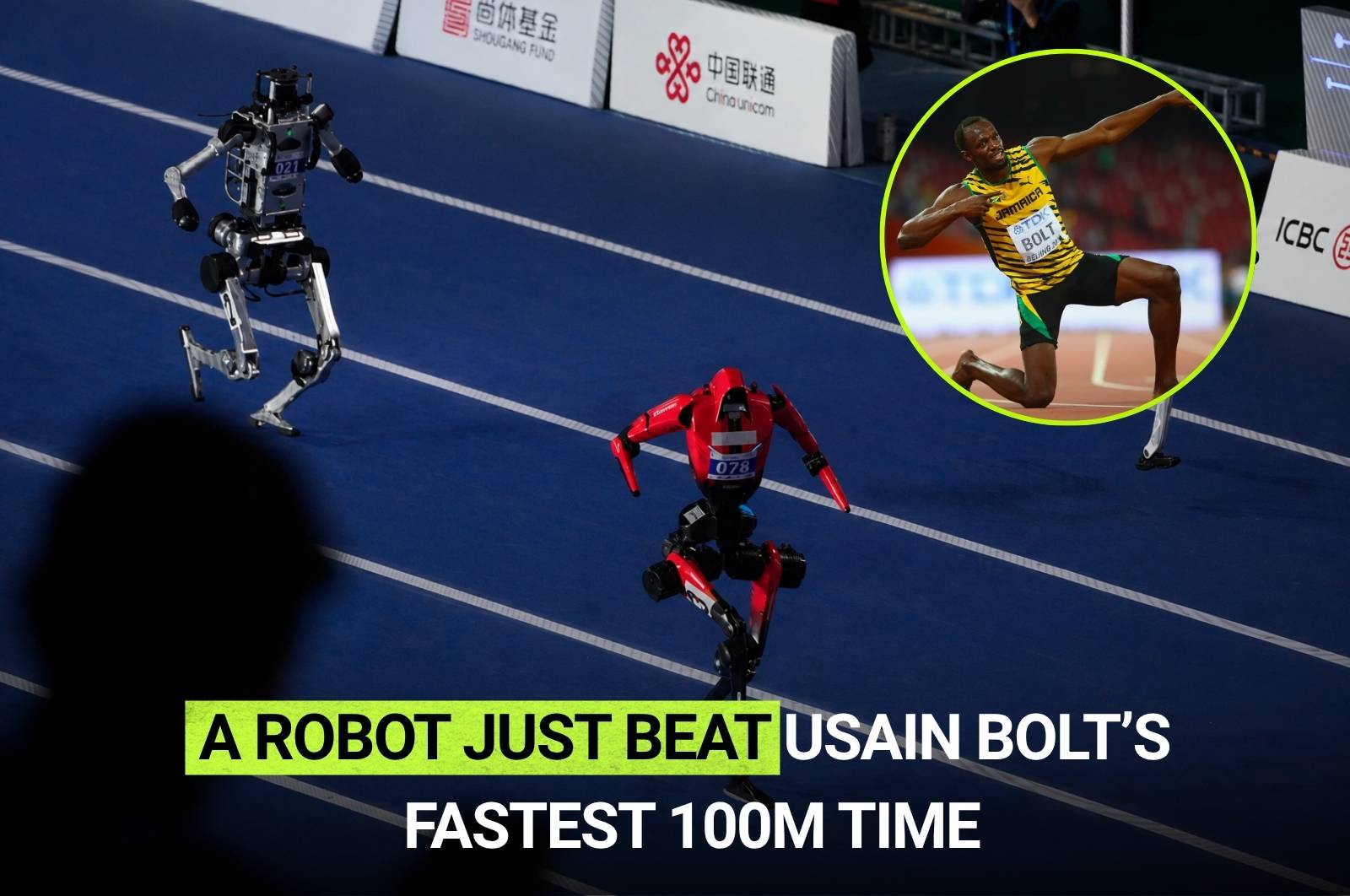
A humanoid robot named Tien Kung Ultra ran 100m in 9.39 seconds in Beijing, faster than Usain Bolt's 9.58 world record. No governing body has ratified it.
On the opening day of the World Humanoid Robot Games in Beijing, a bipedal robot named Tien Kung Ultra covered 100 metres in 9.39 seconds.
Usain Bolt's human 100m world record is 9.58, set in Berlin on August 16, 2009, per World Athletics.
That means the machine covered the distance 0.19 seconds faster than any human on earth ever has.
Before the internet crowns anyone, three things about the run are worth knowing.
Thing One: The Time Was Not Ratified By Anyone Independent
The 9.39 figure was announced by the organisers of the event.
The organiser is the World Humanoid Robot Sports Federation, which was launched at the closing ceremony of the first edition of these Games in 2025.
The federation, in other words, grew out of the event it now sanctions.
There is no independent governing body for humanoid robot sprinting.
World Athletics does not ratify machine performances, and rightly so, because they are not competing under the same event.
Which is a useful reminder of how tight human record ratification actually is. Earlier this year, World Athletics
rejected a human half-marathon record because the runner had followed a pace car, per Marathon Handbook reporting.
Thing Two: A Robot Cannot Slow Down Yet
The reason robotics researchers are interested is not the number on the clock.
It is what happened at the finish.
Tien Kung Ultra ran straight into a thick blue safety mat past the line and stumbled sideways.
Support staff carried it out of the finish area on a stretcher.
Bolt, in Berlin in 2009, jogged a lap and struck a pose.
That is a real engineering gap, not a joke. A body that can produce peak power for 10 seconds but cannot decelerate is not yet a runner.
The Person Building It Agrees
Guo Yijie, the technical lead on the project, was blunt with Xinhua.
He said the real challenge is turning peak performance into consistent reliability.
He specifically flagged structural fatigue, joint cooling, and drivetrain durability as the barriers to deploying these systems for long-distance running.
That is another way of saying the 9.39 is a burst, not a sustained capability.
Thing Three: The Faster Time Was Set At A Practice Session
A separate robot, Lightning, built by Chinese smartphone maker Honor, reportedly clocked 9.32 seconds during a pre-Games test.
That result was not observed by outside officials.
In the actual heat at the opening ceremony, Lightning ran 9.47 and finished behind Tien Kung Ultra.
Both robots crossed the line under Bolt's human mark. Both then hit the same wall.
Two days later, Tien Kung Ultra ran 8.86 seconds in a semifinal, per Global Times, before falling to the ground and emitting sparks.
The Longer Trajectory Is The Real Story
Sixteen months ago, the winner of Beijing's first robot half-marathon needed roughly two hours and 40 minutes to finish.
That robot swapped batteries three times along the way.
This year, robots are running under Bolt's 100m mark and Chinese state media is reporting semifinal times in the 8s.
The curve is steep in a way that human athletics has never seen and, by definition, cannot see.
Human peak sprint performance has moved by roughly 0.4 seconds in 100 years, per the World Athletics record progression.
Machine sprint performance moved by more than that in a single calendar year.
What It Actually Means For Running
Not much, in the short term.
A humanoid robot running 9.39 has no bearing on the human record book or on how any actual person trains.
What it does hint at is a future where machine-paced racing, robot pacers, and machine-athlete demonstration events become part of the sport's wider entertainment landscape.
His 9.58 is untouched by any human on the planet, 17 years after he ran it.
It just, on Saturday, got touched by something else.
The scale of the event around the sprint is easy to miss.
This year's Games ran 51 events across athletics, football, dance, and practical tasks like connecting EV cables and making beds.
More than 2,000 robots are entered across the programme, per Reuters and Fox News reporting.
A sprint headline is what makes the wider event legible to a non-technical audience. That is exactly why the organiser led with it.
For running, the useful distinction is between what a machine can produce and what a machine can sustain.
A 100m burst without deceleration is a lab result. A finishable marathon on the same platform is still years away.