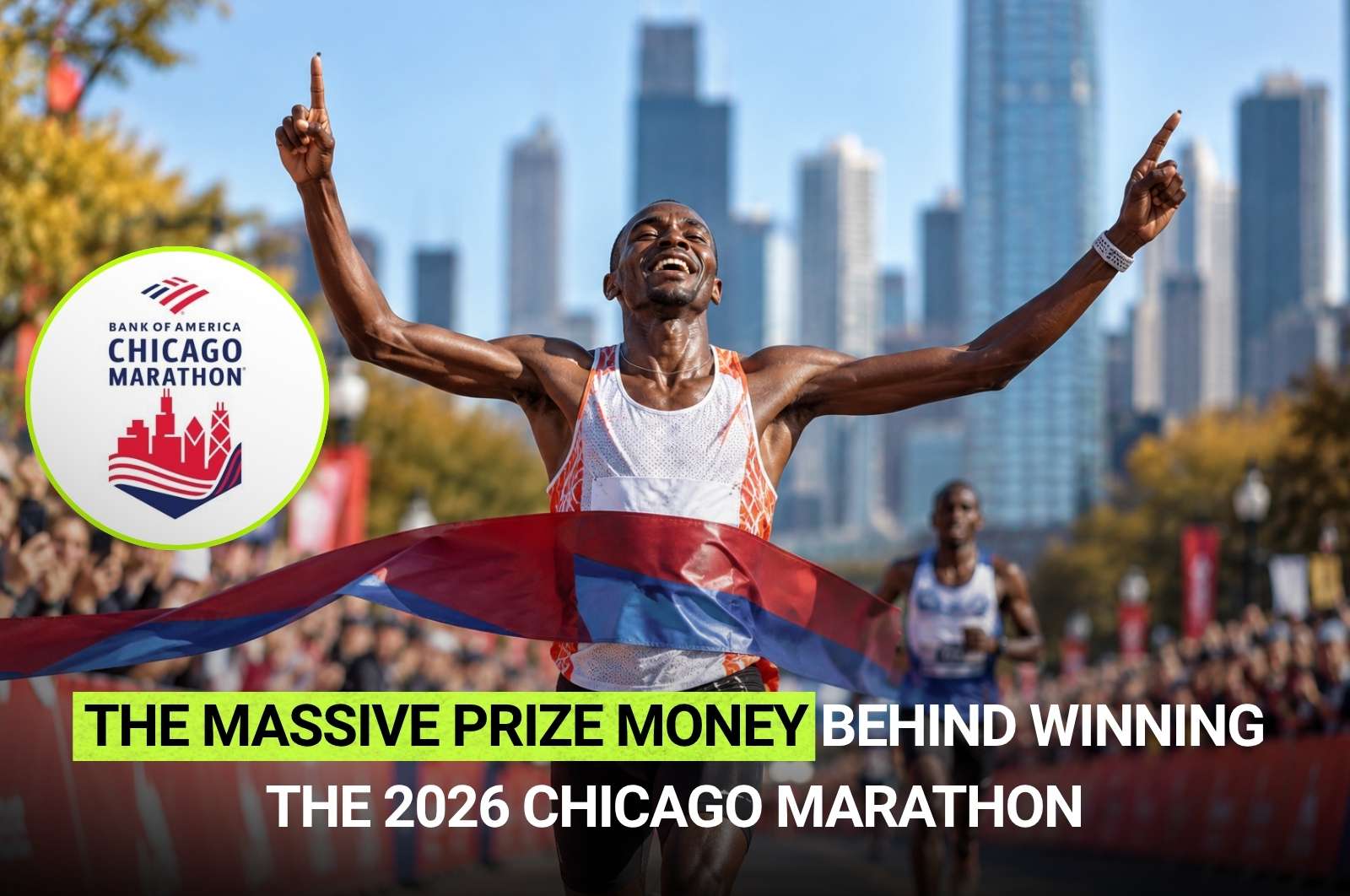
Amos Kipruto earned $100,000 for winning the 2026 Bank of America Chicago Marathon in 2:01:09, missing a $50,000 course record bonus by 34 seconds. Full purse breakdown.
When Amos Kipruto broke the tape on Sunday morning in Grant Park, he won the biggest race of his life.
He also left $50,000 sitting on the course behind him.
Kipruto crossed the line in 2:01:09, which was fast enough to win the 2026 Bank of America Chicago Marathon by nearly two minutes, but 34 seconds too slow to collect the race's course record bonus. That one window of time turned a $150,000 payday into a $100,000 one.
What Amos Kipruto earned on Sunday
The headline number is clean. For winning the men's open division, Kipruto earned $100,000.
That is the standard first-place payout at the Bank of America Chicago Marathon, and it has been for several years. Second place earns $75,000, third place earns $50,000, and the purse continues down to 10th.
Kipruto is Kenyan, so he was not eligible for the top American bonus (an additional $15,000). He is 34 but not yet a masters athlete, so the masters bonus did not apply either.
His total take-home from the race itself: $100,000.
The $50,000 that got away
Chicago pays a $50,000 bonus to any open-division winner who breaks the course record on the day.
The men's record is 2:00:35, set by the late Kelvin Kiptum in 2023. It still stands.
Kipruto needed to run 2:00:34 or faster to collect that bonus. He ran 2:01:09, which is 34 seconds short.
To put that in physical terms, 34 seconds across 26.2 miles is roughly 1.3 seconds per mile. That is the margin by which he missed an extra $50,000, and one moderately faster surge in the final 10K would have turned the check into $150,000.
The full 2026 Chicago Marathon prize purse
The Bank of America Chicago Marathon offers one of the most generous and transparent prize structures in professional road running. The event's cumulative purse now exceeds $1 million across the open, wheelchair, para-athletics, and bonus pools.
Here is the published breakdown that applied on Sunday.
Open division (men's and women's)
• 1st: $100,000
• 2nd: $75,000
• 3rd: $50,000
• 4th: $30,000
• 5th: $25,000
Positions 6th through 10th continue the sliding scale, with amounts not individually published for 2026.
Course record and top American bonuses
• Course record bonus (open division): $50,000
• Top American, 1st: $15,000
• Top American, 2nd: $12,000
• Top American, 3rd: $10,000
• Top American, 4th: $7,000
• Top American, 5th: $5,000
• Masters division winners: $2,000 each
The combined top American pool pays out $98,000 across the men's and women's races.
What everyone else on the podium took home
The men's race ended up producing a few surprises, which is reflected in the prize-money distribution.
Men's payouts
• Amos Kipruto (KEN), 1st, 2:01:09: $100,000
• Tadese Bikila (ETH), 2nd, 2:02:56: $75,000
• Milkesa Mengesha (ETH), 3rd, 2:03:46: $50,000
• Jacob Kiplimo (UGA), 4th, 2:04:18: $30,000
• Boki Diriba (ETH), 5th, 2:05:01: $25,000
Kiplimo's drop from the podium cost him real money as well as glory. The gap between the second-place $75,000 payout he was expected to collect and the fourth-place $30,000 he actually earned is $45,000, a very expensive cracked race on a day the defending champion was expected to finish ahead of several of the men who beat him.
Women's payouts
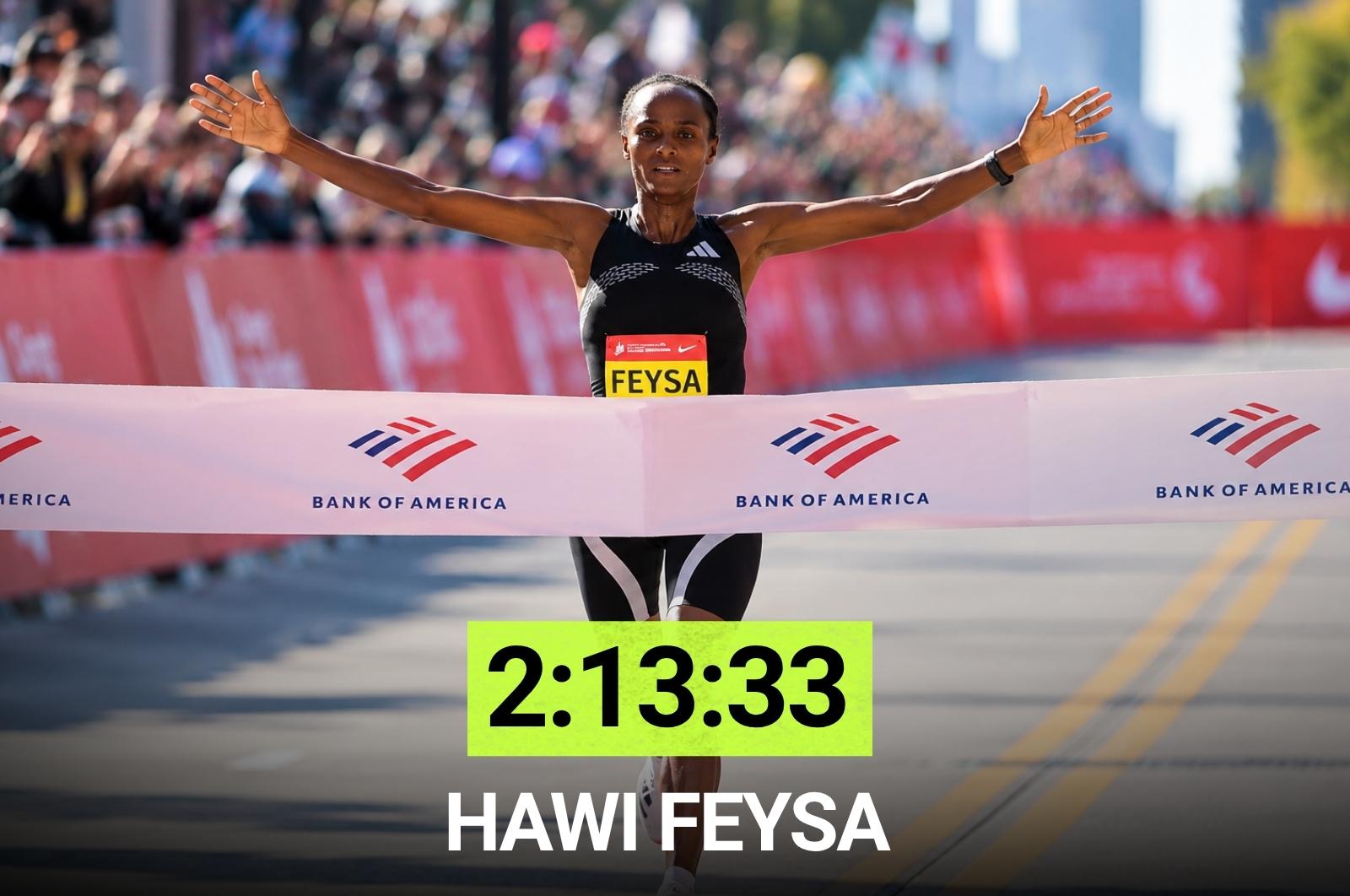
• Hawi Feysa (ETH), 1st, 2:13:33: $100,000
• Sharon Lokedi (KEN), 2nd, 2:14:07: $75,000
• Brigid Kosgei (KEN), 3rd, 2:14:55: $50,000
The women's course record of 2:09:56 still stands, so no course record bonus was paid on that side either. Feysa took home the clean $100,000.
How Chicago's money compares to the rest of the sport
A $100,000 winner's check is competitive with the other World Marathon Majors. London and Berlin pay similar first-place figures, Tokyo pays a touch less, and New York pays a comparable amount with a stronger American focus.
Chicago sits in the middle of the Majors on headline prize money but near the top on course-record bonuses and depth of payout. A fifth-place $25,000 payday is the kind of money that keeps sub-elite careers alive.
The one race that currently pays more
If you want to find a marathon that pays more than Chicago, you have to leave the Majors circuit entirely. Valencia has set a new standard for marathon payouts, with time bonuses and overall prize structures that have begun to make the independent races genuinely competitive with the Majors.
That is one piece of the broader money story in distance running right now. Prize pools are rising, time bonuses are getting bigger, and the question of where a world-class marathoner races is now partly a financial decision.
Learn the Training Secrets of Kenyan Runners
Discover the authentic training methods of Kenyan runners and start improving your running faster than you ever thought possible.
A good year for a top-tier marathoner at Kipruto's level now looks something like two majors raced, one podium or better in each, plus one invitational or independent race, with appearance fees stacked on top of prize money.
Appearance fees for a man with a 2:01:09 personal best are not published, but they run into the mid-to-high six figures per race for the biggest names.
Add shoe-sponsor retainers, performance bonuses from the sponsor side, and national-federation payments, and a top marathoner can clear seven figures in a strong year.
That is the context around Kipruto's Sunday payday. The $100,000 prize check is the visible number, but the ripple effects on his appearance fees, his sponsor negotiations, and his next contract cycle are where the much larger money sits.
The Chepngetich comparison
For a sense of how much a course-record performance adds, look at Ruth Chepngetich's 2024 Chicago Marathon. That performance rewrote the women's world record, and she collected the $50,000 bonus on top of her $100,000 winner's check.
Chepngetich's total that day was $150,000 for a single morning of running. That is exactly the number Kipruto was 34 seconds short of touching.
What this prize purse really tells you
Chicago's money reflects a specific philosophy. The race pays serious money for serious performances, but the biggest checks are reserved for history-making times, not just wins.
That approach has worked.
Chicago has produced some of the fastest marathon times ever run, in both the men's and women's races, and the $50,000 bonus is one of the quiet reasons.
Kipruto missed it on Sunday. Someone will not miss it next year.
For now, the pay stub reads $100,000, the trophy sits in Grant Park, and the course record remains the single most valuable 34 seconds in the sport.