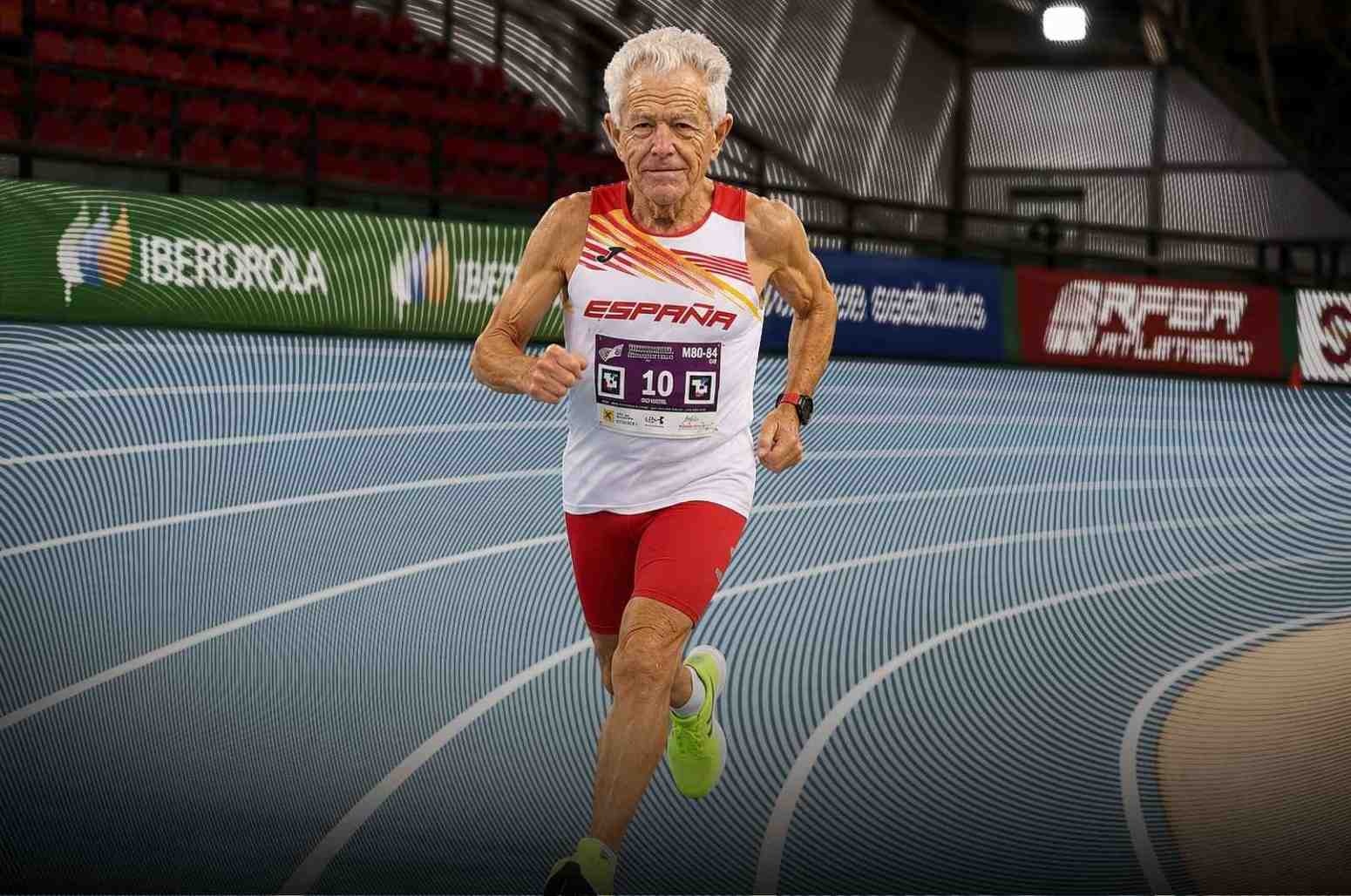
Juan López García began running at 66 and could not finish a mile. At 82, he holds the world 50K ultra record for his age group and a VO2 max never seen before over 80.
Juan López García retired at 66 from a life spent under cars, doing what any retired mechanic in Toledo might do.
He tried to run a mile. He could not finish it.
Sixteen years later, at 82, he holds the world record in the 80 to 84 age group for the 50-kilometre ultramarathon.
He also won the world marathon championship for his age group in 2024 with a 3:39:10.
The Lab That Wanted to Understand Him
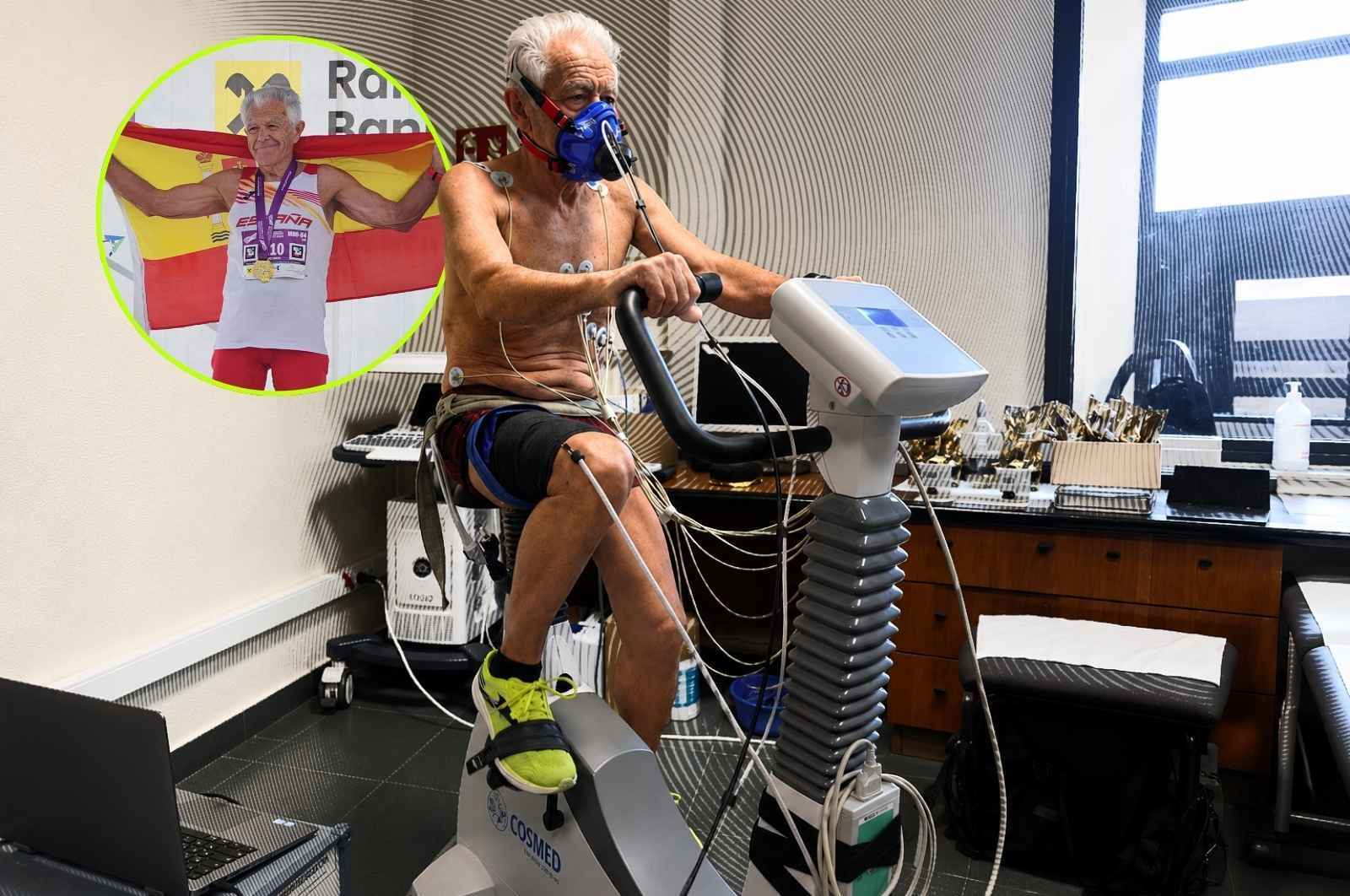
His performances caught the attention of a European research group studying elite masters athletes.
They invited him to their lab and put him on a treadmill.
Their findings, published in January 2026 in the peer-reviewed journal Frontiers in Physiology, are startling.
VO2 max like a 20-something
The standard rule of thumb is that VO2 max, the body's peak oxygen-using capacity, drops roughly 10 percent per decade after age 30.
That would put an average 82-year-old man well under half of a healthy 20-year-old's value.
López García's VO2 max is the highest ever recorded in someone over 80. It is comparable to a healthy man in his twenties or thirties.
Muscle mass numbers that do not belong to an 82-year-old
Testing showed he retains around 77 percent muscle mass, a figure typically seen in someone about 30 years old.
His maximal fat oxidation rate sits near 0.55 grams per minute, similar to much younger endurance athletes.
He also begins burning fat as fuel at around 77 percent of his VO2 max, way above the typical range.
His Actual Backstory
López García was not a hidden former athlete. He spent his working life as a freelance mechanic and, by his own account, exercise was mostly an afterthought.
Physically he was unremarkable, about 5-foot-2 and 130 pounds.
The transition point was the Camino de Santiago. He walked around 800 kilometres of the pilgrimage route, spread over several weeks.
That walk seems to have been the switch. When it was over, he tried running.
From one mile to ultra
His first attempt at running a mile failed. He built it up in small doses.
By 70 he was competing, first at 800 metres, then longer distances, and eventually to ultras.
The older he got, the longer and faster he ran.
Why He Trains: Not What You Would Expect
When asked in a Spanish television interview why he trains so hard, so late in life, López García gave a simple answer.
He wants to be strong enough, and independent enough, to keep caring for his wife.
That answer sits at the heart of every other data point in his file. He is not chasing a podium or a Strava badge.
He is training so that he does not become a burden.
The 5 Habits Behind His Physiology
What did the researchers and the man himself actually credit for the numbers?
1. He runs daily, without fail
He trains every day, in short controlled sessions rather than one weekly hero effort.
Consistency, not volume, is the load bearer.
2. He eats conservatively and consistently
A Mediterranean-style diet: olive oil, fish, legumes, garden vegetables, small portions, low sugar.
3. He walks before he runs, every day
His base of aerobic activity was walking, and it never went away. Daily walking still fills the gaps around his running.
4. He has a reason bigger than himself
The care-for-his-wife motivation is not incidental. Purpose is a documented driver of exercise adherence at every age.
5. He genuinely believes the engine works when you use it
His stated philosophy, in translation: engines work best when they are used. That is the entire framework in one sentence.
What The Science Actually Says About Late-Starters
The most common myth about elite masters athletes is that they were lifelong endurance freaks. Many of them were not.
Case-study research on world-record-holding masters marathoners, hosted on the NIH National Library of Medicine, has shown that elite older runners still race at 90 percent or more of their VO2 max. That is a percentage most 30-year-olds cannot maintain over a marathon.
The genes matter. But the training and the daily consistency matter more than most people were told.
What This Means For You
You are almost certainly not going to hold a world record in your eighties. That is not the point.
The point is that the ceiling on late-life aerobic fitness is a lot higher than the standard aging story admits.
If you are already running, keep going. If you are starting late, you have not missed the window.
The 3 practical takeaways
Move every day. It matters more than one hard session.
Train for someone. Purpose sustains habits that willpower cannot.
Do not confuse your assumed ceiling with your actual ceiling. You have never met it.
The Bigger Picture
López García's VO2 max number is the headline. His stated reason for training is the story.
What the researchers cannot fully explain in the lab is what he explains in one interview line: he wants to still be able to look after the person he loves.
That is not a training principle you can put on a chart. It might be the most important one on this page.
It is the same shape of story, told at a different age.