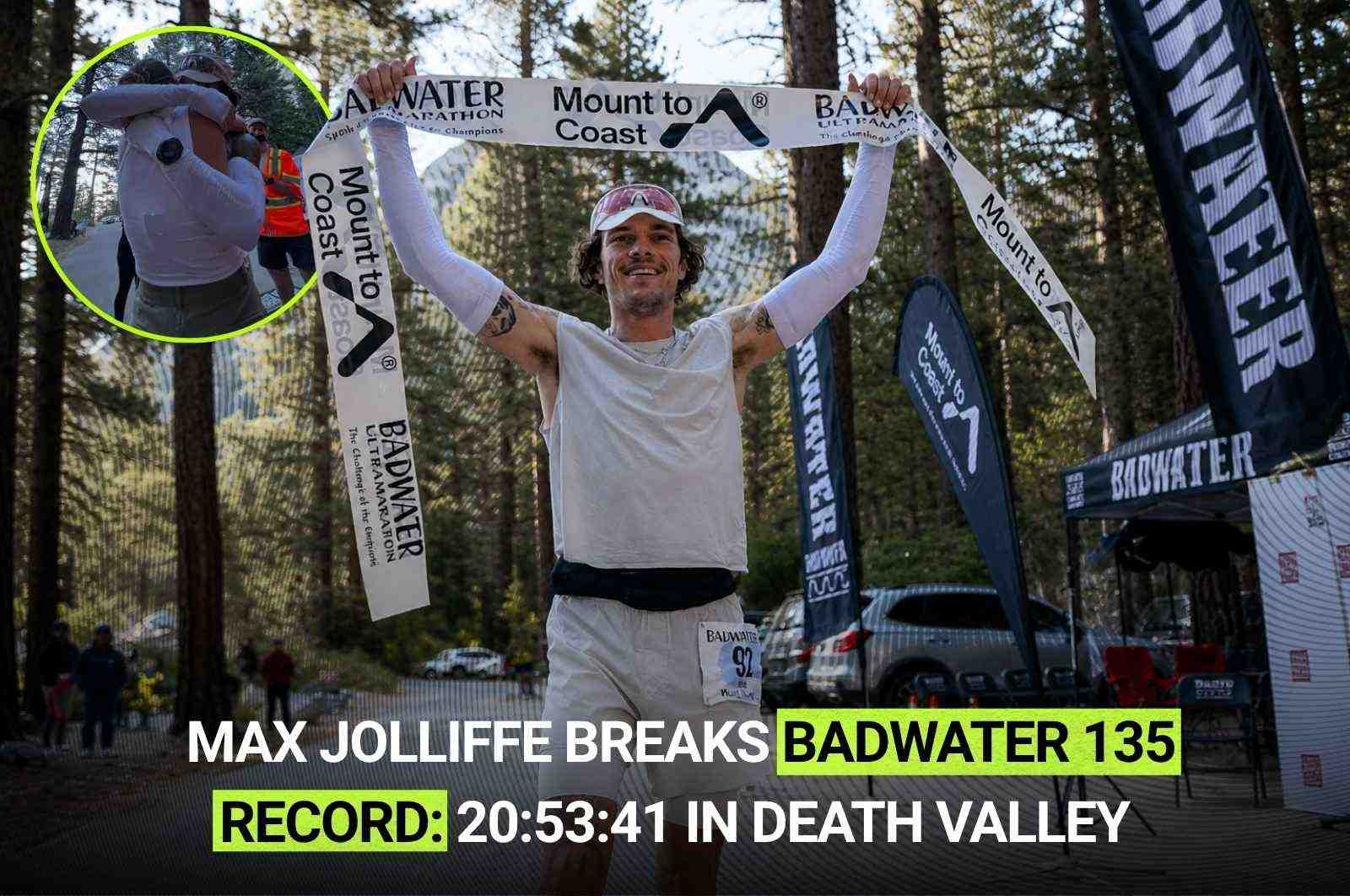
On Tuesday evening, at the trailhead below Mount Whitney, a 34-year-old runner from Costa Mesa, California, did something that had never been done in the nearly 40-year history of the Badwater 135.
Max Jolliffe crossed the finish line in 20 hours, 53 minutes, and 41 seconds, becoming the first person ever to break 21 hours across 135 miles of Death Valley heat.
He took 39 minutes and 20 seconds off the standing course record of 21:33:01, set by Yoshihiko Ishikawa in 2019.
And he was not alone.
Eleven minutes and fifty-one seconds behind him, Spanish runner Carmen Maria Perez finished second overall in 21:05:32 and rewrote the women's course record at the same time, a mark that had stood since 2023.
Two of the most stubborn records in ultrarunning fell inside the same evening, in the same race, on the same climb.
What Badwater 135 actually is
The Badwater 135 is not a mountain trail race.
It is a paved highway ultramarathon that runs from the lowest point in North America to a mountain trailhead in the Sierra Nevada.
The route starts at Badwater Basin at 280 feet below sea level and finishes at Whitney Portal at 8,360 feet, covering 135 miles and about 14,600 feet of cumulative climbing across three separate mountain ranges.
It happens in late July. In Death Valley, on black asphalt.
The race is regularly described as the toughest foot race on the planet, and the field this year reflected that reputation.
Ninety-eight athletes from 21 nations entered, with an average age of 46 and 65 of them attempting the race for the first time.
For 2026, race organizers tightened the overall time limit from 48 hours to 45.
Nobody expected the front of the race to need anywhere near it.
A rookie at the front
Jolliffe is listed on the roster as a professional athlete, and he was a Badwater rookie.
The men's race, by most previews, had no clear favorite going in.
Ivan Penalba Lopez of Spain had finished second three times, in 2022, 2024, and 2025.
Harvey Lewis, the schoolteacher who won in 2014 and 2021, was back at age 50 for a 15th straight finish.
Jolliffe was one of several names to watch, not the name.
That changed on the climb.
How the record actually got broken
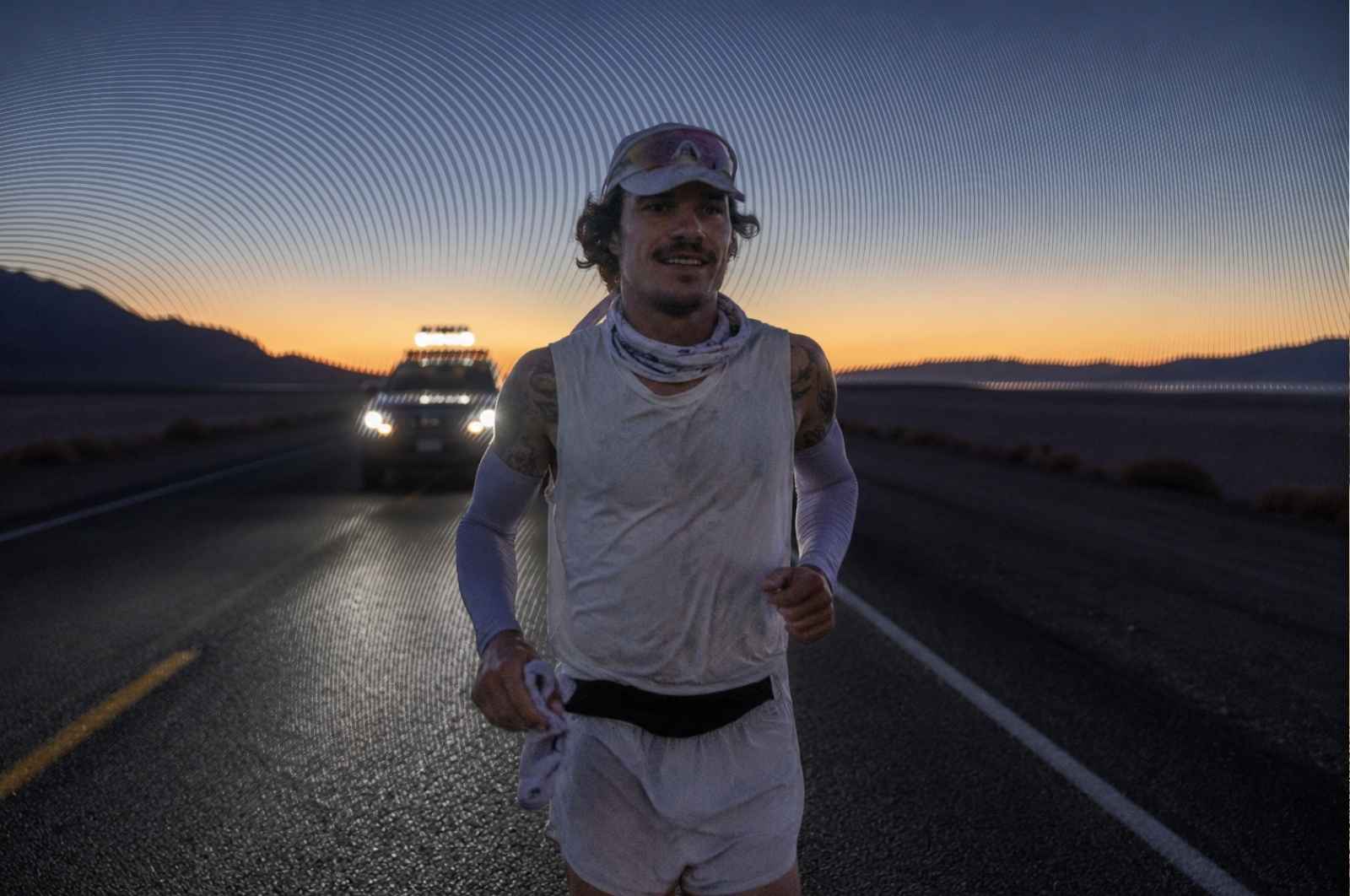
For most of the desert, Jolliffe was not leading. Perez was.
She reached the Furnace Creek time station at mile 17.7 in 2 hours 18 minutes. He was at 2:20.
She hit Stovepipe Wells at 5:43 to his 5:48, Panamint Springs at 10:25 to his 10:26, and Keeler at 15:52 to his 15:57.
The race arrived in Lone Pine, at mile 122.8, with three runners inside seven minutes of one another.
Tamás Bódis of Hungary was through at 18:07, Jolliffe at 18:13, and Perez at 18:14.
What remained was the Whitney Portal climb, which the race lists at 4,750 feet of gain over 12.2 miles, an average grade of 7.4 percent, with the final mile the steepest stretch of the whole route.
Jolliffe climbed it in 2 hours 40 minutes, and Perez in 2:51:32.
Bódis, the runner who had entered Lone Pine in front, took 3:27:47 and drifted back to third.
Jolliffe led Perez by one minute at Lone Pine. By the finish line, twelve miles later, that gap had grown to almost twelve minutes.
That is where the race was actually decided. Not on the desert floor, but on the final climb.
What that pace actually looks like
Over 135 miles of desert heat, climbing three mountain ranges, Jolliffe averaged approximately 9:17 per mile (5:46 per km).
That is a pace many recreational runners cannot hold for a single road half-marathon in cool weather, in the dark, on flat ground, fully rested.
He held it for 135 miles across Death Valley, uphill, on a night that reached triple-digit temperatures well after sunset.
Why Death Valley breaks people, and why it did not break him
A run of this length in this kind of heat is not just a fueling and pacing problem, it is a physiological one.
That is a technical way of saying: the best runners in Death Valley are not just fitter.
They have prepared their bodies to move heat.
Heat acclimation is a well-documented adaptation that expands blood plasma volume, lowers resting heart rate at a given workload, and starts sweating earlier and more efficiently.
The changes take about ten to fourteen days of deliberate heat exposure, and they wash out within about a month if the exposure stops.
That is why Badwater is not a race a fit runner can just show up to.
It is a race a fit runner has to build a body for, weeks in advance, in a sauna or in the heat of the day at home.
Durability, not just speed
The other thing that separates a sub-21-hour finish from a 25-hour one is not raw speed, it is durability, the quiet ability to keep moving well when everything hurts.
Bódis was ahead at Lone Pine and finished third. Jolliffe was behind for most of the desert and finished first.
The runners who did not blow apart in the last twelve miles are the ones who trained the last twelve miles the hardest.
The Perez story people are going to miss
The headline is Jolliffe. It should not only be Jolliffe.
Paulson was on the start line this year, wearing bib number 1.
She finished seventh overall in 24:59:36, second among the women, watching her own record fall by nearly the same margin the men's fell by.
The two records fell by margins seventeen seconds apart, which is not a coincidence.
That is what a night looks like when the front of the race is running faster than it has ever run.
What made this year different
Four runners in total finished inside 22 hours. In previous editions, one runner inside 22 hours has been notable.
Pete Kostelnick, the 2016 champion and a former transcontinental record holder, was sixth in 23:50:12. Ivan Penalba Lopez was fourth in 21:57:44.
The whole front of the race compressed forward at once. Which suggests the ceiling on this course was not where anyone thought it was.
What runners can actually take from this
You are not going to run Badwater tomorrow, and almost nobody is. But the mechanics of what happened this week hold three lessons that scale down to any long race.
1. Do not let the last climb decide it
Jolliffe won this race because he ran the last twelve miles better than everyone else.
Not because he ran the first hundred faster.
The next time you build a long race, budget effort for the last part of the course, not the first.
A negative-split climb wins races, and a positive-split flat almost never does.
2. Heat is a training problem, not a race-day problem
The runners who cracked in Death Valley did not crack because it was hot. They cracked because they were not built for it in advance.
Two to three weeks of deliberate heat exposure, whether by post-run sauna or by training in the warmest part of the day, is enough to move the needle. The Running Week's heat training guide covers the practical protocol. 3. The dark hours count
The 2026 race started in three waves at 8pm, 9pm, and 10pm on Monday night. Jolliffe and Perez both started in the last wave, and most of their running happened in the dark.
Night running is a specific skill: pacing without visual reference, fueling on a schedule instead of on feel, and staying awake through the dip that hits most runners between 2am and 5am.
Runners who train it in advance are the ones who race through it.
What this record actually says about the ceiling
Ishikawa's 21:33:01 had stood for seven years. Before him, the record had crept down in minutes, not blocks.
Jolliffe knocked almost 40 minutes off it in a single race, and Perez did the same on the women's side.
That is not a small refinement, it is a step change.
The next generation of ultra-endurance running is arriving faster than most sport-watchers are ready for.
What was considered the outer edge of human capacity in the desert on Monday night was, by Tuesday evening, no longer the outer edge at all.
And somewhere, someone is already looking at 20:53:41 and thinking they can run it faster.