Norwegian Trail Star Ida Amelie Robsahm Dies at 30 in Fall on Romsdalseggen Ridge
Norwegian trail runner Ida Amelie Robsahm, fifth at the OCC just weeks earlier, died after a fall on the Romsdalseggen ridge in western Norway. She was 30.

Former college miler Stephen Biebelhausen ran 4:17 with a baby stroller at the 2026 Guardian Mile in Cleveland, blowing past the previous mark of 4:26.29 and reopening a heated ratification debate.
Some records fall by a second. Some fall by five.
This one just fell by nine.
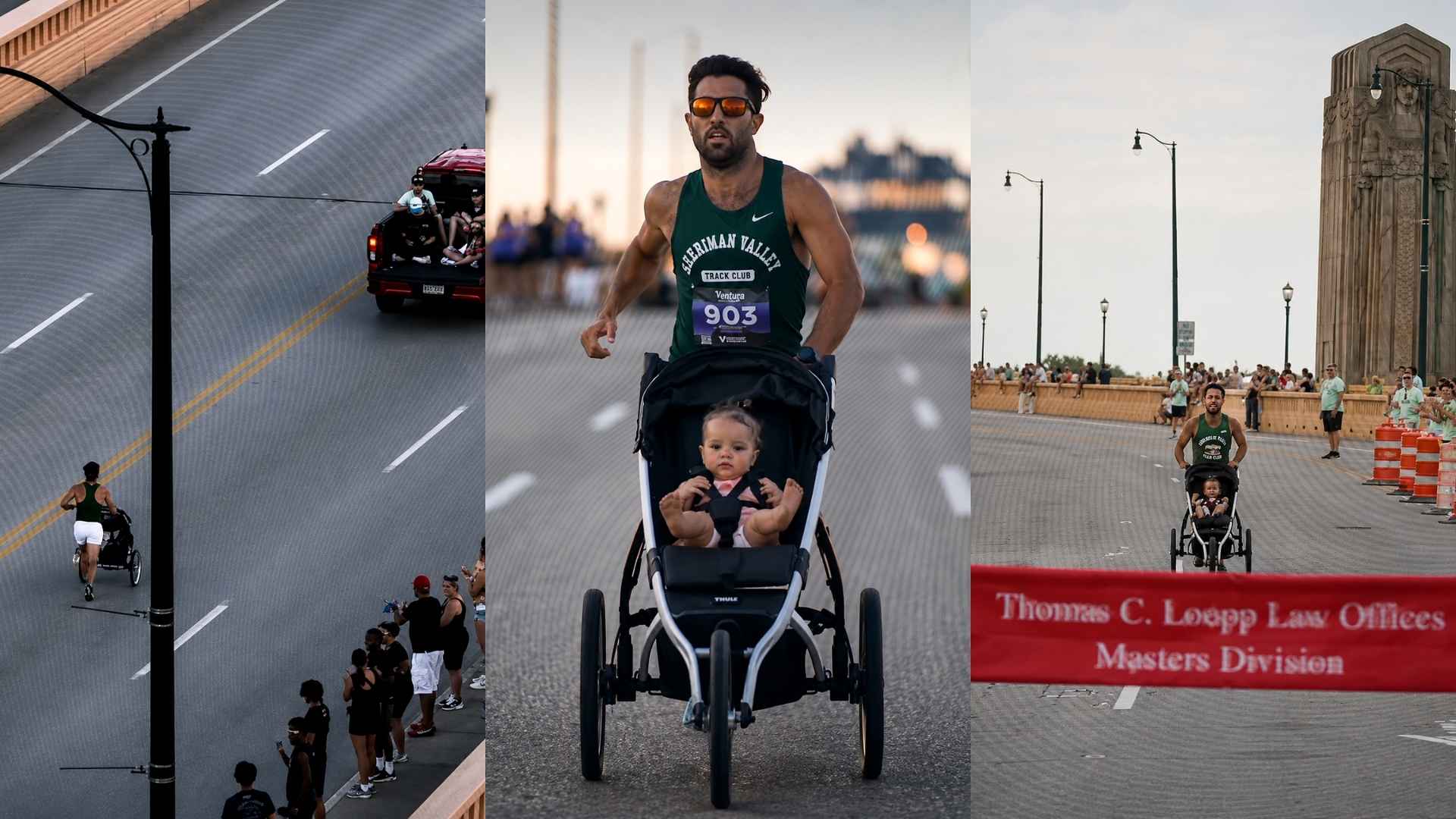
Yesterday, August 8, 2026, at the Guardian Mile in Cleveland, American runner Stephen Biebelhausen ran a mile in 4 minutes and 17 seconds while pushing his baby in a jogging stroller.
For context: the previous men's stroller mile world best was 4:26.29, set on a flat track in July 2025.
Biebelhausen went sub-4:20 on a road, with a stroller, across a bridge.
If you watch running, you know how absurd that number is. If you push a stroller yourself, you already know it is closer to impossible.
Biebelhausen is not a viral novelty. He is a former Miami University miler, a Mid-American Conference finalist who owns a 3:47.62 personal best in the 1500 metres.
His World Athletics profile also lists a 2:25:31 marathon from Boston 2024.
That is the resume of a genuine, sub-elite American distance runner. Not a hobbyist stunt.
That resume matters here. A 4:17 mile is inside his legitimate open-race range, which means the stroller add-on becomes a physics problem instead of a fitness one.
A 4:17 mile is 64.25 seconds per quarter. Most recreational runners cannot hit that pace in a full-effort 400.
If you want a fair benchmark for your own mile, the average mile time by age and sex is a useful reality check. It puts the Biebelhausen number in perspective in about ten seconds of reading.
The Guardian Mile is Cleveland's signature one-mile road race, run across the Hope Memorial Bridge with the skyline as a backdrop.
The course is World Athletics-certified and point-to-point. It climbs for the first half, then drops fast to the finish.
Elite men have gone sub-4:00 on it.
That downhill matters. A net-drop road course is inherently faster than a flat 400 metre oval, especially for the second half of a mile.
Guinness ratifies these attempts under strict conditions. Prior ratified marks, including Kaitlin Donner's 5:11.46 women's pram record, were set on flat courses (typically a track) with a stroller carrying a child of stated minimum age, and with signed witnesses.
A point-to-point road with net elevation loss is a different animal.
The 4:17 will still be a world best in the eyes of the running community. Whether the Guinness certificate follows is another question.
The same debate is playing out around the previous men's stroller mile mark of 4:26.29, which is still listed as under review pending Guinness verification.
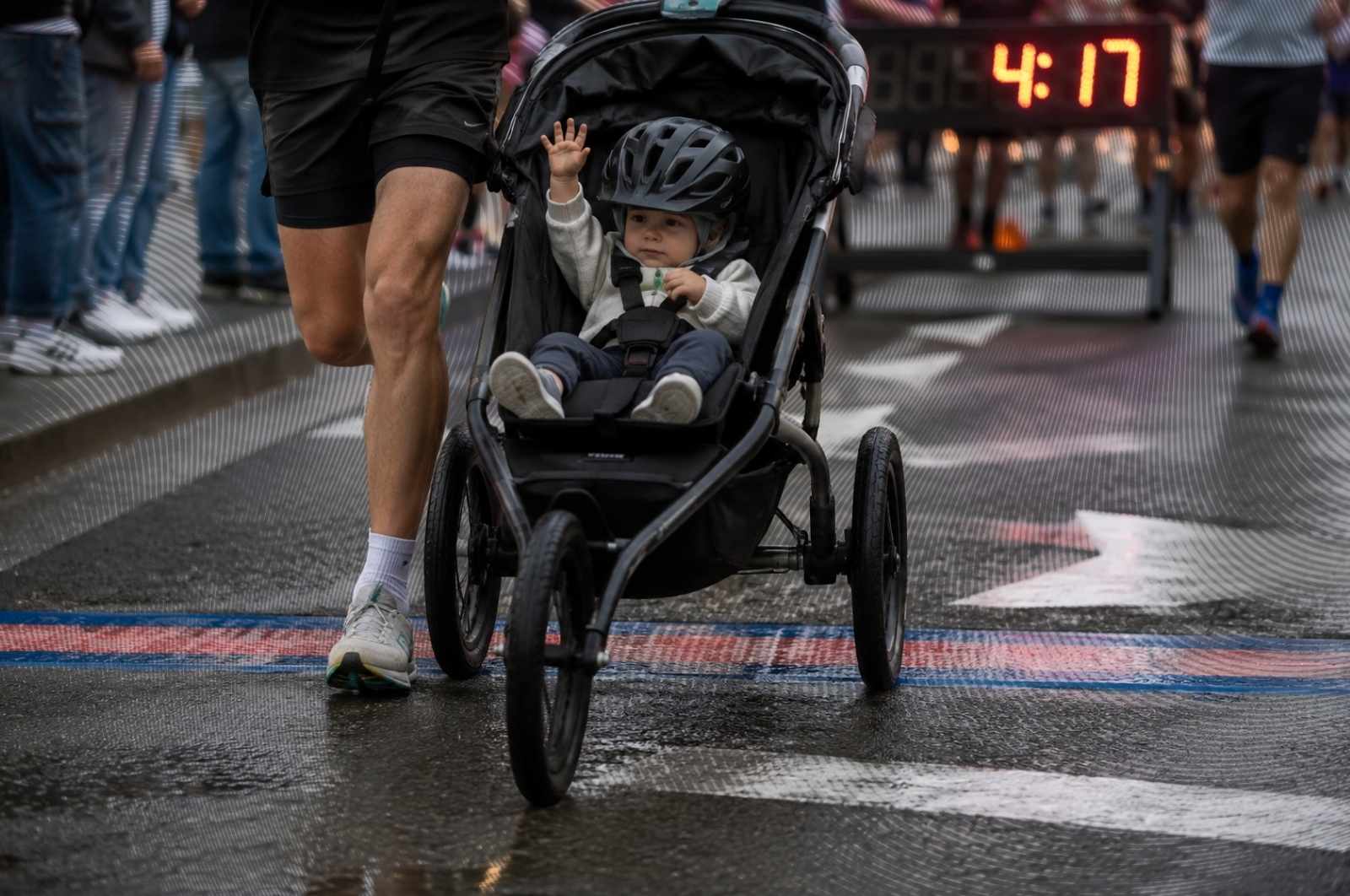
Stroller running is having a moment. And not just for stunts.
Elite parents are proving that adding twenty extra pounds and a rolling wind-catcher barely dents their times.
Earlier this year, an Italian runner set the world record for fastest 100km pushing a pram. On the mile side, marks have dropped almost yearly.
A pattern is emerging. Sub-elite parents with track speed are choosing the stroller as their record vehicle, because it is the last frontier of running still open at the top.
There are three real penalties, and none of them are what most people assume.
1) Aerodynamic drag: a three-wheel jogging stroller is a rolling parachute at mile pace, and wind resistance rises with the square of speed.
2) One-arm running: you lose the counter-swing on the pushing side, which kills stride efficiency and forces the trunk to over-rotate.
3) Steering tax: the stroller wants to drift on cambered road, and every micro-correction eats a fraction of a second.
Running a 4:17 while paying all three of those tolls is not something you fake with fitness. It is a technical feat.
You are almost certainly not going to run a 4:17 mile, and neither is anyone you know.
That is not the takeaway.
The takeaway is that the stroller stops being an excuse. If a real dad can go 4:17 with one, your Tuesday tempo does not become impossible because the baby is coming along.
Parents who train with a stroller tend to develop stronger posterior chains, better upper-body control, and higher heart-rate ceilings at the same paces. It is training with a resistance component you do not have to design.
You do not need a stroller to chase a mile PR. You need a plan.
A structured four-week block can genuinely move your time. Our guide on how to beat your mile PR in 4 weeks with a proven training routine lays out the intervals, the pace targets, and the recovery scaffolding.
Do that once. Then, if you want to push it, add the stroller.
The moment Biebelhausen crossed the Hope Memorial Bridge finish line, three things happened at once.
The stroller mile record dropped by nine seconds. The definition of a legitimate stroller time got pulled a full pace zone faster.
And a very specific category of running dad, the sub-elite miler with a jogging stroller in the garage, just found their new benchmark.
Guinness will do what Guinness does. The number will get argued about, ratified, re-ratified, or footnoted.
None of that changes what happened on the bridge. A father ran a mile in 4:17 with his kid along for the ride.
And running just got a new impossible.
Start your running journey today!
No spam. Cancel anytime.