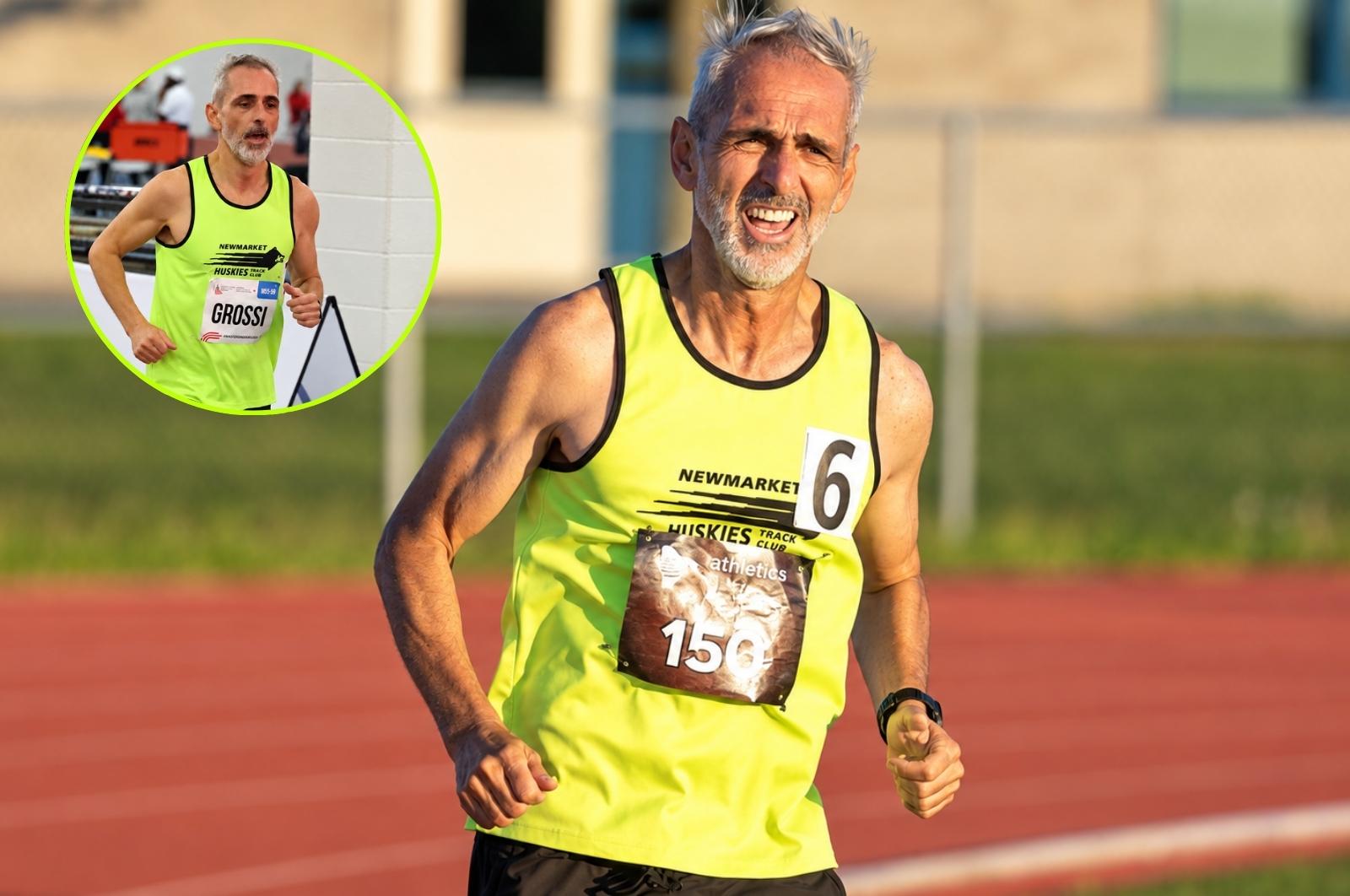
Ontario doctor Danny Grossi spent 29 days in hospital fighting a blood clot that nearly cost him his leg. Less than a year later he was Canadian masters 1,500m champion, and he had built a training AI along the way.
Pictured from Danny Grossi
In an ICU bed in 2025, Danny Grossi, a doctor from Aurora, Ontario, was staring down the possibility of losing his leg.
A blood clot in his calf had triggered a cascade of complications, and doctors told him he might never run again.
In March 2026, less than a year later, he stood on top of the podium at the Canadian Indoor Masters Championships, having won the M55-59 1,500 meters in 5:07.84.
In between, he had also built a software company.
How this started
Grossi is not a career runner. He is a physician with degrees from Princeton University and the University of Toronto, and he had drifted away from competitive racing for decades.
In 2024, watching his four children compete on the track, he decided to come back.
He raced cross-country, started building fitness, and everything was going well until the numbness started.
The clot that hid in plain sight
During the 2024 cross-country season he began feeling numbness in his ankle and foot.
His doctors could not figure out what was causing it, and the symptoms dragged on into the spring.
By early 2025, as he was preparing for the Canadian Masters Indoor Championships, the pain became unbearable.
An extended scan finally caught it: a blood clot in his leg, higher up than the original imaging had reached.
The complication that almost took the leg
Once the clot was cleared, blood came flooding back into a lower leg that had been restricted for months.
That triggered compartment syndrome, a condition where pressure builds inside a muscle compartment and starts choking off the tissue from the inside.
It required four fasciotomies to relieve the pressure.
He spent 29 days in hospital, including eight in intensive care.
The question that changed everything
Grossi tells the story of a single question he asked himself while lying in that ICU bed.
If he was fortunate enough to run again, how would he rebuild intelligently?
That is the question most returning-from-injury runners never articulate.
They train harder, or they train softer, and hope the body responds.
Why a physician was well positioned to try something different
Grossi came at rehab the way a scientist would attack an unfamiliar problem. He tracked everything he could get a signal on: heart rate variability, training load, sleep, subjective effort, blood markers, cadence, pace.
Then he did the thing most runners never do with their own data.
He tried to make it mean something.
The AI experiment
Rather than pipe every metric into a spreadsheet and stare at it, he used artificial intelligence models to look for signal across the streams simultaneously.
He wanted the tools to tell him what was correlating with feeling good, and what was correlating with the next bad run.
The work he was doing on himself turned into a product.
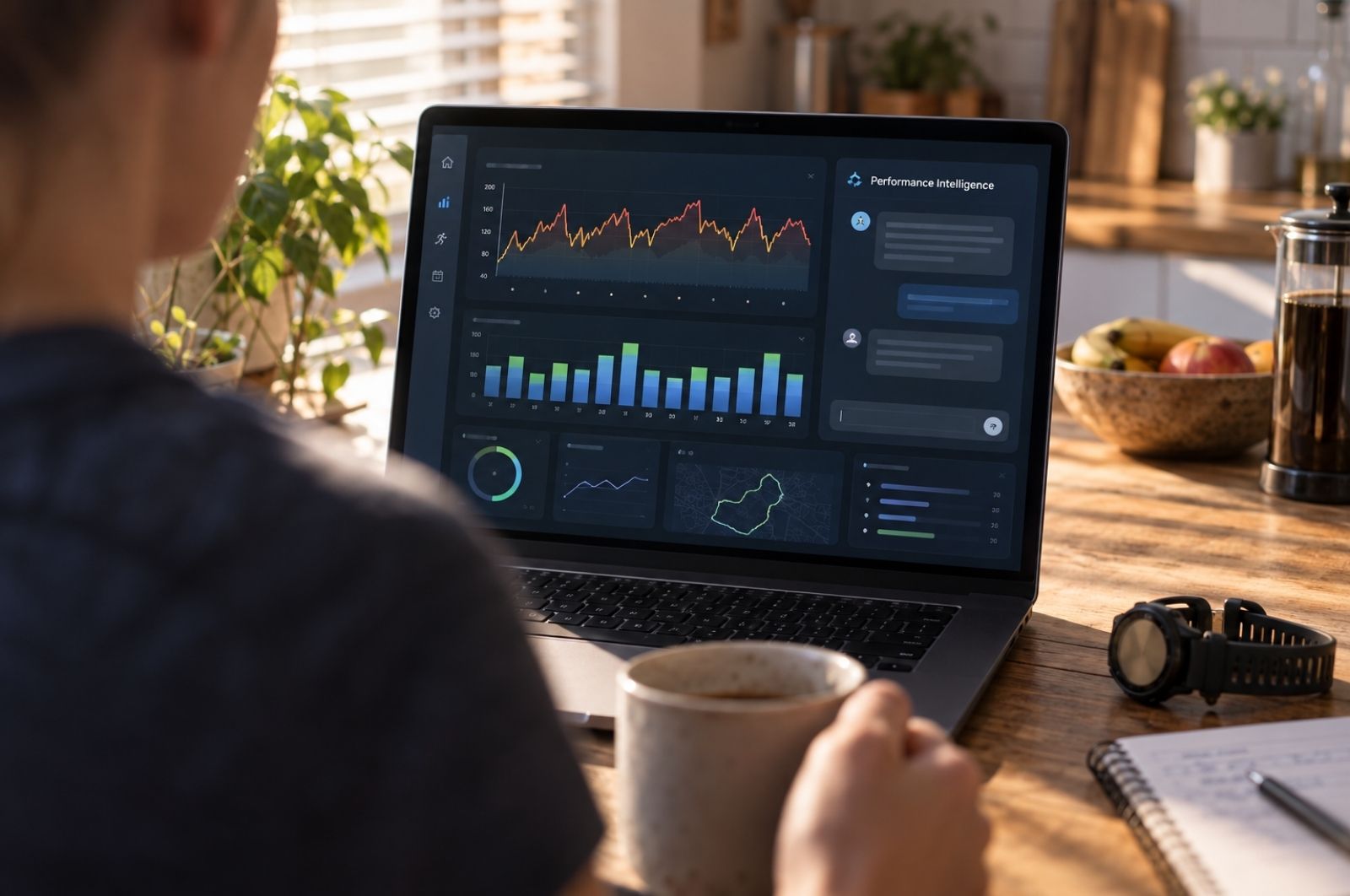
That product is now called PIRX, short for Performance Intelligence Rx, and it is being marketed as a performance intelligence platform for runners.
The comeback race
In March 2026, Grossi returned to the Canadian Masters Indoor Championships he had been preparing for the previous year when the clot showed up.
He won.
5:07.84 in the M55-59 1,500 meters is not a token result. It is a legitimate championship-caliber time for that age group, and it came less than a year after the ICU.
The scale of what that took
Rebuilding from compartment syndrome and four fasciotomies is not a linear process.
Nerve function returns slowly and unpredictably, and calf strength has to be rebuilt from a base of essentially zero.
For any runner who has come back from a serious injury, the story will feel familiar.
The training-data angle nobody talks about
That gave his AI experiment a baseline that most returning runners will never have.
When his return-to-run numbers looked off, he had comparison data going back years to check them against.
What this actually tells the rest of us
Most runners will not have Grossi's medical background, and most will not be building an AI training platform in their downtime.
That is fine, because his story still lands two useful points.
One: data only helps if you *use* it
Every runner reading this is probably wearing a watch that collects far more data than they ever look at.
Grossi's project only worked because he decided to interrogate his numbers instead of glancing at them.
That is a habit, not a technology. The tools help, but the habit is the hard part.
Two: the mental frame matters as much as the physical rebuild
Grossi has been open about the fact that he needed a project during his recovery.
The AI experiment was as much psychology as it was performance science.
What is next
Grossi is now training for the 2026 World Masters Athletics Championships, aiming to return to the international stage.
The PIRX platform he built during recovery is now the tool he is using to plan his own preparation.
In his own words, buried in the reporting: the irony is that the product only exists because everything went wrong.
That is a good line, and it lands right.
Most useful things get built by people who had no choice but to figure something out.
The masters running world tends to specialize in that particular kind of person.