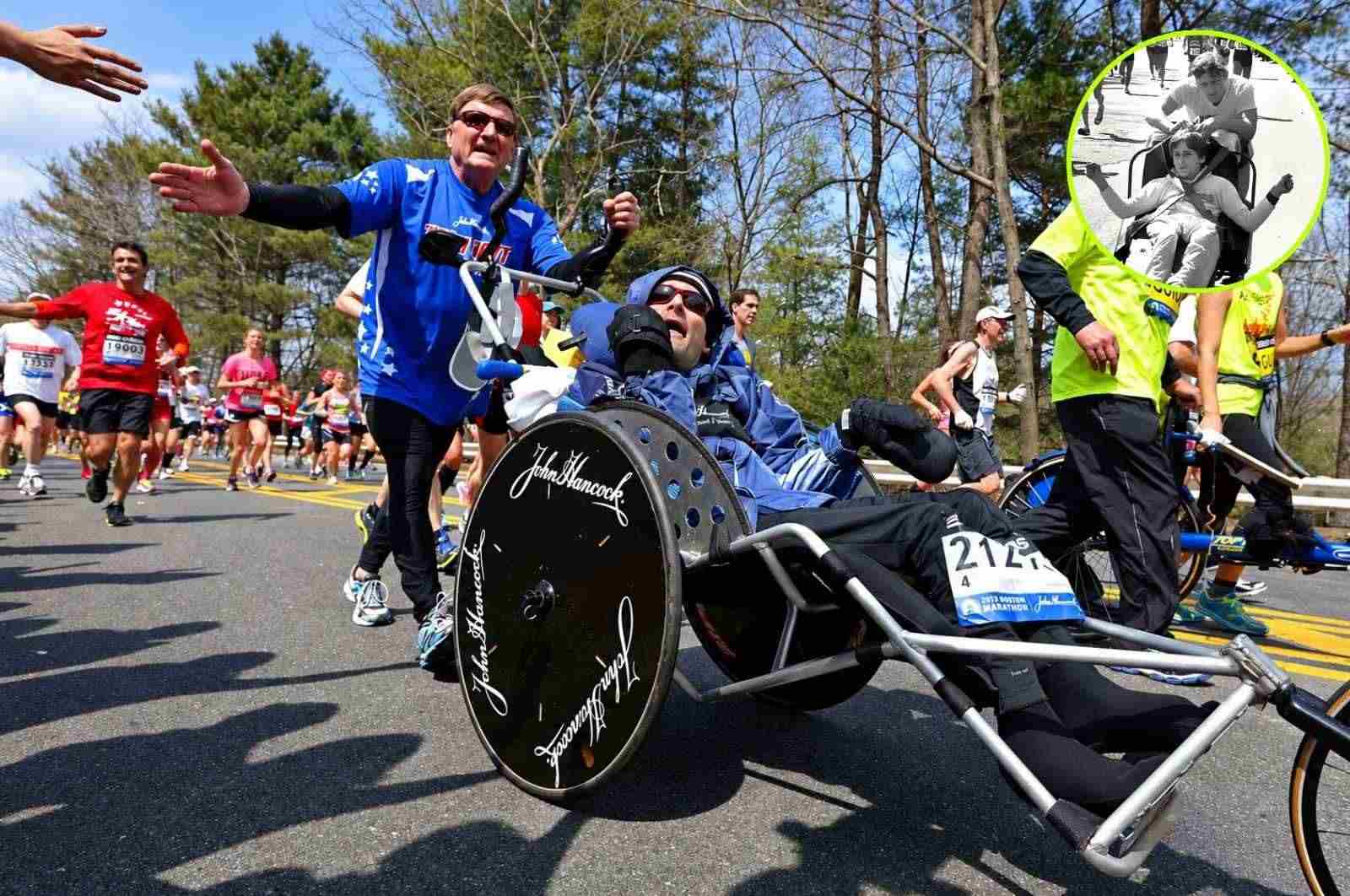
Rick Hoyt typed one line after his first race with his father. Everything about Team Hoyt followed from that sentence, including 32 Boston Marathons and 6 Ironmans.
Picture Credit : AP Photo/Michael Dwyer
In 1977, a 15-year-old boy with cerebral palsy in Massachusetts asked his father to push him in a five-mile charity race for a paralysed lacrosse player.
That evening, using a computer that let him spell one letter at a time by tapping his head, the boy typed a single sentence.
"Dad, when I am running, my disability seems to disappear."
Everything Team Hoyt became, and everything the adaptive endurance world inherited from them, followed from that sentence.
The Boy Who Was Never Supposed to Speak
Rick Hoyt was born in 1962 with cerebral palsy after complications during birth.
Doctors told his parents, Dick and Judy, that he would be a vegetable for the rest of his life and recommended institutionalising him.
Fifty years later, Dick would famously joke that he and Rick were still trying to figure out what kind of vegetable.
The Hoyts refused the institution.
Engineers at Tufts University built Rick a communication device that let him spell words with head movements.
With it, he attended public school for the first time, and eventually earned a degree from Boston University.
The father who was not a runner
Dick Hoyt was 37 years old in 1977. He ran a couple of miles a week.
He was a National Guard officer, not an endurance athlete.
When Rick used his communication device to ask about the charity race, Dick said yes because he could not bear to say no to his son.
The pair finished next to last, in a wheelchair that a family member later described as maneuvering like a shopping cart with a bum wheel.
For the next two weeks, Dick could barely walk. He was, in his own words, disabled.
The Sentence That Changed Everything
That night, Rick sat in front of his communication device and typed the line that would define the next four decades of American road racing.
"Dad, when I am running, my disability seems to disappear."
For a boy who could not speak, could not walk, could not use his arms or legs, and had spent 15 years being seen through the lens of what he could not do, the run had erased the lens.
Dick Hoyt spent the rest of his life making sure that erasure kept happening.
The training a father did in a wheelchair
When Rick was at school and unable to train with him, Dick would put a bag of cement in the wheelchair and run alone.
That is how the man who barely ran a couple of miles a week became a marathoner and eventually a triathlete.
That detail is not the flashy part of the Team Hoyt story. It is the real one.
The cement bag, done in private, when nobody was watching, is what made the finish lines possible.
The 32 Bostons, the 6 Ironmans, and the 1,100 Races
Team Hoyt went on to compete in over 1,100 endurance events, including 72 marathons, 257 triathlons, 6 full Ironman triathlons, and 32 Boston Marathons.
Their first Boston was 1980. Race organisers turned them down twice in the late 1970s and eventually told them they would need to earn a qualifying time.
So they did.
Every one of those races involved Dick pushing, pulling, or towing Rick.
In the swims, Dick pulled Rick in a small boat with a rope tied around his waist.
On the bike, Rick sat in a special seat over the front wheel. On the run, the specialised racing chair did the carrying.
The 2013 finish that never happened
Dick had planned to retire from Boston after the 2013 race. That was the year of the finish-line bombing.
The Hoyts were about a mile out when officials stopped them.
They came back in 2014 for one more, and finished properly.
Dick died in 2021 at 80. Rick died in 2023 at 61.
A dentist named Bryan Lyons pushed Rick for the years between Dick's retirement in 2014 and Lyons' own unexpected death in 2020.
Why That Sentence Still Matters
Rick Hoyt's single-sentence description of what running gave him is now the founding text of the entire modern adaptive endurance movement.
Every guided blind runner, every push-athlete duo, every wheelchair marathoner racing at a major, every all-terrain wheelchair now being loaned out at national parks, is downstream of that one line typed by head movements on an early computer in 1977.
What runners can still learn from Dick
Dick Hoyt was not a naturally gifted athlete.
He was a middle-aged man who said yes to his son, and then went home and put a bag of cement in a wheelchair to train.
The Team Hoyt lesson is not about talent. It is about response.
When the person you love asks you for something impossible, the useful question is not can they? but what would need to change to say yes?
What Rick left behind
Rick Hoyt used running to speak.
He said, through his father's legs, that a person is more than the sum of what their body cannot do.
The Hoyt Foundation still helps individuals with disabilities and the organisations that serve them.
The Sentence, One More Time
"Dad, when I am running, my disability seems to disappear."
One sentence. Forty-plus years of racing.
Thirty-two Bostons and six Ironmans.
Over a thousand finish lines, and a movement.
Nothing else in modern endurance sport has done more with fewer words.