Olympic medalist Jenny Simpson collapsed at a Raleigh pop-up mile in June. Two months later she revealed the rare heart condition, ARVC, that ends her running.
Picture from trackjenny and Getty Images.
Jenny Simpson does not remember any of it.
On the evening of June 16 in Raleigh, North Carolina, the three-time Olympian was pacing a group of young girls through a mile at a Sir Walter Running pop-up event when her heart stopped.
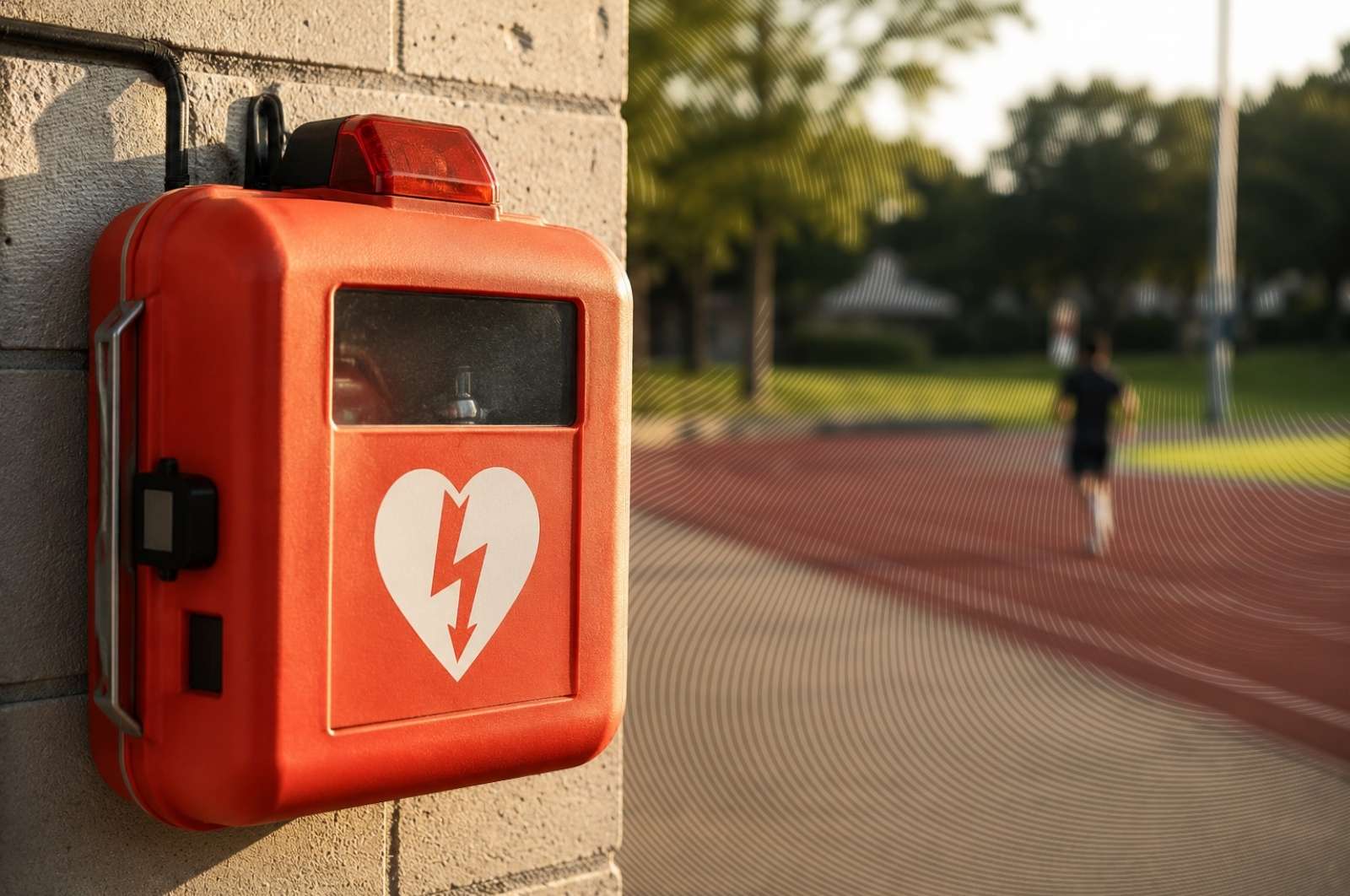
Bystanders performed CPR, an AED was used at the track, and she was rushed to hospital.
Two months later, on August 20, she shared the diagnosis that has ended her running forever.
What Happened That Night
The details Simpson has released paint a story that came very close to a different ending.
Ivy and Joey Pointer, from Fleet Feet where Simpson had recently taken a role as chief running officer, were among the first to reach her. Ivy is a pediatric intensive care physician, and the couple happened to carry an AED because their own child has a congenital heart condition.
That combination of trained hands and a defibrillator on scene mattered.
She was resuscitated at the track, transported to hospital, and then went into cardiac arrest again.
She was placed on life support and transferred to Duke University Hospital for advanced heart failure care.
Her body, in her own words
In her Instagram statement, Simpson described the medical picture in stark terms.
Her heart continued to fail even after resuscitation, her weakened pumping function let fluid build up in her lungs, and both organs needed machine support for days.
Then, in her words, her heart "woke back up" and her body proved remarkably resilient.
Within days she was breathing and pumping on her own.
The full announcement, as reported by ESPN and other outlets, included the reason her doctors would not clear her to run again. The Diagnosis: Arrhythmogenic Right Ventricular Cardiomyopathy
Simpson was diagnosed with arrhythmogenic right ventricular cardiomyopathy, or ARVC.
It is a rare inherited heart muscle disease. Cleveland Clinic describes it as a condition where healthy heart muscle is gradually replaced by fatty or fibrous tissue, mostly in the right ventricle. That scarring interferes with the electrical signals that normally coordinate each heartbeat, and it can trigger dangerous rhythms.
ARVC is not common.
Estimates suggest it affects roughly one person in every 2,000 to 5,000, and it can run in families.
It is also one of the leading causes of sudden cardiac death in young athletes, which is exactly why the medical guidance is what it is.
Why the guidance is so absolute
It stresses the right ventricle exactly where the muscle is being replaced by scar tissue, and it can bring on the dangerous rhythms that cause cardiac arrest in the first place.
Once ARVC is confirmed, competitive and high-intensity endurance training is off the table.
That is the sentence Simpson was reading.
In her post she framed it plainly.
Her future, she said, is still an incredible gift and has great purpose, but returning to running would be dangerous. The chapter, in her words, has ended.
A Career That Reshaped American Distance Running
Simpson's competitive career was already over.
She retired at the 2024 New York City Marathon after a body of work that included the 2011 world 1,500 metres title, which made her the first American woman to win that event, and a bronze medal at the 2016 Rio Olympics, the first American woman to medal in the Olympic 1,500.
She represented the United States at three Olympic Games.
The June collapse happened during a mile run she was pacing for girls in the community.
She has said she is at peace that her final run was that one, a slow mile in a community setting, rather than a race. It is a rare kind of grace to write about your own ending that way, and it is worth noticing.
What Runners Should Take From This
The instinctive question after any elite athlete's cardiac event is whether the sport itself is the problem.
For the vast majority of runners it is not. Running lowers cardiovascular disease risk on a population level, and the evidence for that is strong across decades of research.
Conditions like ARVC, hypertrophic cardiomyopathy, and certain congenital heart defects are the exceptions.
They are rare, and they can hide in seemingly healthy bodies for years before revealing themselves. A recent study out of Paris found a small spike in cardiac arrest risk during finish-line surges, which lines up with the pattern of rare underlying conditions being unmasked by peak effort rather than caused by it. When to actually take heart symptoms seriously
Family history is the biggest single red flag for inherited heart conditions.
Unexplained fainting during or after exercise, chest pain, palpitations that come on with effort, and a resting heart rate or rhythm pattern that seems consistently off deserve a conversation with a doctor.
AEDs at community events
The single most important detail in Simpson's story is not medical.
It is that an AED was on scene and trained bystanders used it.
Every minute without a defibrillator after cardiac arrest cuts survival odds sharply, and the community mile she was pacing had the equipment because someone brought it.
That equipment saved her life, and it should be at every organised running event.
The Chapter That Has Not Ended
Simpson finished her post with a line that is easy to miss.
"That chapter has ended," she wrote. "Thankfully, my story hasn't."
She is back in Colorado, working on a recovery plan with her Duke team, and moving into the next thing.
Whatever that turns out to be, she has already changed the sport once.
The odds are good she will do it again.
This piece deals with a serious cardiac event. If you notice unexplained fainting during exercise, chest pain, or a family history of sudden cardiac death, speak to a physician rather than adjusting training on your own.