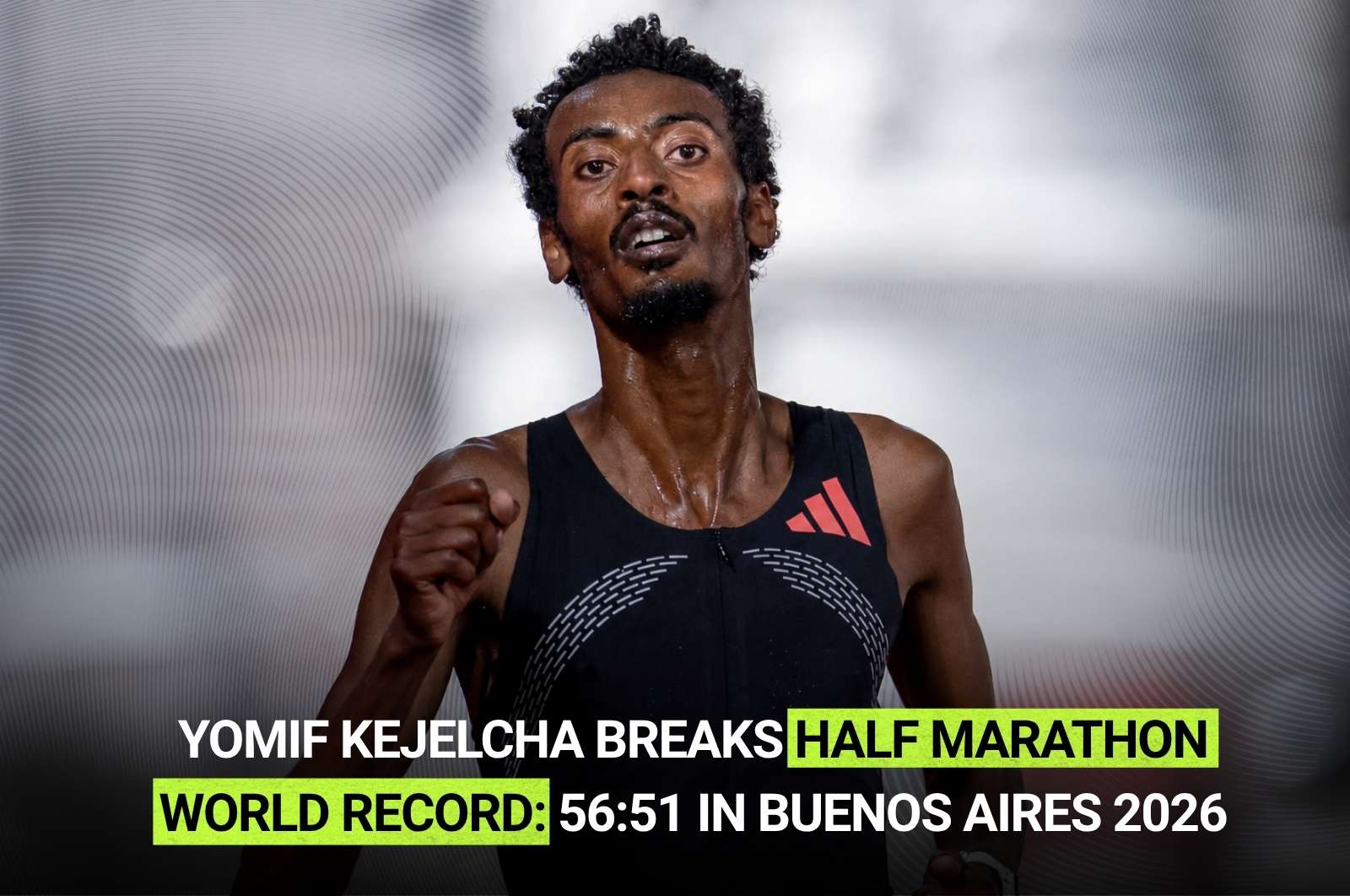
Yomif Kejelcha ran 56:51 at the 2026 Buenos Aires Half Marathon to break Jacob Kiplimo's 57:20 world record. How the record finally fell in South America.
Yomif Kejelcha has the half marathon world record back.
The Ethiopian ran 56:51 to win the 21K de Buenos Aires on Sunday morning, slicing 29 seconds off the official world record, subject to the standard ratification process.
The previous mark of 57:20 belonged to Uganda's Jacob Kiplimo, set at the Lisbon Half Marathon on March 8, 2026.
Kejelcha's run works out to a scarcely believable 2:41 per kilometer, averaged across the entire race.
It is the first time the official men's half marathon world record has ever been set in South America.
It was also Kejelcha's first race since his historic marathon debut in London in April.
The Fastest Half Marathon Ever Run Is Still Not the Record
Here is the twist that makes this record different from every other. Kiplimo has actually covered the distance faster than 56:51, and his time does not count.
In February 2025, Kiplimo clocked a stunning 56:42 in Barcelona, a performance that looked untouchable for a decade. World Athletics later refused to ratify it, ruling that he ran too close to the lead vehicle and gained an illegal pacing advantage.
That decision quietly handed the record back to Kejelcha's ratified 57:30 from Valencia in 2024. Kiplimo answered with 57:20 in Lisbon this March, and that became the official standard Kejelcha chased on Sunday.
The record book now reads strangely as a result. Kejelcha's 56:51 stands as the new world record, pending ratification, while Kiplimo's faster 56:42 remains a footnote with an asterisk.
Why Ratification Suddenly Matters
Every road world record must pass checks on course measurement, anti-doping controls, pacing rules, and shoe regulations before it becomes official.
The Barcelona case proved those checks have real teeth.
The formal review usually takes months, and the paperwork will be watched closely this time.
Until it clears, the sport will attach the customary asterisk, exactly as it does for every new record.
A Record Ping Pong Five Years in the Making
The men's half marathon record has become a private duel decided by absurdly thin margins.
Kibiwott Kandie ran 57:32 in Valencia in 2020, and Kiplimo took it with 57:31 in Lisbon a year later.
Kejelcha then stole it by a single second with his rain-soaked 57:30 in Valencia in October 2024.
Kiplimo's annulled 56:42 followed, then his legitimate 57:20, and now Kejelcha's emphatic reply.
Two of the last four legal handovers were decided by exactly one second.
The 21K de Buenos Aires bills itself as the fastest half marathon course in the Americas, and Sunday proved the marketing right.
More than 31,000 runners filled a sold-out start on Avenida Figueroa Alcorta in Palermo for the 8:00 AM gun on a southern winter morning.
The course record coming in was 58:29, set by Kiplimo himself in 2025 and standing as the fastest half ever run on the continent. Kejelcha demolished it by 1 minute and 38 seconds.
Every previous record of the modern era came from a short list of European and Middle Eastern speedways, places like Valencia, Lisbon, Copenhagen, and Ras Al Khaimah. Sunday moved the sport's fastest stage across an ocean.
Organizers at the Asociación Ñandú have now broken their own participation record five years in a row.
A performance like this confirms Buenos Aires as a genuine destination for world-class road racing, not just a regional showcase.
Put That Pace on Your Treadmill
Sustaining 56:51 means holding just over 22 kilometers per hour from gun to tape across the full 21.1 kilometers.
Most commercial treadmills top out around 20, so you could not even simulate this effort at your gym's maximum setting.
Think of it as four consecutive 5Ks in roughly 13:28 apiece, followed by a final kilometer at the same rate.
Kejelcha arrived in Argentina three weeks after his 29th birthday, already the second fastest marathoner in history.
At April's London Marathon he ran 1:59:41 on his debut, finishing 11 seconds behind Sabastian Sawe's 1:59:30 world record as only the second man ever under two hours.
In June, World Athletics ratified his road 10K world record of 26:31 from Castellón.
e also held the world indoor mile record of 3:47.01 from 2019 until 2025.
Few athletes in history have stretched world-class range from the mile all the way to the marathon.
His World Athletics profile now shows national or world records at four different distances, capped by a sub two hour marathon.
His trophy shelf covers the track as well. He owns world indoor 3000m titles from 2016 and 2018, plus 10,000m world championship silver medals from 2019 and from Tokyo in 2025.
Get The Exact Method Kenyan Runners Train With
Discover the authentic training methods of Kenyan runners and start improving your running faster than you ever thought possible.
Kejelcha said before the race that he had been looking for a fast half marathon to sharpen up before his next marathon. Buenos Aires won out over other options for its course, its organization, and its late August date.
Spanish-language previews reported that his autumn calendar points toward the Valencia Marathon, where Sawe's 1:59:30 would come under direct threat.
Kiplimo, who finished third in London in 2:00:28, now has every reason to respond over 21.1 kilometers. Between them, the two rivals have owned this record continuously since 2021, and neither man has shown the slightest sign of letting it rest.
For now the record book says 56:51, written for the first time on South American asphalt.
Given how this rivalry keeps escalating, the only safe prediction is that the number will not survive for long.