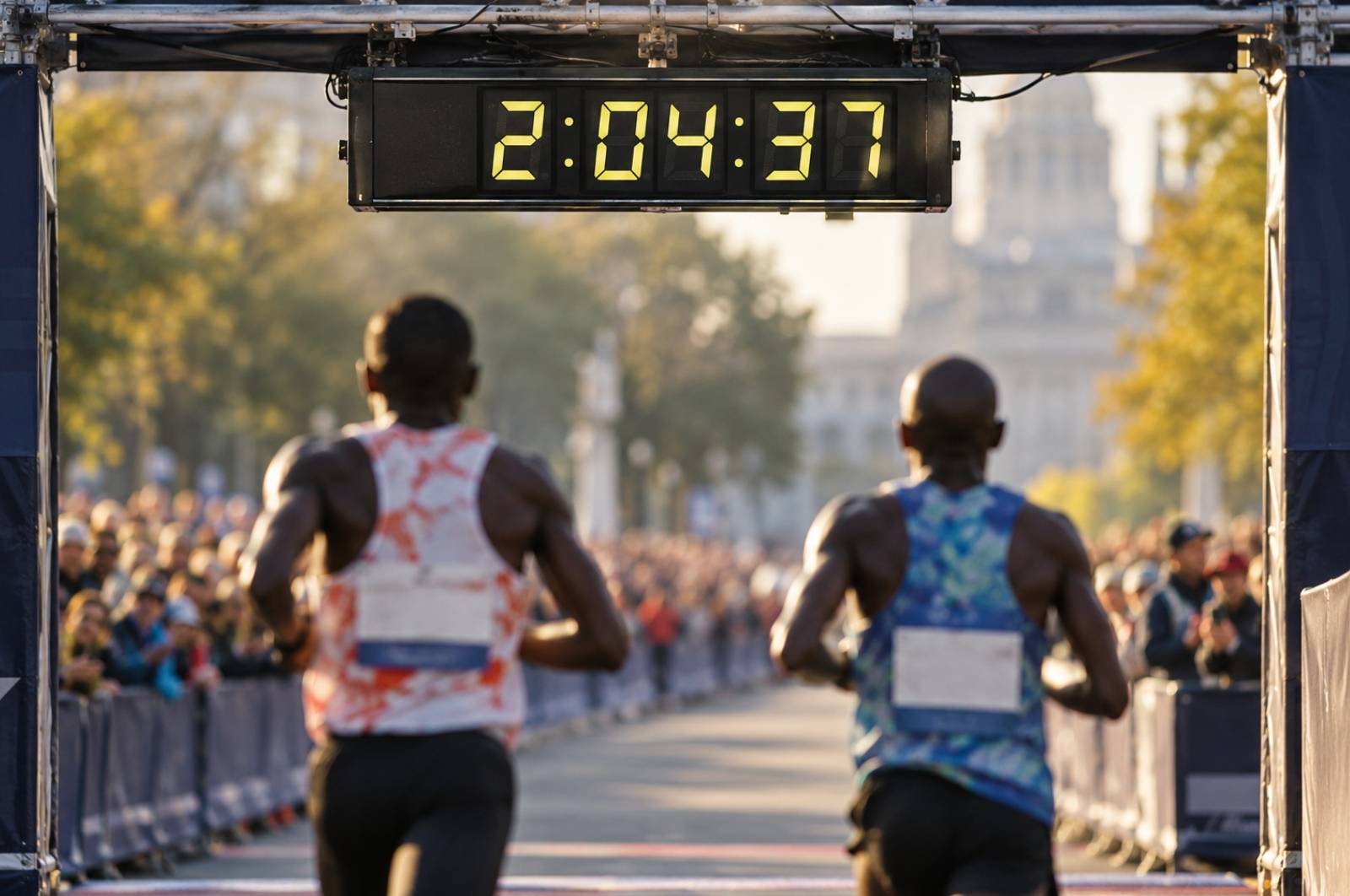
Three men broke the Boston course record. Seven broke Sydney's. Two men beat two hours in London. Here is what the data on marathon course record clusters actually shows.
On April 20, John Korir won the Boston Marathon in 2:01:52.
Two men behind him also broke the previous Boston course record on the same day.
A week later, Sabastian Sawe ran 1:59:30 at the London Marathon, becoming the first person to complete a sanctioned marathon in under two hours.
Yomif Kejelcha finished second in 1:59:41. Two men, one race, under the old world record.
On Sunday in Sydney, seven men broke the previous course record inside a single race.
Marathon course records no longer fall in isolation. They fall in packs.
The First Mechanism: Drafting Is A Bigger Advantage Than Anyone Realised
A 2022 study on the metabolic cost of aerodynamic drag, published in the Journal of Applied Physiology, measured what horizontal impeding forces actually cost an elite marathoner.
The findings were blunt.
Gross metabolic power increased by 6.13 percent for every 1 percent of body weight of horizontal impeding force.
For a 52 kg elite at two-hour marathon pace, aerodynamic drag accounts for about 7.8 percent of their total metabolic cost.
Which means optimal drafting can save between 3 minutes 42 seconds and 5 minutes 29 seconds over 42.195 kilometres.
The 2026 Update That Sealed The Case
In April 2026, a Heriot-Watt University research group led by Prof. Bert Blocken published a wind-tunnel and CFD study modelling groups of up to 45 runners.
Their results showed that a well-organised pack could produce time savings of up to 30 to 40 seconds from formation alone.
Three days after the research was first made public, Sawe broke the world record in London by drafting for most of the race.
The Heriot-Watt team documented the correlation directly.
The Third Mechanism: Race Design Now Optimises For Records
Modern Major fields are recruited with a specific pace target in mind.
Pacemakers, drink stations, split callouts and pack composition are set up to give the front group the best possible shot at a fast time.
Sydney recruited a course-record-hunting field for 2026. It got seven men under the previous record.
Why The Cluster Pattern Is Not Random
Cluster records are the mathematical consequence of a field running the same drafted, shod, pace-controlled race together.
The lead pack shares roughly the same aerodynamic advantage. The same shoe economy, and the same pace targeting.
When one man breaks the target, the pack behind him is already three minutes into their own time budget.
They arrive at the finish clock in a cluster because they left the pace line as a cluster.
The Chicago 2024 Precedent
The pattern is not new to 2026.
Kelvin Kiptum's 2:00:35 at Chicago in October 2023 was followed a year later by Ruth Chepngetich's 2:09:56 women's world record on the same course.
Both wins were pack-supported. Both were shod in current-generation carbon-plated shoes.
Chepngetich's time was later invalidated after a three-year doping ban.
Kiptum's stood until Sawe broke it in London this April.
What This Means For Recreational Runners
The mechanisms behind cluster records are not just elite phenomena.
The Heriot-Watt team explicitly noted that recreational runners benefit from staying in packs longer and running single file rather than side by side.
Depending on positioning, drafting behind just one other runner saves 20 to 30 seconds over a marathon for a recreational time.
Which, on a 4:15 marathon, is enough to move a runner from just under a target time to comfortably under it.
The Practical Rule
Tuck in when you can, and hold formation as long as the pace stays honest.
The gain is small per kilometre and large across a full marathon. Sydney's lead group demonstrated it at 2:04 pace on Sunday.
The Question Nobody Wants To Ask
If seven men can break a Major course record in a single race, is the record still doing the job records are meant to do?
Course records used to signify a rare individual achievement.
In 2026 they now, at some events, signal that the field showed up in current-generation shoes and worked together.
World Athletics has already tightened rules on human world record ratification. Sawe's London 1:59:30 required extra doping-control transparency before it was ratified.
Course records are not held to the same standard.
Which is why, in a year where cluster records are becoming the norm, the meaningful individual statistic is no longer the winning time. It is the gap between the winning time and third place.