The Training Change Every Woman Runner Over 45 Is Getting Wrong
A 2025 clinical study of women in perimenopause and postmenopause found a training change that outperformed extra mileage. Most running plans still miss it.

Stress fractures affect up to 20% of distance runners. Here are the warning signs, the RED-S connection, and the bone-health protocol every runner over 35 should know.
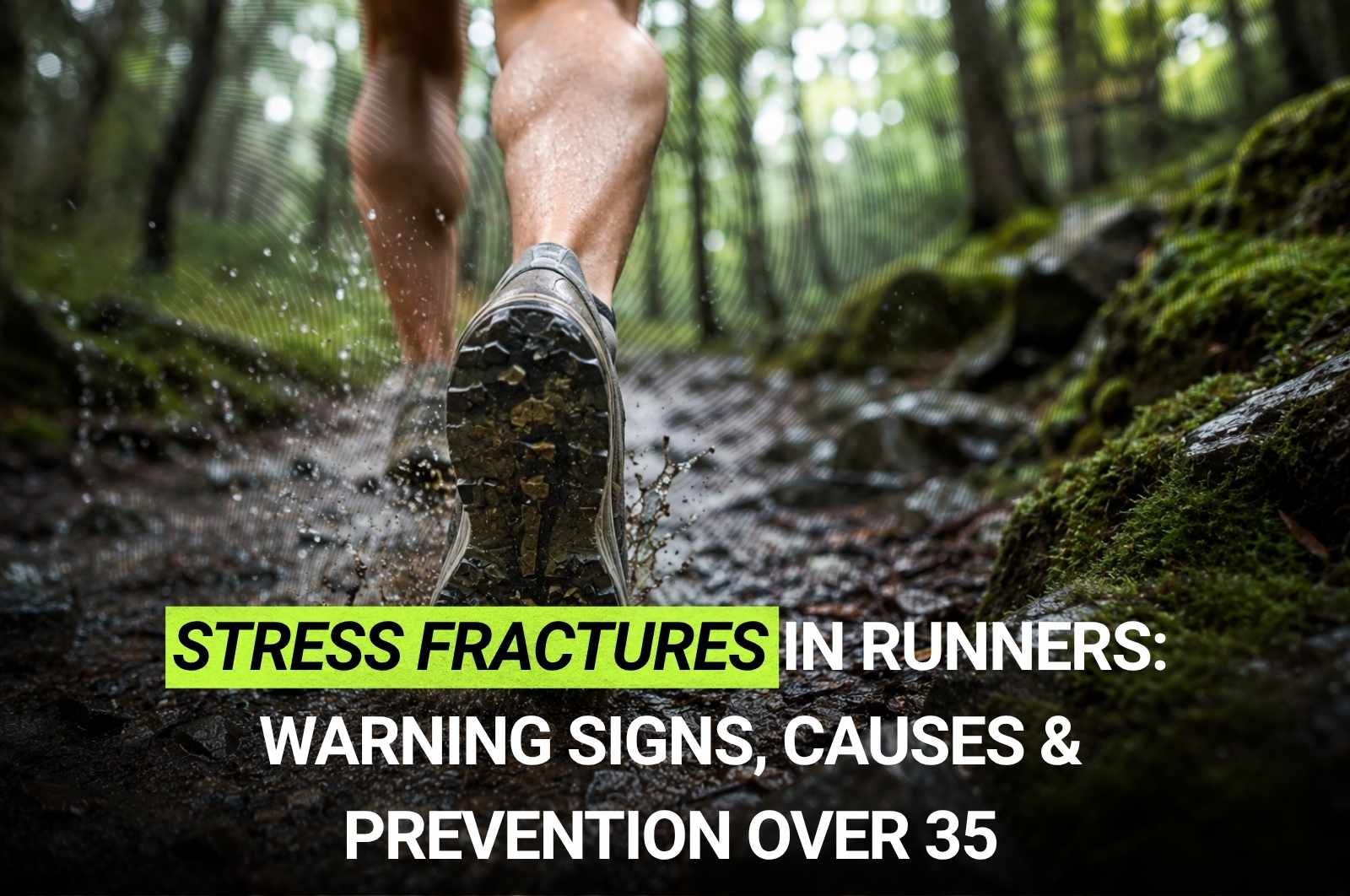
A stress fracture almost never arrives out of nowhere.
It gives warning signs for weeks, sometimes months, before it finally sidelines a runner for two months of no impact.
The problem is that most runners over 35 miss those warning signs entirely.
And the second problem is that even when a runner does show up in a doctor’s office, standard X-rays miss most early stress fractures.
Only MRI reliably picks them up, with a sensitivity above 95%. It sits alongside the six most common running injuries as one of the injuries doctors most often catch too late.
Stress fractures affect up to 20% of distance runners at some point in their careers, according to sports medicine reviews.
That number rises sharply after 35, and rises again after menopause for women.
According to the Cleveland Clinic’s clinical overview, stress fractures are overuse injuries that develop when physical activity puts more load on a bone than it has time to recover from.
They start as bone bruises and eventually become small hairline cracks.
The physics are simple. Running loads the tibia, the metatarsals, the femoral neck, and the fibula with forces that far exceed body weight.
Bone is a living tissue that constantly rebuilds itself in response to stress.
When the training load outpaces the rebuild rate, the deficit shows up as a crack.
About two-thirds of runner stress fractures occur in the tibia (the shinbone) and the metatarsals (the long bones in the foot).
The femoral neck, the fibula, and the navicular are the next most common sites.
Femoral neck fractures are the ones to worry about.
They are rarer, but if missed they can require surgery and end running for good.

This is the single most important sign.
A bone stress injury in its earliest phase hurts only late in a hard session, and only mildly.
Over the following weeks, the pain begins earlier and earlier in the run.
Then it starts appearing on easy days, and eventually hurts even when walking.
Any runner over 35 who notices this migration should stop running and see a sports medicine physician.
That pattern is a stress reaction moving toward a full fracture.
Stress fractures are almost always local. If a runner can press one finger onto a specific point of the tibia, the metatarsal, or the shin, and reproduce the pain reliably, the odds of a bone stress injury are high.
Diffuse leg pain is more often shin splints or a soft-tissue issue.
Point tenderness is bone.
Bone pain that wakes a runner in the night, or that is present at rest, is a serious sign.
Soft tissue injuries generally settle when the runner is off their feet.
Bone stress injuries do not. Rest pain is the point at which the runner must stop running immediately.
Peak bone mass is reached by the late 20s.
From about 35 onwards, both men and women begin to lose bone mineral density gradually, and the rate accelerates for women through the perimenopausal window.
Runners with historically low body weight, a history of amenorrhea, or a family history of osteoporosis are at particular risk.
The DEXA scan is the gold-standard test, and any runner over 35 with a stress fracture history should be asking for one.
Relative Energy Deficiency in Sport, or RED-S, is now considered the single largest driver of bone stress injuries in runners.
Research indexed in a 2026 cross-sectional PMC study on Czech female endurance athletes confirmed that low energy availability is prevalent in this population and directly linked to compromised bone and hormonal profiles.
The trap is subtle. RED-S does not require an eating disorder.
It can happen to any runner who is training hard and eating slightly less than they need, day after day, for months.
The bones are the first system to break.
Vitamin D deficiency, low calcium intake, and (less commonly) vitamin K deficiency are all documented risk factors.
Vitamin D in particular is worth checking with a simple blood test.
Low vitamin D delays healing and raises the risk of a second stress fracture within the same year. It is one of the most correctable variables in the entire injury picture.
A basic screen for a runner over 35 with a stress fracture history should include a DEXA scan, a vitamin D blood test, a full iron panel, and, for women, a check on menstrual cycle regularity.
None of these tests are exotic. All can be requested through a GP, though a sports medicine physician will interpret them more accurately.
Under-fuelling is the single most correctable driver of stress fracture risk.
Track intake for a week, honestly, and compare it to expenditure.
Most runners in the risk group are eating 300 to 600 calories a day less than they need without realising it.
That gap is enough to compromise bone rebuild over a training cycle.
Bones respond to impact and to heavy loading.
Running provides some of that stimulus, but it is not enough on its own.
Two sessions of heavy strength training per week, including barbell squats and deadlifts, delivers the loading pattern that builds bone density.
This is now part of the recovery framework covered in our guide to returning to running after an injury.
A confirmed stress fracture typically requires six to eight weeks of no running, and sometimes 12.
The temptation to test the leg early is what turns a six-week injury into a six-month one.
Return-to-run protocols should be walk-run based and gradual.
Rushing this stage produces the second fracture, which is often worse than the first.

Discover the authentic training methods of Kenyan runners and start improving your running faster than you ever thought possible.
Learn More About The Method →Limited-time reader discount available
Stress fractures are almost entirely preventable, and almost entirely predictable.
The runner’s job is to recognise the warning signs early, to fix the fuelling gap, and to protect bone health with strength work and micronutrient checks.
The doctor’s job is to order the right imaging (usually MRI, not X-ray) and the right blood work.
The runner and the doctor working together is the single strongest defence against a fracture that could otherwise sideline a season.
Start your running journey today!
No spam. Cancel anytime.