
A King's College London Researcher Found 15 Minutes of Running Is All Your Brain Needs
A researcher who tracked 37,000 people found that just 15 minutes and 9 seconds of movement lifts mood. The science of why running works on the brain.

The Sydney Marathon has more climbing than any other Abbott World Marathon Major. Here is the elevation data, the three climbs that decide it, and how to train.
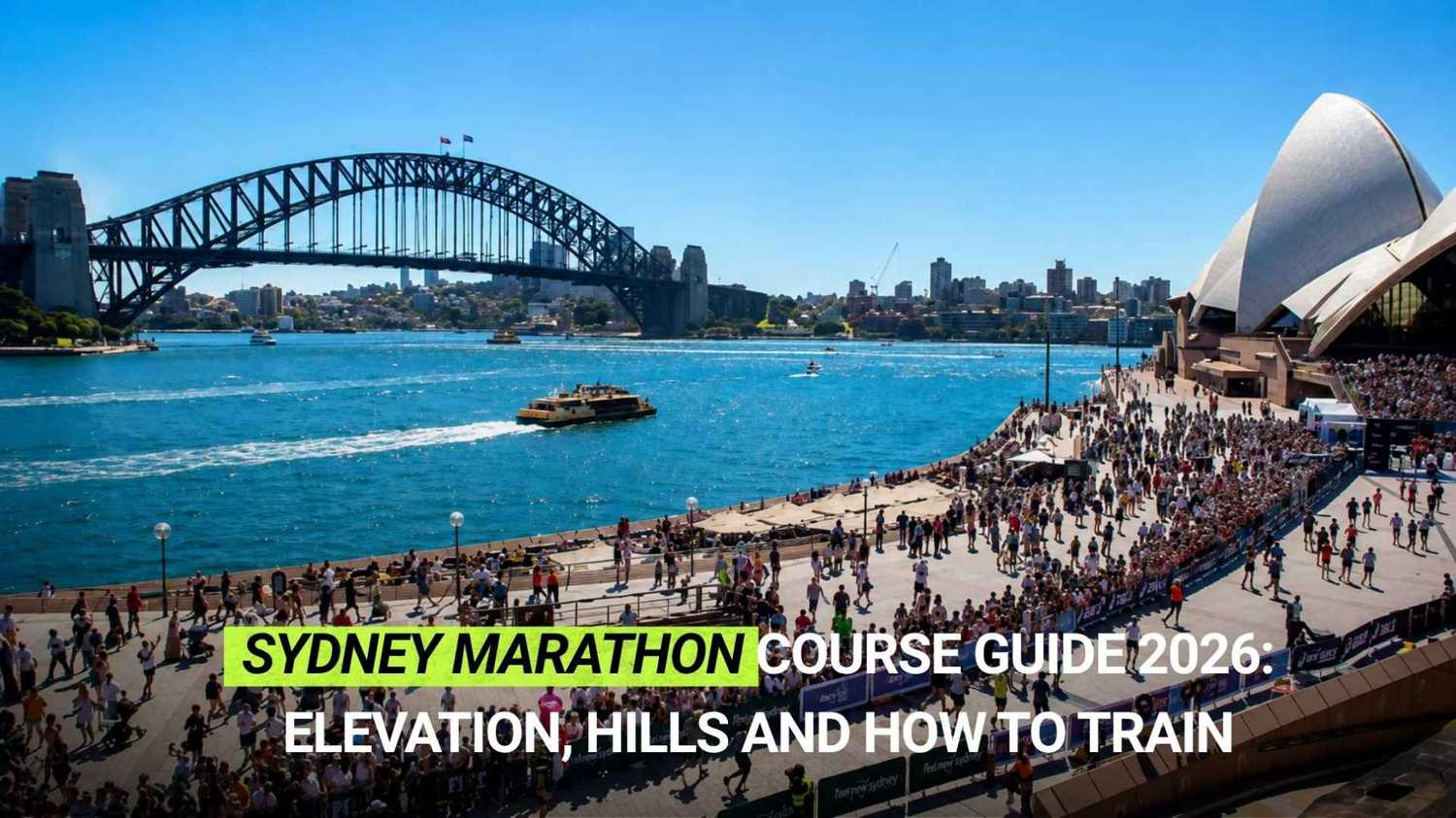
The TCS Sydney Marathon runs on August 30, and it carries a reputation that is not marketing.
It is the hilliest race in the Abbott World Marathon Majors series.
The number that settles the argument is 313 metres of cumulative elevation gain.
That total exceeds every other Major, including Boston and New York.
Sydney also has 396 metres of elevation loss, which produces a net drop of 83 metres from start to finish.
That net figure is the most misleading statistic in road racing.
A net downhill course sounds fast. Runners see minus 83 metres and mentally file Sydney alongside a flat, quick race.
What the net figure hides is that gain and loss are two separate physiological costs, and they do not cancel out.
They stack.
Climbing costs you aerobically, raising oxygen demand and heart rate at a given pace.
Descending costs you mechanically, loading the quadriceps eccentrically as they lengthen under load to control each landing.
Downhill running is the classic laboratory model for exercise-induced muscle damage. Researchers use it precisely because it reliably breaks muscle down.
Eccentric contractions generate higher force than concentric ones at the same muscle activation, which places greater mechanical stress on fibres and connective tissue.
That produces microtears, inflammation, and the strength loss you feel as dead legs.
Published research on downhill running documents reduced contractile function, impaired running economy, and elevated damage markers that persist for days afterwards, as detailed in this peer-reviewed study on downhill running and muscle damage.
Now put that in Sydney's order. You take the biggest descent of the day inside the first 3 kilometres, then spend the remaining 39 kilometres asking those same damaged quadriceps to climb 313 metres.
That sequencing is what makes the course hard. Not the raw gradient.
The course has no sustained flat segment longer than a few hundred metres. You are almost always going up or down.
Three sections matter more than the rest.
The Sydney Harbour Bridge crossing arrives early, and it is the single largest descent on the course after a short approach rise. The span runs roughly 500 metres.
It is also fully exposed to harbour wind. Gusts across the bridge deck are common and there is no shelter.
The mistake here is obvious in hindsight. Fresh legs plus a downhill plus adrenaline plus a landmark equals a split far faster than goal pace.
Every second you gain on the bridge is borrowed against the last 10 kilometres. Hold back.
The course tilts upward on Oxford Street at roughly the 15km mark. It is a sustained ascent through one of Sydney's busiest strips.
At 15 kilometres you are still fresh enough to attack it and stupid enough to try. The reward comes fast, because a descent follows.
Run it by effort, not by pace. Let your watch show a slower split and take the time back on the drop.
This is the one that ends races.
The final significant climb rises near Art Gallery Road and Mrs Macquarie's Chair, at gradients reported around 3 percent, when you are 38 kilometres deep.
There is no tactical answer to this climb. There is only whether your quadriceps still work.
After it, the road drops toward the Sydney Opera House forecourt for one of the best finishes in the sport.
Getting there in one piece is the entire assignment.

If your race is on August 30, you cannot build hill strength from scratch now. You can still protect yourself.
Most runners hill-train exclusively uphill. That prepares the aerobic system and completely ignores the eccentric loading that actually wrecks a Sydney race.
Here is the useful part.
A single bout of downhill running produces a repeated bout effect, a protective adaptation that blunts damage from subsequent eccentric exercise.
Research indicates that protection from an initial damaging bout can persist for a meaningful stretch of weeks, which is why one or two controlled downhill sessions well before race day pay off.
The evidence base is summarised in this study on the repeated bout effect in runners.
Practically, that means moderate downhill running at controlled effort, on a gradient you can hold form on, finished at least 10 to 14 days out.
Not the week of the race.
Overstriding on descent increases braking force at every landing. Braking force is exactly the eccentric load you are trying to limit.
Increase your cadence slightly and let your feet land closer to your body.
It feels less efficient and costs your quads far less.
The Mrs Macquarie's Chair climb happens at 38 kilometres.
Training a hill at kilometre 3 of a fresh run does not simulate that at all.
Put a short climb at the very end of one long run. The specificity matters more than the volume, a principle that applies to most of the errors covered in 7 major long run mistakes every runner needs to avoid.
And because a hilly course drains glycogen faster than a flat one, your fuelling plan matters more here than usual. Get the loading right using the ultimate guide to carb loading for runners.
The difficulty has not stopped fast running. Hailemaryam Kiros set the men's course record of 2:06:06 in 2025, the fastest marathon ever run on Australian soil.
Sifan Hassan took the women's record down to 2:18:22 in the same race, cutting more than three minutes off the previous mark.
She was candid afterwards about starting too hard and paying for it in the final five kilometres.
That is the course teaching a reigning Olympic champion the same lesson it will teach you.
Restraint early, everything late.
The 2026 field suggests both records are in danger, with 19 men entered who have run faster than 2:06:06.
Discover the authentic training methods of Kenyan runners and start improving your running faster than you ever thought possible.
Learn More About The Method →Limited-time reader discount available
Sydney is not a personal best course for most runners, and pretending otherwise sets you up badly.
It is a course where a smart, conservative first 10 kilometres buys you a finish at the Opera House with your legs intact.
Full course and timing detail is published on the official TCS Sydney Marathon race page.
Race it by effort and let the bridge go. Save something for kilometre 38.
Start your running journey today!
No spam. Cancel anytime.