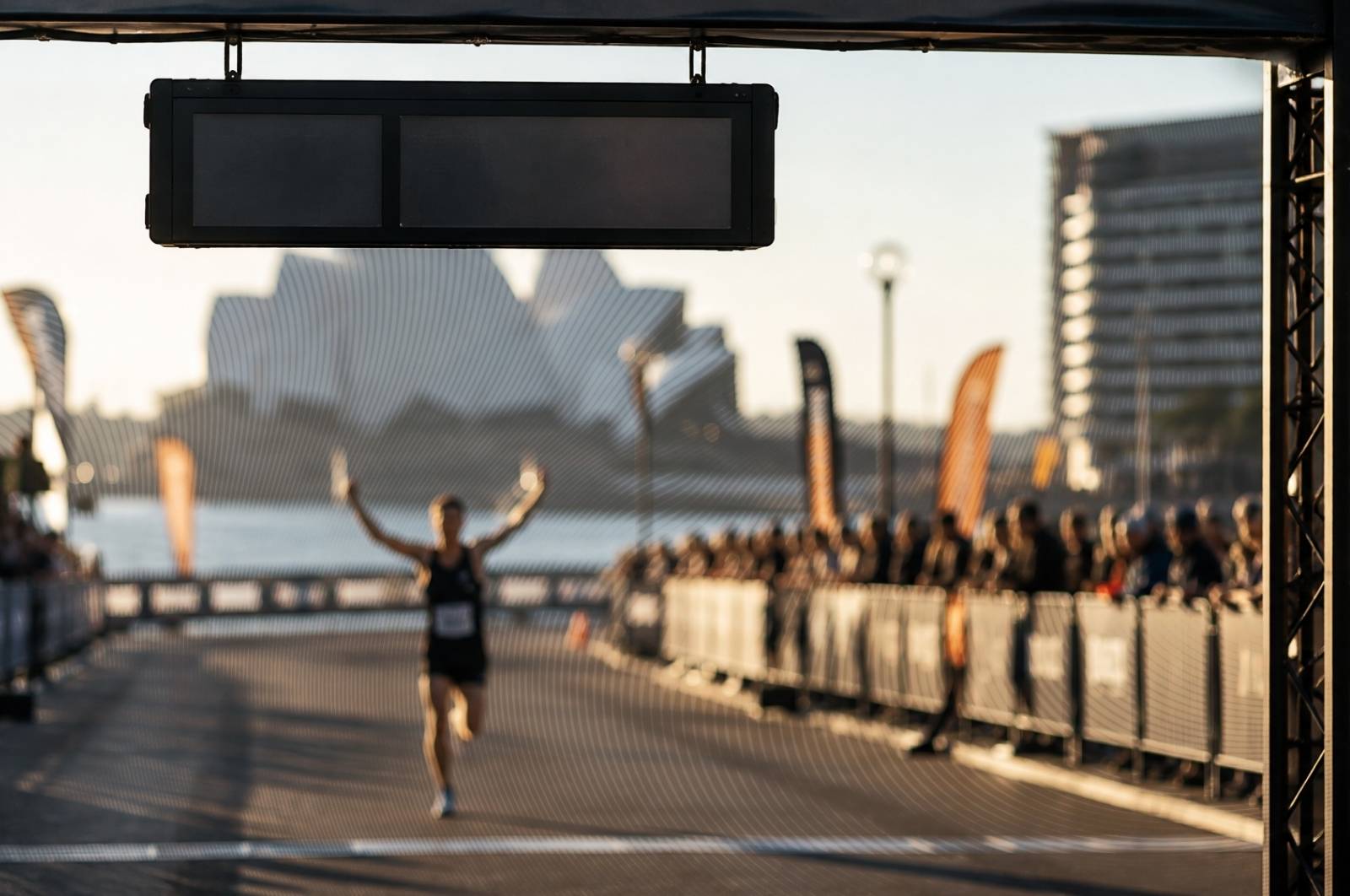
Nineteen men entered for the 2026 TCS Sydney Marathon have run faster than the 2:06:06 course record. Here is the field, the names, and what the numbers mean.
The course record for the TCS Sydney Marathon is 2:06:06, set by Ethiopia's Hailemaryam Kiros in 2025.
It is the fastest marathon ever run on Australian soil.
Nineteen men entered for the 2026 race on August 30 have already run faster than that. Not close to it, faster.
That single statistic tells you everything about how quickly Sydney's status has changed since it joined the Abbott World Marathon Majors.
The Depth, Tier by Tier
Race organisers published the field breakdown, and the numbers escalate in a way that is genuinely unusual for a Major outside the traditional big four.
25 men hold personal bests under 2:10:00
19 men have run faster than the existing course record of 2:06:06
14 men have gone under 2:05:00
5 men have broken 2:04:00
3 men have broken 2:03:00
For context, a 2:06:06 winning time would have been a course record in Sydney every year until 2025. In 2026 it might not make the podium.
The Fastest Man in the Field
Sisay Lemma of Ethiopia arrives with a personal best of 2:01:48, the quickest mark on the entry list.
He is a former champion at both Boston and London.
Lemma's racing signature is aggression. He has a history of taking races out hard and daring the field to come with him, which on a course like Sydney is a fascinating gamble.
The early Harbour Bridge descent rewards exactly that instinct.
The climb at 38 kilometres punishes it.
The Reigning World Champion
Alphonce Simbu of Tanzania leads the billing, and his story is the one worth telling.
At the 2025 World Athletics Championships in Tokyo, he became the first Tanzanian athlete in history to win a world title in athletics.
That is not a marathon record, it is a national first across the entire sport.
He owns a personal best of 2:02:47 and arrives in the form of his career, having finished second at the Boston Marathon in both 2025 and 2026. Back-to-back runner-up finishes at Boston is a punishing way to prove you belong.
Sydney is his debut on the course.
The Debutant Everyone Is Watching
The most intriguing name on the list has never run a marathon.
Hagos Gebrhiwet of Ethiopia is the second-fastest 5,000m runner in history and an Olympic medallist over the distance.
He is also the fourth-fastest half-marathoner of all time, with a personal best of 57:41.
Athletes with that profile are the sport's great unknown.
Raw speed over 5,000m does not automatically transfer to 42.195 kilometres, and the marathon has humbled faster track runners than him.
But a 57:41 half suggests the endurance is already there.
If Gebrhiwet converts, Sydney could witness one of the fastest debuts in recent memory.
Choosing the hilliest Major for that debut is either supremely confident or a serious tactical error. There is no third option.
The Entire 2025 Podium Is Back
Defending champion Hailemaryam Kiros returns to protect the record he set.
He is joined by Addisu Gobena, who was second in 2:06:16, and Tebello Ramakongoana of Lesotho, third in 2:06:47.
Ramakongoana is the one who has changed most.
He arrives having set a new personal best of 2:04:18 at Boston earlier this year, more than two and a half minutes faster than his 2025 Sydney run.
Also confirmed are Timothy Kiplagat of Kenya, who ran 2:02:55 at the 2024 Tokyo Marathon, and Vincent Ngetich, who has podiumed at an Abbott World Marathon Major in three consecutive years.
Why Depth Matters More Than a Single Star
A course record usually falls because conditions align and one athlete has an exceptional day.
Depth changes the mechanism entirely.
With this many capable runners, a large lead group can share pacing duty deep into the race.
Nobody has to burn themselves out front alone.
That dynamic is how fast times happen, and it is the same reason negative split racing works so effectively when the pack cooperates, a tactic broken down in how to run negative splits for race day success.
The Case Against the Record Falling
There is a real argument on the other side, and it is the course itself.
Sydney carries roughly 313 metres of elevation gain, more than any other Major.
The final significant climb arrives around 38 to 40 kilometres.
Records tend to fall on flat, wind-sheltered, loop-style courses.
Sydney is none of those things.
There is also the tactical reality. When a field is this deep, races often turn tactical rather than fast, because winning a Major matters more to an athlete's career than a course record does.
Kiros ran 2:06:06 last year in a race that broke open only after the pacemakers left at 30 kilometres.
A similar pattern in 2026 could produce a thrilling finish and a slow-ish time.
The Number to Watch
Halfway. In 2025 the men's lead group reached the halfway point in 1:03:45, which projects to roughly 2:07:30 without any second-half fade.
If the 2026 lead group comes through halfway meaningfully quicker than that, the record is genuinely live.
If they come through slower, the day belongs to whoever handles the last climb best.
Learn the Training Secrets of Kenyan Runners
Discover the authentic training methods of Kenyan runners and start improving your running faster than you ever thought possible.
Two years ago, Sydney was a well-regarded regional marathon. It is now attracting fields that Berlin and Chicago would recognise.
The race is the sole remaining participant legacy of the Sydney 2000 Olympic Games, and it now draws entrants from more than 117 countries.
Participation has grown from around 5,300 runners in 2022 to a record 35,000 for 2026.
That trajectory is why the elite field looks like this, and it mirrors the way other Majors build their season narratives, as covered in the preview of the Tokyo Marathon 2026 elite field.