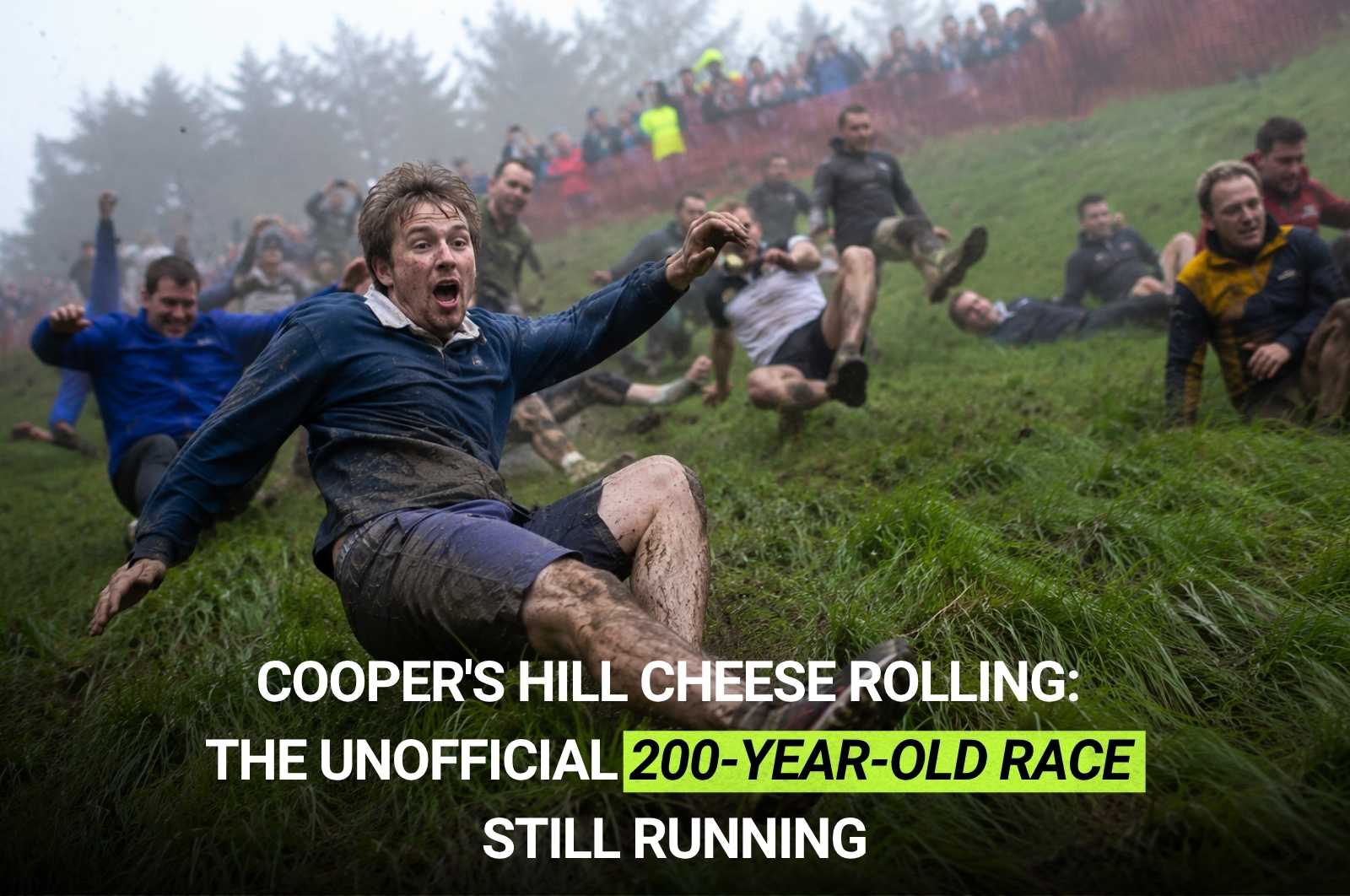
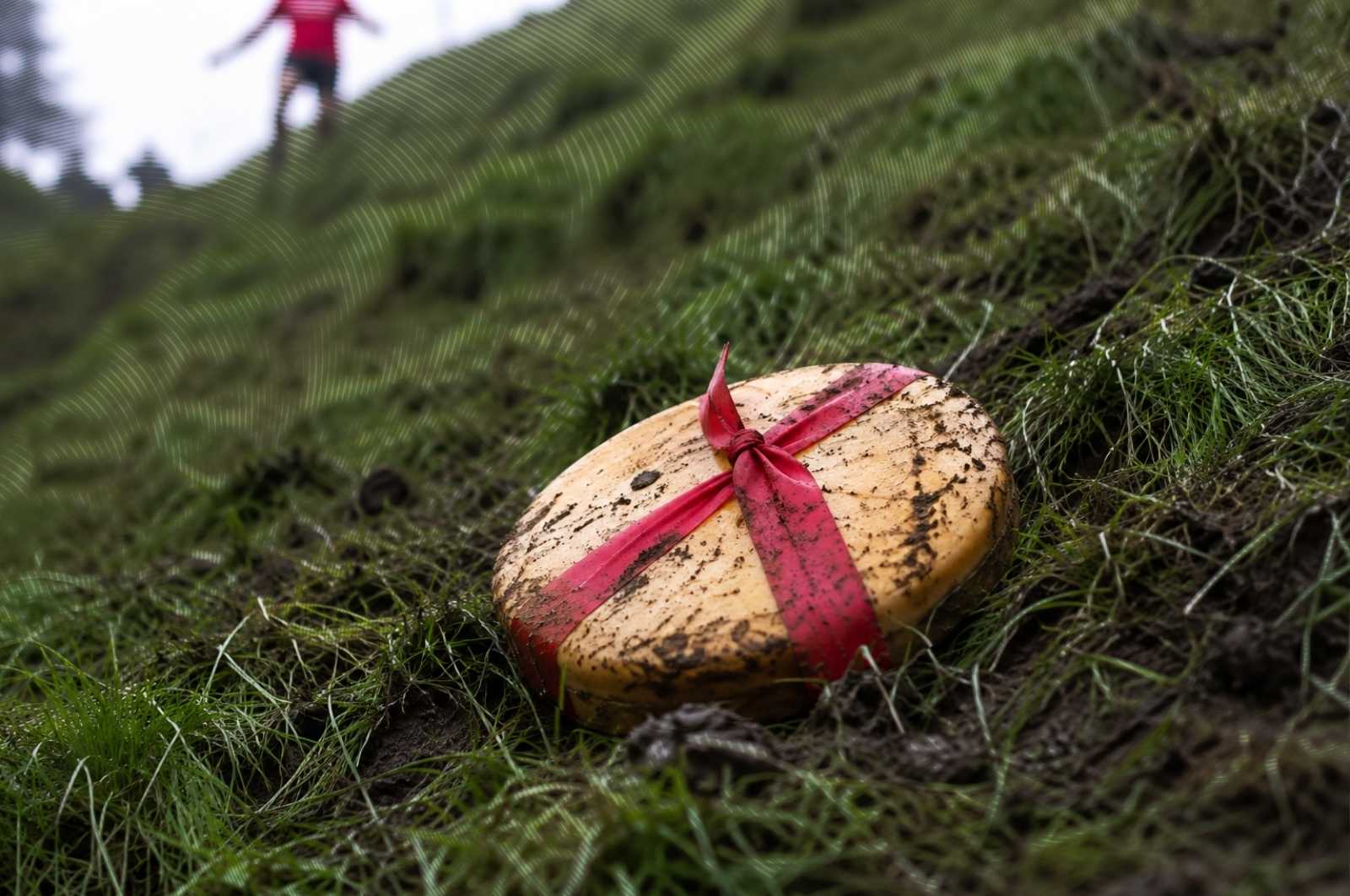
On the last Monday in May, a wheel of Double Gloucester cheese is released from the top of a nearly vertical grass hillside in Brockworth, Gloucestershire. Seconds later, a line of adults throw themselves off the same edge in pursuit.
The cheese wins every year. The first runner to the bottom takes the wheel home.
This is the Cooper’s Hill Cheese-Rolling and Wake, and by any modern standard it should not exist.
There is no organising body, no permit, no insurance, no first-aid contract, and no legal accountability if someone breaks their neck at the bottom.
And yet the race, in some form, has been happening for nearly 200 years, with roots that likely stretch back much further.
A race the authorities have tried and failed to shut down
The first written record of the event is a message sent to the Gloucester Town Crier in 1826.
Even then, according to organisers, the tradition was considered ancient.
The event ran officially until 2010, when insurance and safety concerns forced organisers to cancel it.
In 2013, a police inspector warned the 86-year-old cheesemaker who supplied the wheels that she could be held personally responsible for any injury on the hill. She kept supplying cheese anyway.
It has now been an entirely unofficial event for more than a decade.
Volunteers set up an orange plastic fence, a Master of Ceremonies calls the start, and the crowd sorts itself out.
The rules, such as they are
There are four downhill races on the day.
Three are for men, one is for women, and there are separate uphill races for children and mixed adults.
The rules can be summarised in one sentence. Get to the bottom first, and the cheese is yours.
Participants must be over 18 for the downhill events. Nobody registers or signs a waiver.
You simply arrive at the top of the hill and step forward.
Why the hill itself is the story
Cooper’s Hill is roughly 200 yards long and, at points, functionally vertical.
The cheese wheel accelerates to a speed reported by multiple sources at up to 70 miles per hour before it reaches the flat.
The competitors do not run down the hill so much as fall down it in a controlled way.
Most tumble, several somersault, and a few slide on their backs the whole way.
The injuries reported over the years include broken bones, concussions, and, on one memorable occasion, a competitor being struck by lightning.
There is no confirmed death associated with the event, which locals attribute partly to luck and partly to soft turf.
The 2026 result was a first
On 25 May 2026, the German YouTuber Tom Kopke won the first men’s downhill race, defending his title for the third year in a row.
The children’s uphill was won by 11-year-old William Anderson, son of 23-time champion Chris Anderson.
The 2026 edition set an unexpected record.
It was the first time in the event’s recorded history that every men’s downhill was won by a non-British competitor, with winners from Germany, the Netherlands, and the United States.
How this fits into the broader story of unofficial races
Cooper’s Hill is not the only race in the world that survives outside the modern permitting system.
Around the world, quirky, chaotic, community-run events continue to thrive precisely because they refuse to formalise, as covered in our roundup of America’s most epic and quirky running races.
The pattern is consistent everywhere it appears.
These races exist because a specific community decided they would keep happening, and the local authorities eventually gave up trying to stop them.
They are also the opposite of everything modern race organising has become.
There is no expo, no medal, no merchandise, no timing chip, no photographer selling proofs at the finish, and no charity partner.
The strange economics of not having a prize
The winner takes home a 7 to 9-pound wheel of Double Gloucester.
That is the entire prize.
There is no cash.
There is no trophy.
This is arguably why the event has survived.
Nobody is getting rich, no sponsor is exposed to liability, and no governing body has any leverage to demand changes.
What runners can, and cannot, take from this
The case for chaos
The Cooper’s Hill event is a reminder that racing did not start as a corporate product.
It started as neighbours deciding to compete on a hill, or across a field, or through a town square.
Modern road racing, even at its best, has drifted a long way from that origin.
The event survives because of a specific set of local conditions, generations of institutional memory, and a hill soft enough that tumbling injuries usually heal. None of that transfers.
A runner tempted to organise something similar elsewhere would inherit all of the legal risk without any of the cultural cover.
The authorities cannot easily shut down 200 years of tradition in a single village, but they can absolutely shut down a first-year event on an insurance-free basis.
Watch Cooper’s Hill for what it is, and marvel at it. Consider travelling to see it.
Do not, however, try to build one at home.
The bottom line
The Cooper’s Hill Cheese-Rolling is one of the strangest survivors in modern sport.
It has no permit, no insurance, no formal organisation, and no plans to stop.
It exists because the community decided it should. It continues because nobody with any legal authority has been willing to stand at the top of the hill and tell them no.
The next race is scheduled for 31 May 2027.
Admission is free, and no registration is needed.
All that is required is a strong stomach, a soft skull, and a serious taste for cheese.