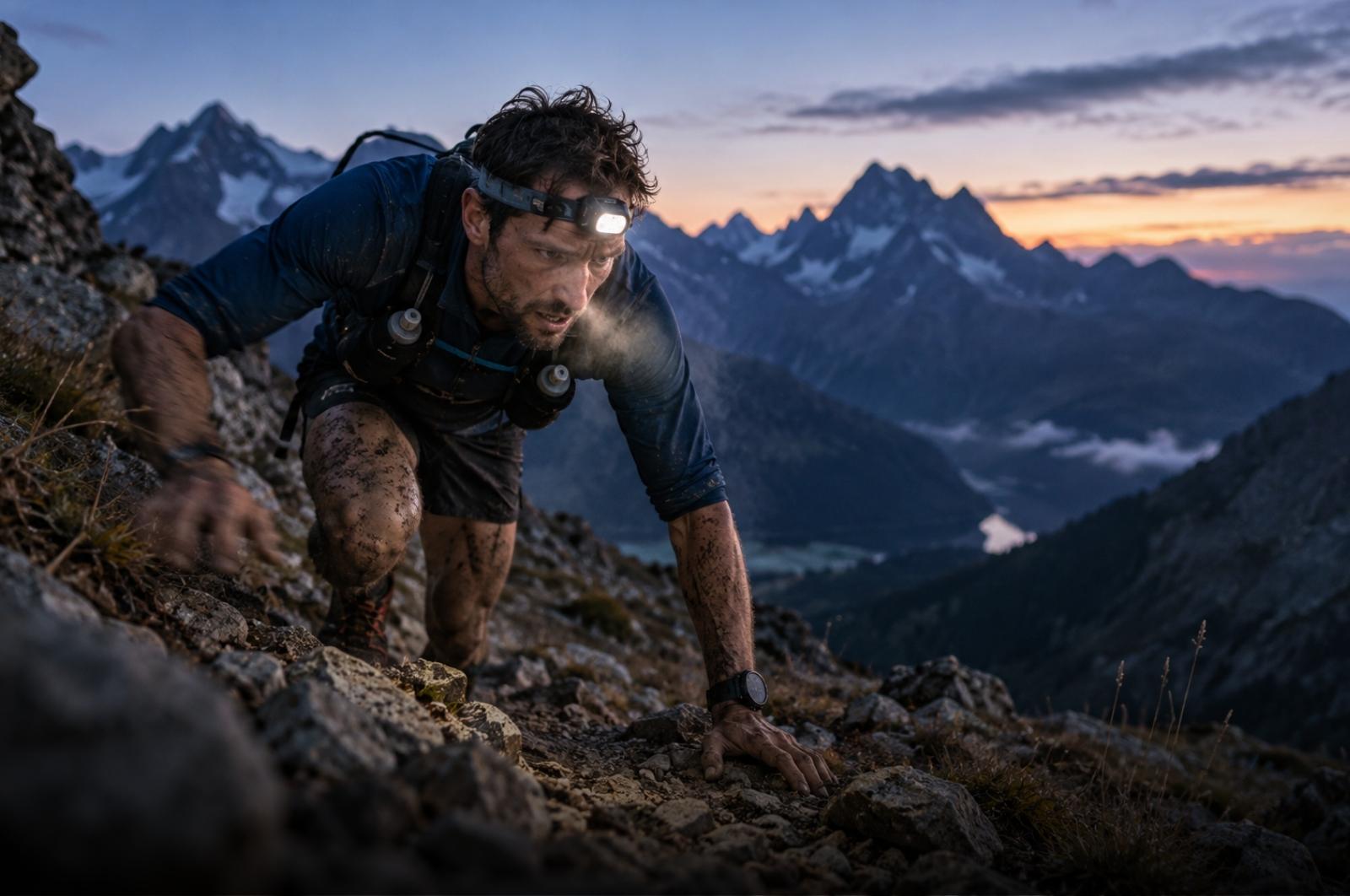
Ben Dhiman fell hard 10km from the UTMB finish and still won. Here is what fatigue biomechanics research reveals about why elite runners fall late in races.
When Ben Dhiman won the 2026 UTMB in 18:16:29, becoming the first man ever to break 19 hours at the race, he did it after falling hard with roughly 10 kilometres to go.
He got up, kept running, and still won by more than 31 minutes.
The fall was not bad luck. It was physics.
Elite runners fall late in long races for the same reasons recreational runners injure themselves on Sunday long runs.
The Actual Data On What Fatigue Does To A Runner
A 2016 study on a 110-kilometre mountain ultramarathon measured neuromuscular fatigue and biomechanics before and after the race.
Runners showed maximum voluntary contraction (MVC) decrements of roughly 35 percent for the knee extensors and 28 percent for the plantar flexors after the race.
That means the muscles that control landing and push-off had lost about a third of their peak force capacity.
Step frequency increased by roughly 2.7 percent as a compensatory response. Ankle range of motion decreased by around 4.1 percent.
The runners were, in effect, shuffling more than running by the end.
Why Their Bodies Chose That Strategy
The change in foot strike was fatigue-dependent, not random.
Runners who started as rearfoot strikers landed less on the heel by the end. Runners who started as forefoot strikers landed flatter.
Both groups converged on a landing pattern that minimised impact shock and muscle stretch.
It was, per the researchers, a protective adjustment.
The Postural Stability Collapse
The other reason elite runners fall late in ultras has nothing to do with muscle force.
It has to do with the sensory system that tells the brain where the body is in space.
A separate study on an 80-kilometre mountain race measured runners' postural stability with a force platform, before and after the race.
The centre-of-pressure length increased by 36 percent in the front-to-back direction and 29 percent in the side-to-side direction after the race.
In plain English: they could no longer stand still without swaying more than a third further than they had that morning.
Now translate that onto a technical descent at 10 kilometres from a UTMB finish, in the dark, on wet rocks. A fall is the expected outcome.
The Signal Recreational Runners Should Actually Take From This
Falls in long races are not a discipline problem or an attention problem.
They are the visible tip of a physiological cascade that begins hours earlier.
Every long training run does a smaller version of the same thing to a recreational body. Muscles lose force, proprioception dulls, landing changes.
What Elites Do About It, In Race
Ben Dhiman fell, got up, and finished.
Elites recover in-race for one specific reason.
Their aerobic base is deep enough that the metabolic cost of the fall itself is negligible against their remaining energy budget.
A recreational runner falling at the same relative point in a race has a much smaller cushion.
Which is why the actionable lesson is not "be more careful late".
It is "train the fatigue-resistance the elites take for granted".
The Two Training Adaptations That Matter Most
The first is single-leg strength work.
Runners who add split squats, step-downs, and single-leg deadlifts to their week show measurable improvements in late-race MVC retention.
The second is deliberate pre-fatigued balance training.
Standing on one leg with eyes closed for 30 seconds after a hard run is uncomfortable and revealing.
It also trains the same proprioceptive system that collapses in a 20-hour race.
The Injury Connection Runners Miss
The most common weekend runner injuries all cluster around the tissues that fatigue-related biomechanical changes overload.
Runner's knee tracks with quadriceps force loss and altered landing. Plantar fasciitis tracks with ankle stiffness and reduced range of motion.
The mechanism that makes an elite fall at kilometre 164 is the mechanism that gives a recreational runner a strained calf at kilometre 26.
The Trail Super-Shoe Complication
A 2025 review on ultramarathon footwear noted that current-generation trail super-shoes degrade under racing conditions.
Their functional properties change during the event itself.
Which means a shoe optimised for kilometre 50 may not be the shoe underfoot at kilometre 150. We covered how this is reshaping ultra results in our piece on
What The Fall Actually Meant For Dhiman
Dhiman told reporters at the finish that the fall did not surprise him.
The surprise was that his body still had another 10 kilometres in it at that pace.
That, more than the winning time or the 45-minute margin, is the training story of his year.
It is also what separates a training block that leads to a UTMB win from one that leads to a DNF at Grand Col Ferret.