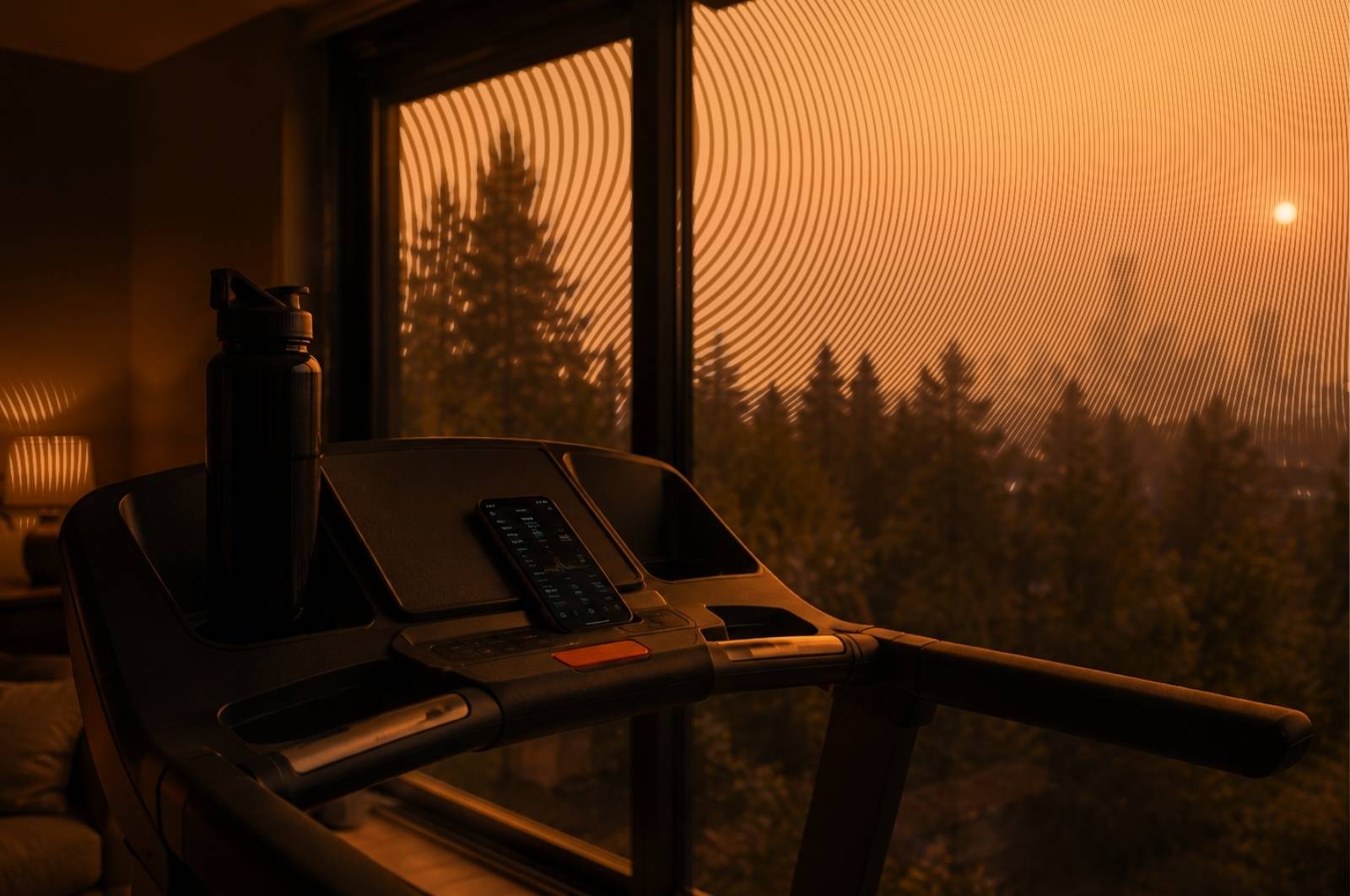
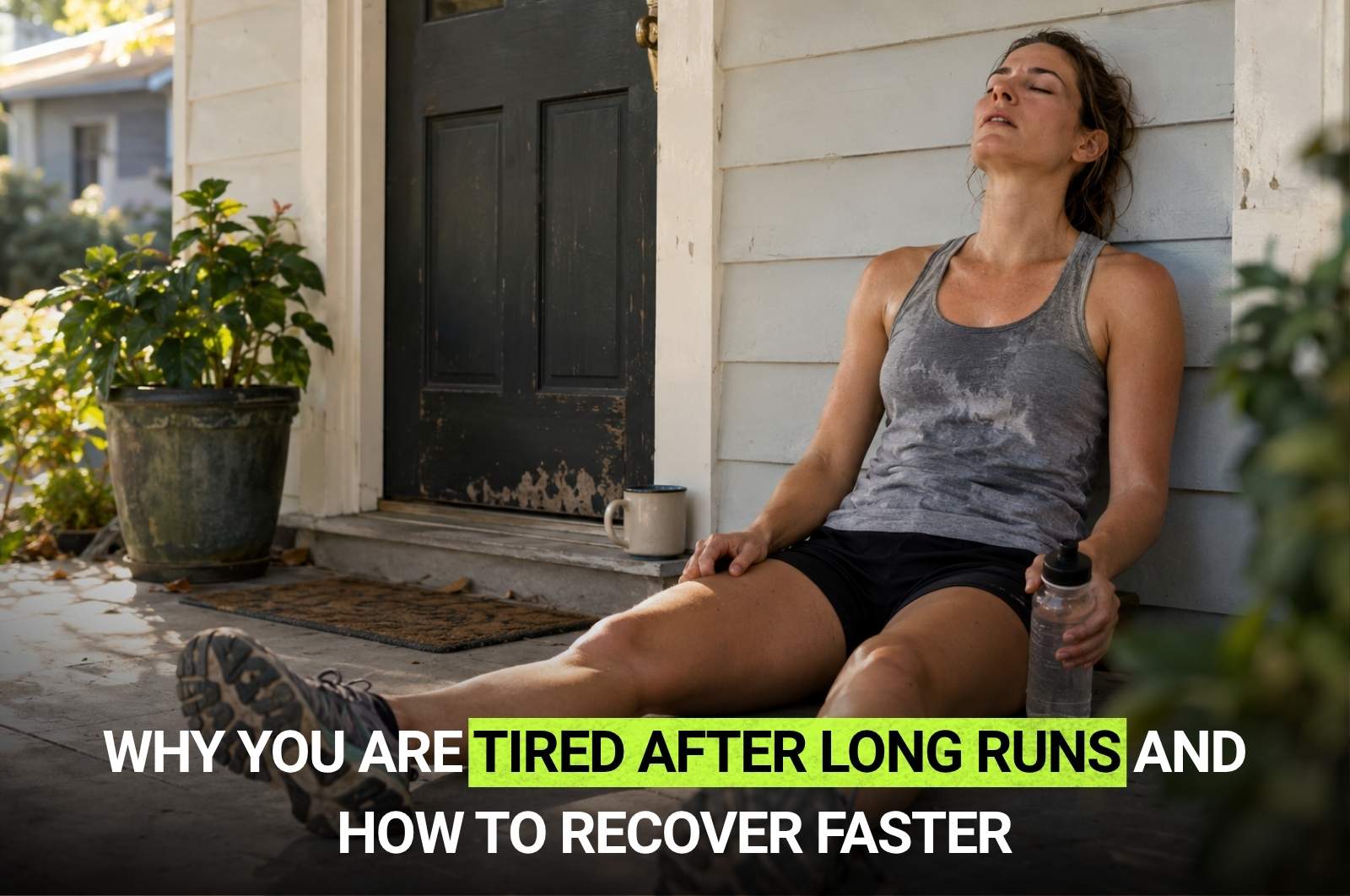
Smoky skies from wildfires push air quality into dangerous territory. Here is the exact AQI number where you should trade the trail for the treadmill.
When the sky turns orange, the honest question is not whether the run is uncomfortable. It is whether it will actually hurt you.
The clean number to keep in your head: once local Air Quality Index (AQI) climbs past 150, the risk-benefit math for outdoor running flips. Take the workout inside.
Between 101 and 150, use judgement, and below 100 you are almost always fine.
Above 200, no outdoor session is worth it, even for elite training blocks.
What wildfire smoke is actually made of
Wildfire smoke is not just haze. It is a dense mixture of fine particulate matter, carbon monoxide, ozone precursors, and irritating gases released as vegetation burns.
The most dangerous fraction is called PM2.5, or particles small enough to travel from your nose deep into the alveoli of your lungs, and from there straight into your bloodstream.
Runners have a specific problem with PM2.5. During hard exercise, ventilation rate can jump from 6 litres per minute at rest to over 100 litres per minute, which is more than ten times the particle dose per breath.
A 30-minute tempo run in unhealthy air can deliver the same PM2.5 exposure as several hours of sedentary breathing.
How to read the AQI like a runner, not a weather app
The Air Quality Index runs from 0 to 500. The scale is coloured to match how bad the air is for you.
AQI 0 to 50 (green): normal training
Air quality is satisfactory. Run whatever your plan calls for.
AQI 51 to 100 (yellow): mostly fine, watch the sensitive
Air is acceptable for the general population. Sensitive groups (asthma, heart conditions, older adults) should watch for symptoms.
For most runners, this is a run-as-planned day.
AQI 101 to 150 (orange): drop the intensity
Sensitive groups will feel it. Everyone else can still run outside, but skip the hard workout.
Trade the tempo for an easy run, and shorten the long run.
Keep breathing through your nose where possible.
AQI 151 to 200 (red): move indoors
This is the take-it-inside threshold. Health effects begin for the general public, not just sensitive groups.
The treadmill wins, cross-training wins, rest wins.
An outdoor easy run is not worth the exposure.
AQI 201 to 300 (purple): no outdoor exercise
Health warnings become severe. Cardiovascular risk climbs for everyone.
Cancel the outdoor run without negotiation. If you have an indoor workout planned, keep windows closed and consider running the HVAC on recirculation.
AQI 301 and above (maroon): stay indoors, no exceptions
This is emergency-level air. Even indoor exercise is questionable if your home does not have good filtration.
Why the treadmill is a legitimate substitute (not a demotion)
Runners talk about treadmills like they are a punishment. On a smoky day, they are a health tool.
Set to a 1 percent incline, a treadmill approximates the metabolic cost of outdoor running well enough that training adaptations transfer almost cleanly.
Making the treadmill day feel like real training
Structure it. Fifteen minutes easy, twenty minutes at tempo effort, ten minutes cool-down beats an aimless 45 minutes staring at a wall.
Use variable inclines to simulate rolling terrain, and add short pickups every five minutes.
Watch something long-form instead of scrolling.
Keep the room cool. Treadmill running is hotter than outdoor running at the same pace because there is no airflow, so a fan and an open interior door go a long way.
If you have to be outside in bad air, what actually helps
Sometimes the run is the run. You are travelling, your gym is closed, life happens.
A well-fitted N95 respirator filters most PM2.5, though breathing through one during exercise is genuinely unpleasant.
A surgical mask or a cotton bandana does almost nothing. The particle size is smaller than the fibre spacing.
If the wind is favourable, run against it toward cleaner air.
Stay closer to home so you can bail, and cut the workout in half.
The recovery reality
A single run in unhealthy air is not going to end your season. Repeated hard sessions in it might.
Symptoms to take seriously: a lingering cough, chest tightness, a sore throat that will not clear, or unusual fatigue for a day or two after training.
If any of those show up, add rest days. Skipping one week of hard training costs almost nothing, and ignoring inflamed airways for a month costs a season.
A useful mental model during smoke weeks: think of your lungs like your Achilles or plantar fascia. Small daily insults you cannot see are still insults.
The best runners are not the ones who train through everything. They are the ones who reach the start line healthy.
When in doubt, treat the treadmill as your friend. The training will still be there when the sky clears.
And keep an eye on your local AQI forecast the night before every planned outdoor session. Two minutes of checking saves days of setback.