The Sudden Grab in Your Calf Mid-Run Is a Warning. Ignoring It Costs You Weeks.
The calf strain that ends a runner’s season starts as a small grab. Here are the real causes, the treatment sequence that works, and what actually prevents a repeat.

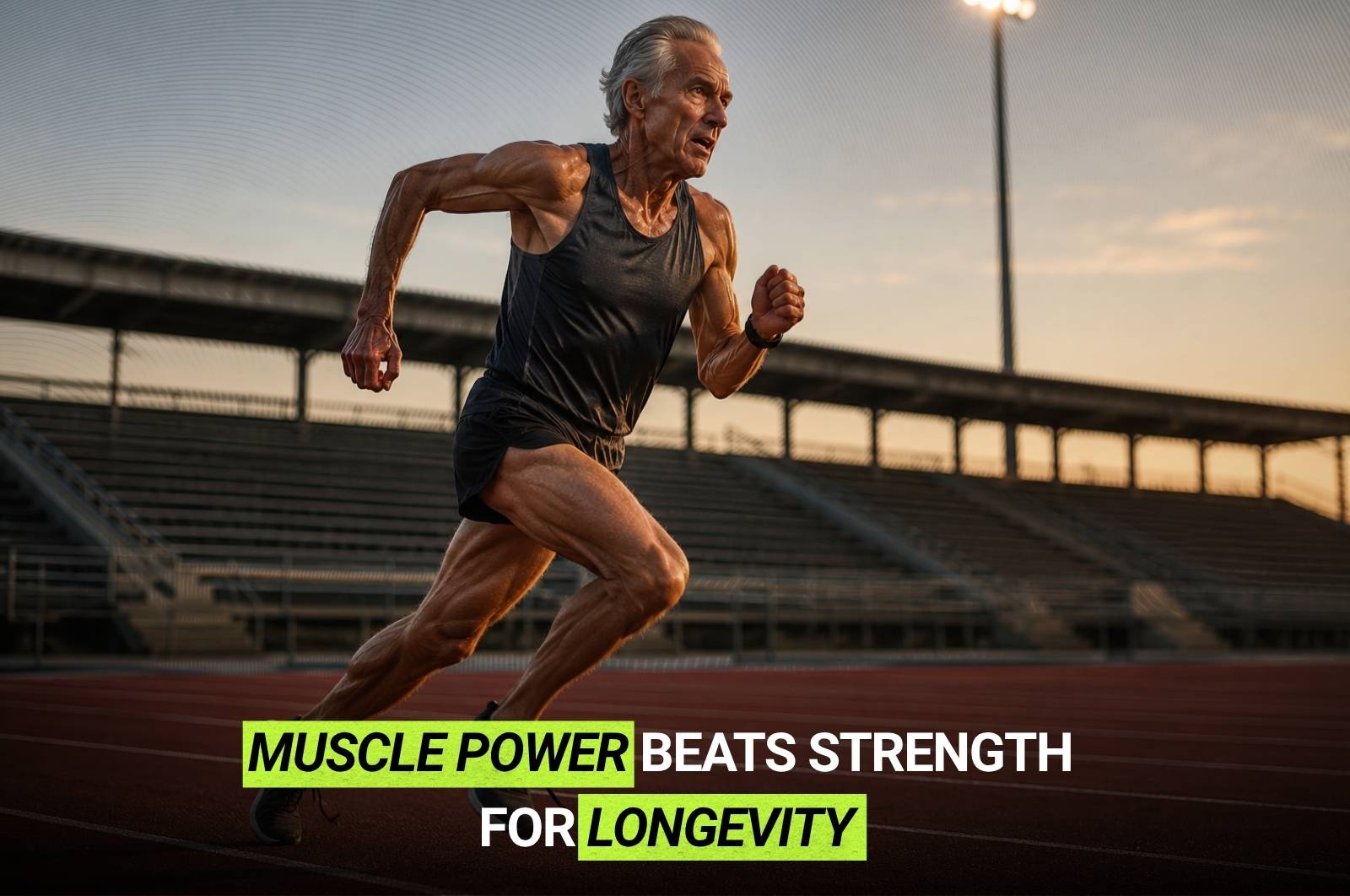
A 2025 Mayo Clinic Proceedings study of 3,889 adults found muscle power predicted mortality far better than muscle strength. It changes what runners should be training.
There is a story runners have been telling themselves for 40 years. More miles equal a longer life.
The 2025 evidence says that is only half the story, and possibly the smaller half.
The other half sits in something almost no distance runner deliberately trains: muscle power.
In August 2025, the Mayo Clinic Proceedings published a prospective cohort analysis of 3,889 adults aged 46 to 75, tracked for a median of nearly 11 years.
The lead author, Dr. Claudio Gil Araújo, and colleagues from the CLINIMEX cohort in Rio de Janeiro asked one very direct question.
Which predicts death better, muscle strength, or muscle power?
For men in the lowest category of relative muscle power, the hazard ratio for all-cause mortality was 5.88 compared with the highest category.
For women, it was 6.90.
When the same analysis was run using muscle strength as the predictor, the hazard ratios collapsed to 1.62 for men and 1.71 for women.
Neither of those strength numbers reached statistical significance after adjusting for age, body composition, and medical history.
The power numbers did, and they did decisively.

Strength is how much force a muscle can produce.
ower is how much force it can produce per unit time.
A powerlifter can bench 200 kilograms slowly.
That is strength.
A runner cutting a sharp turn or catching a stumble on a wet trail generates force in a fraction of a second. That is power.
Both matter. The 2025 data says one of them matters much more for staying alive.
Power is a product of neuromuscular speed and muscle contractile force. Both decline with age.
Speed declines faster. A 60-year-old can often still lift most of what they could at 30, just much more slowly.
That is why so many runners over 50 quietly stop being able to sprint the last 400 metres of a race even when their aerobic base is intact.
The ability to move quickly is what leaves first. It is also what keeps people alive.
The running dose-response literature is unusually clear on this point.
As the American College of Cardiology 2025 longevity review lays out, mortality benefits from running plateau at surprisingly low weekly volume.
The best evidence puts the sweet spot at around 50 minutes per week of easy running, across two to three sessions.
Above that, longevity gains flatten.
Below that, they compound quickly.
Racing performance is a different curve. That one keeps rewarding volume for a long time.
Longevity is not that curve. Longevity rewards a different training stimulus altogether.
That is where power training slots in. A tiny weekly dose does more than an extra 20 kilometres of easy mileage ever will.
The data on running slowing biological aging by nine years is still real.
Adding power training makes it bigger.
Power training is not lifting heavier. It is lifting the same weight, or a lighter one, faster.
Two sessions of 15 to 20 minutes per week is enough to move the needle at this age.
Every rep must be performed at maximum intent. As soon as the speed drops, the set is over.
This is the opposite instinct to what runners bring to training, where the goal is usually to grind out one more rep.
Power training is short, sharp, and finishes before it should. Rest between sets is not optional.
The correct feeling at the end of a power session is fresh, alert, and slightly faster.
A typical runner over 50 currently trains VO2 max, endurance, and occasionally a general-purpose strength routine.
The gap in that picture is glaring, once the 2025 hazard ratios are on the table. There is no power stimulus.
VO2 max is still one of the strongest predictors of healthy aging, as detailed in this full VO2 max primer.
It is also, per recent analysis, a better health indicator than BMI. Power sits alongside it, not in place of it.
Elite masters runners do not usually train power on purpose. They get it as a side effect of racing.
A well-executed 5K finishing kick is a power expression. So are hill repeats and short strides.
That is one reason Jeannie Rice at 77 keeps outrunning her age group by miles, and why running counteracts several distinct effects of aging.
A defensible longevity-focused week for a runner over 45 looks like this.
Three easy runs of 30 to 40 minutes, one hard session (intervals or a tempo), one long run at conversation pace.
Then two short power sessions of 15 to 20 minutes on non-consecutive days. That is the whole prescription.
It is smaller than most training plans, and it lines up cleanly with the 2025 evidence.
Discover the authentic training methods of Kenyan runners and start improving your running faster than you ever thought possible.
Learn More About The Method →Limited-time reader discount available
The accompanying editorial in the same journal put it in one line. Clinicians and coaches should stop asking how much someone can lift, and start asking how fast they can lift it.
For runners, that translates directly. Stop counting miles as the only currency of a long, healthy training life.
Start counting how quickly the body can still generate force. That is the number the 2025 data cares about.
It is also the number that responds fastest to a small, focused training change. Beginners see the largest gains.
The miles will still be there next week. The window to build power stays open, quietly, for a long time.
Start your running journey today!
No spam. Cancel anytime.