
Why Is the Valencia Marathon So Fast and Popular? 7 Reasons Explained
Valencia had nearly 5,500 sub-3 finishers in 2025 and sells out all 36,000 bibs. The seven reasons it is the fastest big marathon on the planet.

Valencia will pay €1 million each for a men's or women's world record on 6 December. Meet the Kenyans who could cash in, and why the women's record matters so much.
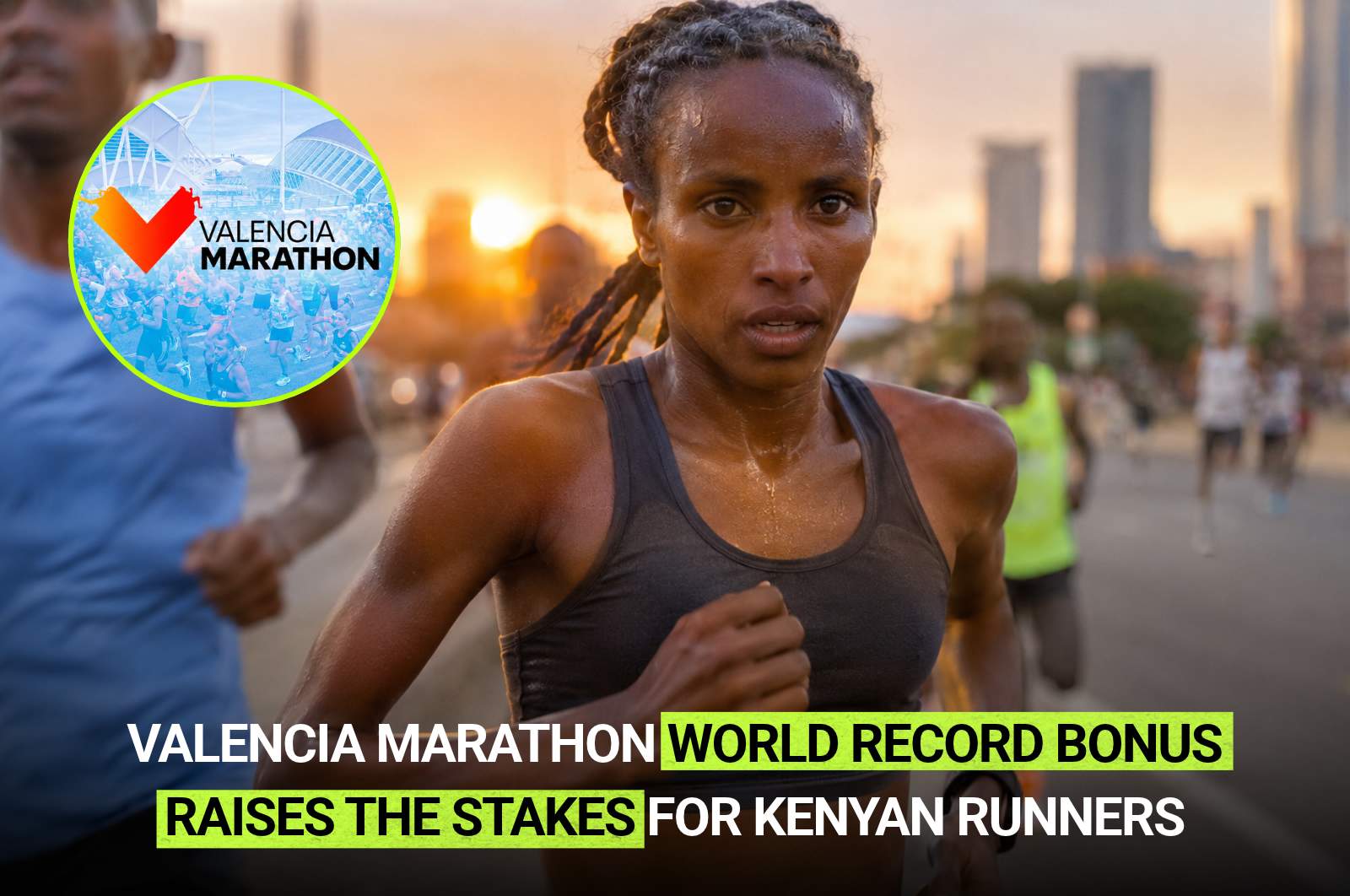
On Sunday 6 December, the Valencia Marathon will pay €1 million to any man who runs faster than 1:59:30 and €1 million to any woman who beats 2:09:56.
Twelve of the leading entries are Kenyan, led by defending champions John Korir and Joyciline Jepkosgei and 10K world record holder Agnes Ngetich on her marathon debut.
Using the rate quoted in Kenyan coverage of last year's race, each bonus is worth roughly Ksh 150 million.
Jepkosgei's win and course record in 2025 earned her about Ksh 15.8 million, so a world record would pay close to ten times that.
The official 2026 regulations list a world record bonus of €1,000,000 for each sex.
A runner who collects it cannot also collect the race-win prize or the €30,000 course record bonus, so the million replaces those payouts rather than stacking on top.
Every prize is subject to anti-doping results, and organisers can reclaim money if a result is later annulled.
The bonus is funded by the Trinidad Alfonso Foundation, backed by Spanish billionaire Juan Roig.
Valencia has offered this bonus before and never had to pay it.
This year, organisers are openly saying the women's record is the target, with elite recruiter Marc Roig telling reporters that Valencia can say that the world record is the goal.
The normal prize ladder is far smaller. Last year, Kenya's Peres Jepchirchir earned €45,000 for finishing second, roughly Ksh 6.7 million.
Even that sum is life-changing for many athletes training in Iten or Eldoret. A world record bonus would dwarf any prize the sport normally pays for a single race.
For the wider history of the race's prize money, see how Valencia set new standards for payouts, prizes and bonuses.
Ngetich already owns Valencia's roads. She set the 10K world record of 28:46 there in January 2024 and ran her half marathon best of 1:03:04 there the same year.
She is also the world cross country champion and the newly crowned world half marathon champion.
After missing the half marathon world record in Valencia by 16 seconds in October 2025, she told World Athletics she knew she had the world record in her legs.
A world record on debut would be extraordinary.
Still, Valencia has launched marathon careers before, including Kelvin Kiptum's 2:01:53 in 2022 and Sabastian Sawe's 2:02:05 in 2024.
Jepkosgei won last year in 2:14:00, a course record and the fastest women's time of 2025, as World Athletics reported. She also set one of her two half marathon world records in Valencia back in 2017.
She opened 2026 with third place in London in 2:15:55.
The world record would need more than four minutes off her best, so a second course record bonus is the more realistic prize.
Korir won last year in 2:02:24 after pacemakers stepped off at 25 kilometres.
He told Kenya's The Star that his prayer is to run sub-two hours, and reports say he has been covering 250 to 270 kilometres a week.
The men's world record would require 2 minutes and 54 seconds off his personal best.
Sawe's 1:59:30 in London this April, the first official sub-two-hour marathon, proved the barrier can fall.
Kenya's depth is the real story.
In the men's race, Alexander Mutiso (2:03:11), Vincent Ngetich (2:03:13) and Geofry Toroitich (2:03:30) all line up, with Toroitich seeking redemption after dropping out of Amsterdam in the cold.
In the women's race, Lilian Kasait (2:19:35) is joined by three more debutants, Winnie Jepkosgei, Gladys Kwamboka and Jesca Chelangat.
Any of them running fast would earn a career-changing pay day and a spot on next year's major start lines.

Ethiopia's Fotyen Tesfay is the biggest threat to Kenya's hopes. She ran 2:10:51 in Barcelona in March, the second-fastest women's marathon ever, and would need two halves of about 1:04:58 to break the record.
The men's field lost its only sub-two runner when Yomif Kejelcha withdrew injured.
Ethiopia's Kenenisa Bekele (2:01:41) and Birhanu Legese (2:02:48) remain, though Bekele is coming back from an Achilles problem that cut short his October half marathon.
The women's world record of 2:09:56 belongs to Kenya's Ruth Chepngetich, set in Chicago in October 2024.
She was banned for three years in 2025, but the record still stands because her positive test came from a sample taken five months after that race.
That leaves Kenya in an awkward position.
Its greatest women's marathon mark is one that parts of the sport now call controversial.
A Kenyan woman breaking it cleanly in Valencia would replace that mark with one the country could celebrate without hesitation.
If Tesfay breaks it instead, the record leaves Kenya altogether, which is why the stakes go well beyond the money.
Kenyan distance running has built its reputation on depth and consistency, as explored in this breakdown of the Kenyan running method.
Valencia gives that system a chance to rewrite a difficult chapter.
The women's record requires an average of about 3:05 per kilometre for the full 42.195 kilometres.
The men's record needs roughly 2:50 per kilometre, more than two minutes faster than Valencia's own course record of 2:01:48.
Everything has to line up, from a windless morning to pacemakers who can hold that rhythm past halfway.
Even then, nobody collects a cent until the anti-doping results clear.
The race starts at 8:15 local time.
By around 10:25, Valencia will know whether it has finally paid out its million, and whether Kenya has a new record to be proud of.
Start your running journey today!
No spam. Cancel anytime.


