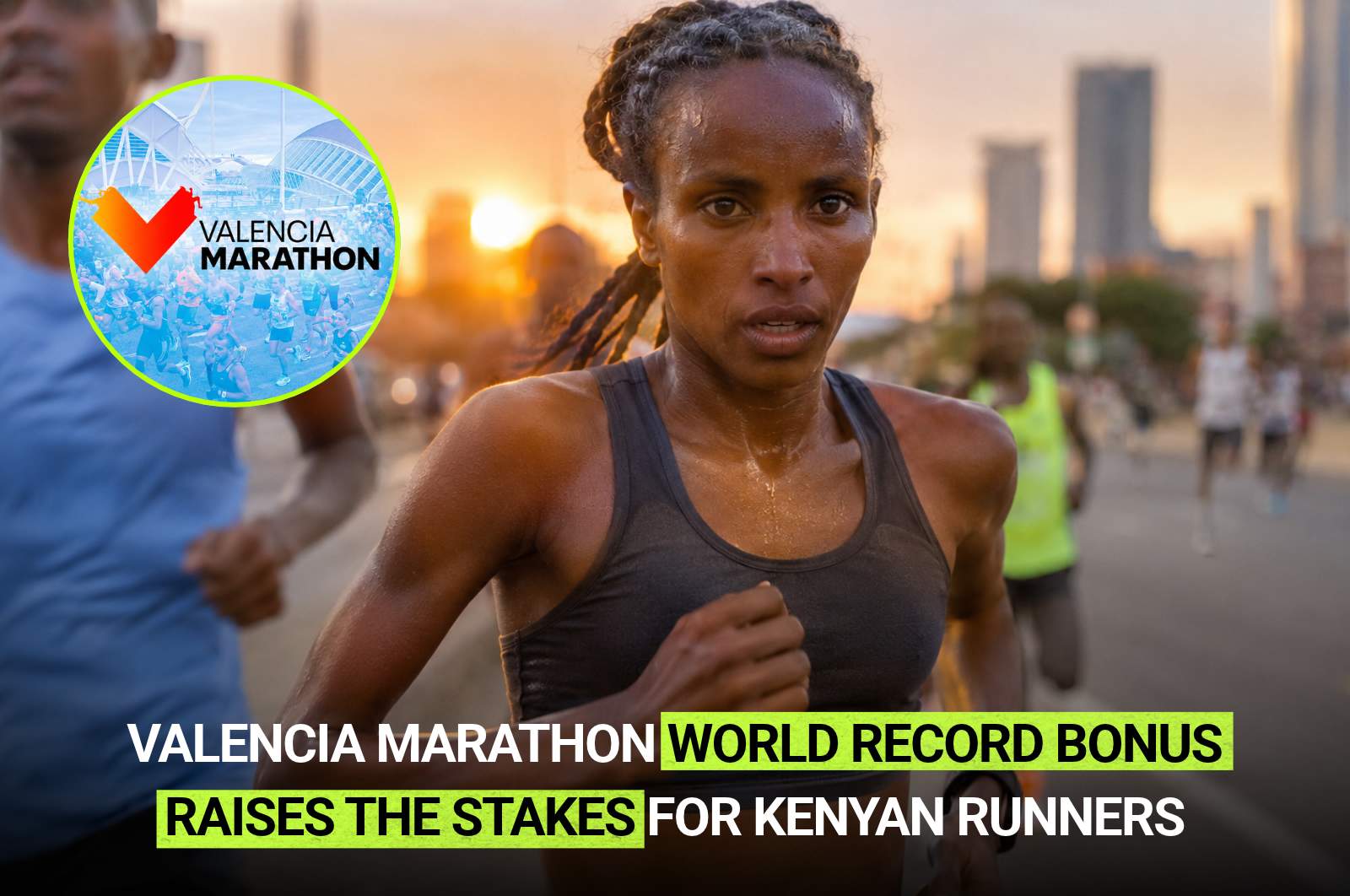
Valencia had nearly 5,500 sub-3 finishers in 2025 and sells out all 36,000 bibs. The seven reasons it is the fastest big marathon on the planet.
Last December, nearly 5,500 runners finished the Valencia Marathon in under three hours.
hat was roughly one in every five finishers, and Canadian Running reported it was a record for the second year in a row.
The flat course and cool December air explain part of it.
The rest comes down to how Valencia pays its elites, how it seeds its waves and where it sits on the calendar, which is exactly why 36,000 bibs now sell out every year.
The Numbers That Made Valencia Famous
A finish time of 2:59:59 would have placed about 5,450th in Valencia in 2025.
The same time would have landed around 4,400th at Boston, a race that demands a qualifying time just to get in.
The depth runs all the way down the results. Canadian Running counted 75 finishers under 2:15 and 520 under 2:30 in 2025.
At the front, the story is even sharper. Sisay Lemma set the men's course record of 2:01:48 in 2023, and Joyciline Jepkosgei lowered the women's record to 2:14:00 in 2025, the fastest women's marathon of that year according to World Athletics.
Valencia is also where future world record holders learn the distance.
According to AIMS, the marathon course sits between a minimum altitude of 3 metres and a maximum of 13 metres. Over 42.195 kilometres, that is as close to a running track as a city road gets.
Race guides describe wide avenues, few tight corners and no real bridges or underpasses to climb out of.
The finish sits on a floating blue carpet at the City of Arts and Sciences, so even the last 200 metres are dead flat.
Reason Two, December on the Mediterranean
Early December in Valencia typically sits somewhere between 10°C and 17°C at race time. The gun goes at 8:15 in the morning, so most of the field finishes before the day warms up.
Sea level matters too. There is no altitude penalty for runners travelling from northern Europe or North America.
Reason Three, the Race Pays for Times, Not Names
This is the part most runners never hear about.
Valencia does not lean on big appearance fees, so its prize structure rewards running fast on the day.
Under the official 2026 regulations, full prize money is only paid to men under 2:20:00 and women under 2:45:00. A course record adds €30,000, and a world record pays €1,000,000 to a man or a woman.
The effect is simple. Elite athletes who choose Valencia arrive fit and ready to race the clock, which drags the whole front of the field along with them.
Reason Four, Pacers for Almost Everyone
Official pace groups start at 2:50 and then run every 15 minutes from 3:00 to 5:00. If you are chasing a sub-3 or a sub-3:30, there is always a balloon and a crowd moving at your exact speed.
The elite pacing is just as precise. In 2025, the pacemakers took the men's lead group to 25 kilometres before John Korir broke away to win in 2:02:24.
Reason Five, Waves Built on Proven Times
Any runner who registers aiming to finish under 3:32 has to prove a previous result from the last three years.
The race then sets off nine waves between 8:15 and 9:35 based on those verified times.
That cuts the congestion that ruins so many big-city marathons.
Runners in each wave are genuinely running similar paces, so nobody wastes the first five kilometres weaving.
Reason Six, the End-of-Season Second Chance
Valencia comes after Berlin, Chicago, Amsterdam and New York. Runners whose autumn race went wrong, from cramp to bad weather, get one more shot at a fast time before the year ends.
This year's men's field is a perfect example. Kenya's Geofry Toroitich dropped out of Amsterdam in the cold and is heading to Valencia specifically for its milder weather.
Reason Seven, a City That Treats Speed as a Product
Valencia calls itself the Ciudad del Running, and the marathon is only one piece.
The January 10K and the October half marathon have both produced multiple world records, including Agnes Ngetich's 28:46 for 10K and Yomif Kejelcha's 57:30 half.
The half runs six weeks before the marathon, so thousands of amateurs use it as a dress rehearsal on the same streets. The city's running culture even reaches its record-chasing amateurs.
Why Everyone Wants a Bib
Organisers said a record 36,000 runners took part in the 2025 edition.
The 2026 race capped entries at 36,000 again and sold out, leaving latecomers on a waiting list.
Demand grew so fast that Valencia scrapped its first-come, first-served system for 2026 and moved to a ballot drawn in front of a notary.
Paco Borao, president of organiser SD Correcaminos, likes to say Valencia has the biggest marathon in the smallest city.
For international runners the package is hard to beat. You get a near-guaranteed fast course, a December city break on the coast and a finish line in one of Europe's most striking pieces of modern architecture.
What It Means If You Are Racing Valencia
A flat course is fast, but it is not easy. With no hills, the same muscles fire in the same pattern for every single step, so your pacing discipline matters more than your hill strength.
The biggest mistake is the start.
Thousands of PB chasers go out too quickly, and a fast first 10K on fresh legs feels effortless until it does not.
Use the depth to your advantage instead. With thousands of runners near your target, you can tuck into a group and let it pull you through the quiet middle kilometres.