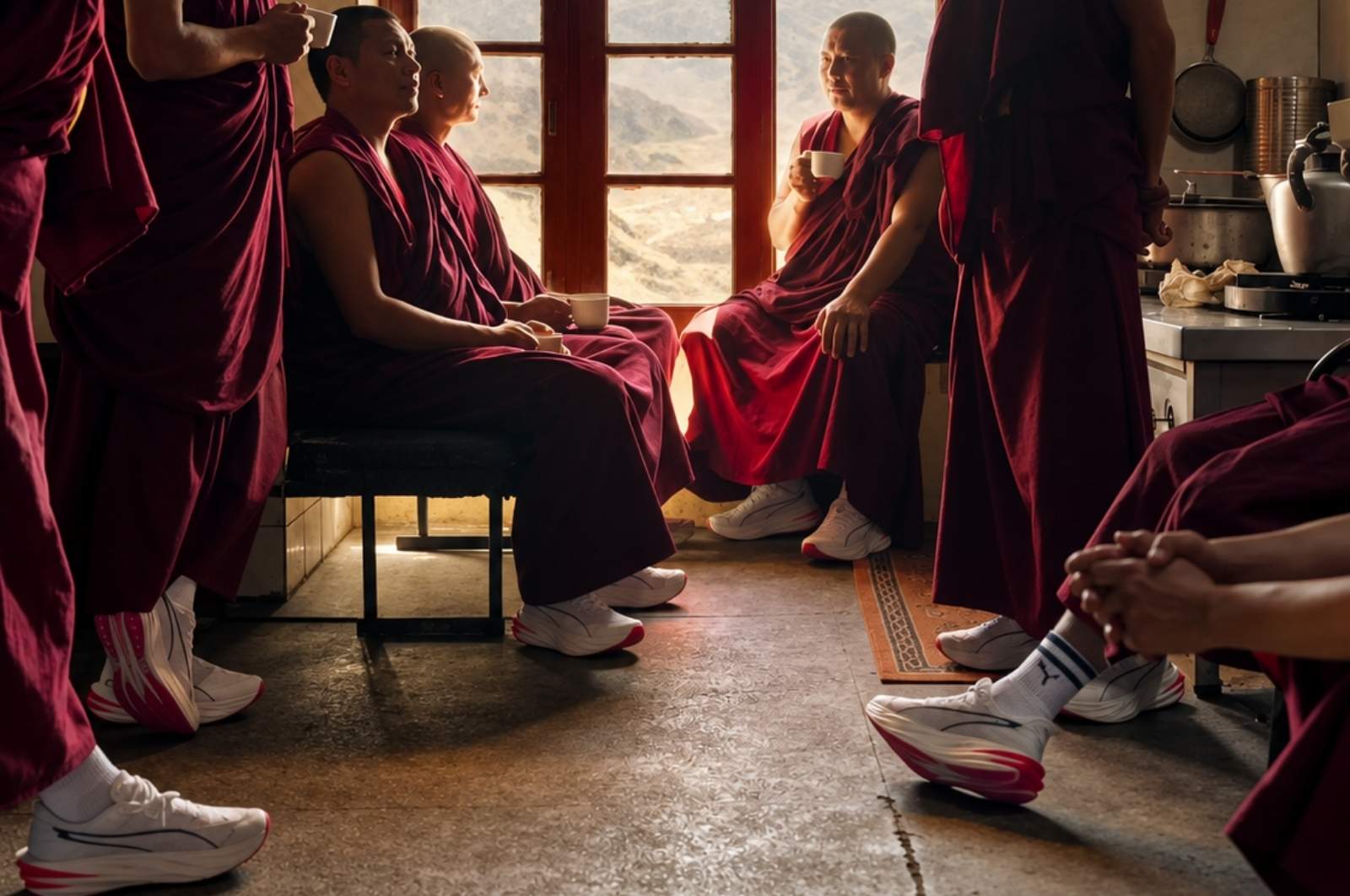
Puma India's "Meditation in Motion" campaign puts 40 Buddhist monks in NITRO Deviate PURE running shoes at Thiksey Monastery ahead of the Ladakh Marathon 2026.
Inside a 15th-century Tibetan Buddhist monastery in Ladakh, 40 Buddhist monks recently posed for a photoshoot in maroon robes and modern running shoes.
The images are from Puma India's new campaign, "Meditation in Motion", built around the Ladakh Marathon that ran September 10 to 13, 2026.
The pitch is simple: running and meditation demand the same thing.
Focus. Discipline.
The ability to stay present.
What the Campaign Actually Shows
The photo series was shot at Thiksey Monastery, a Tibetan Buddhist site perched above the Indus valley in Leh.
The monastery dates back to the 15th century.
Six frames total. Monks in traditional robes, gathered on stone pathways and against the surrounding Ladakh landscape, wearing the Puma NITRO Deviate PURE running shoe.
The shoe itself weighs 220 grams, uses evolved NITROFOAM cushioning, engineered mesh, and PUMAGRIP traction.
No carbon plate. That is a deliberate positioning choice.
Puma is betting that the mental hook, running as meditation, is what sells the shoe to the daily runner.
Why Ladakh, and Why Now
The Ladakh Marathon is not an ordinary race.
It is the world's highest AIMS-certified marathon.
The main races take place in and around Leh at roughly 11,000 feet above sea level.
The showpiece event, the Khardung La Challenge, is a 122-kilometre ultra that starts in Nubra Valley and climbs to around 17,600 feet.
For context, most amateur runners have never trained above 6,000 feet.
The Sponsorship Behind the Story
2026 is Puma India's third year as the exclusive sportswear partner of the Ladakh Marathon.
The 2026 edition was the race's 13th, and the Deviate PURE launch was timed to land in the same week as the start line.
"Running in Ladakh teaches you that you cannot fight the mountain, you have to understand it and embrace it," said Chewang Motup Goba, the race's Founder and Director.
"The altitude, the cold, the wind, the terrain, they all become part of the experience."
Why the Meditation Angle Is Not Just Marketing
The uncomfortable question the campaign forces open is a good one.
Is running actually a form of meditation?
Ask any experienced marathoner what happens somewhere around the 18-mile mark of a long-run and you will hear a version of the same thing.
Internal chatter drops. Breath becomes the entire focus.
The Ladakh campaign is regional, but the shoe technology is not.
Expect similar mental-focus messaging to show up in Puma's global running campaigns over the next twelve months.
And expect more brands to notice.
The wellness runner is not a niche anymore.
For a lot of people picking up the sport in 2026, running is meditation, and the shoe is just the vehicle.
The Backlash the Campaign Is Absorbing
Not everyone has been kind about it.
The most-liked comment on Puma's Instagram post reads: "Nothing says enlightenment like a corporate sponsorship."
It is a fair jab.
Marketing built on religious imagery has a long, uneasy history.
Puma has responded by pointing to the fact that the campaign was made in direct collaboration with the Buddhist Monks of Leh and the Ladakh Marathon team, and that the work was shot entirely in-house rather than farmed out to an agency.
Whether that framing holds depends on your reading of consent, commerce, and cultural exchange.
Learn the Training Secrets of Kenyan Runners
Discover the authentic training methods of Kenyan runners and start improving your running faster than you ever thought possible.
Puma has not published the terms of the arrangement.
Regional coverage suggests that the collaboration was framed as a partnership with Thiksey rather than a paid endorsement of individual monks.
The monks in the frames are unnamed on purpose.
This is quietly the campaign's most important choice. It shifts the focus from personality to practice, and it side-steps the celebrity-endorsement machinery that usually drives sports marketing.
The Deeper Question the Campaign Leaves Behind
Is running actually meditation, or is calling it that a way to make a lifestyle purchase feel like a spiritual one?
The honest answer is probably: both, at once, depending on the runner.
For anyone who has hit that quiet stretch on a long Sunday effort, the overlap is undeniable.
For anyone buying a 220-gram running shoe to feel more focused at their desk on Monday, it is more complicated.
Puma has bet that the ambiguity itself is the story.
Judging by the millions of impressions the campaign has already generated, that bet has paid off.