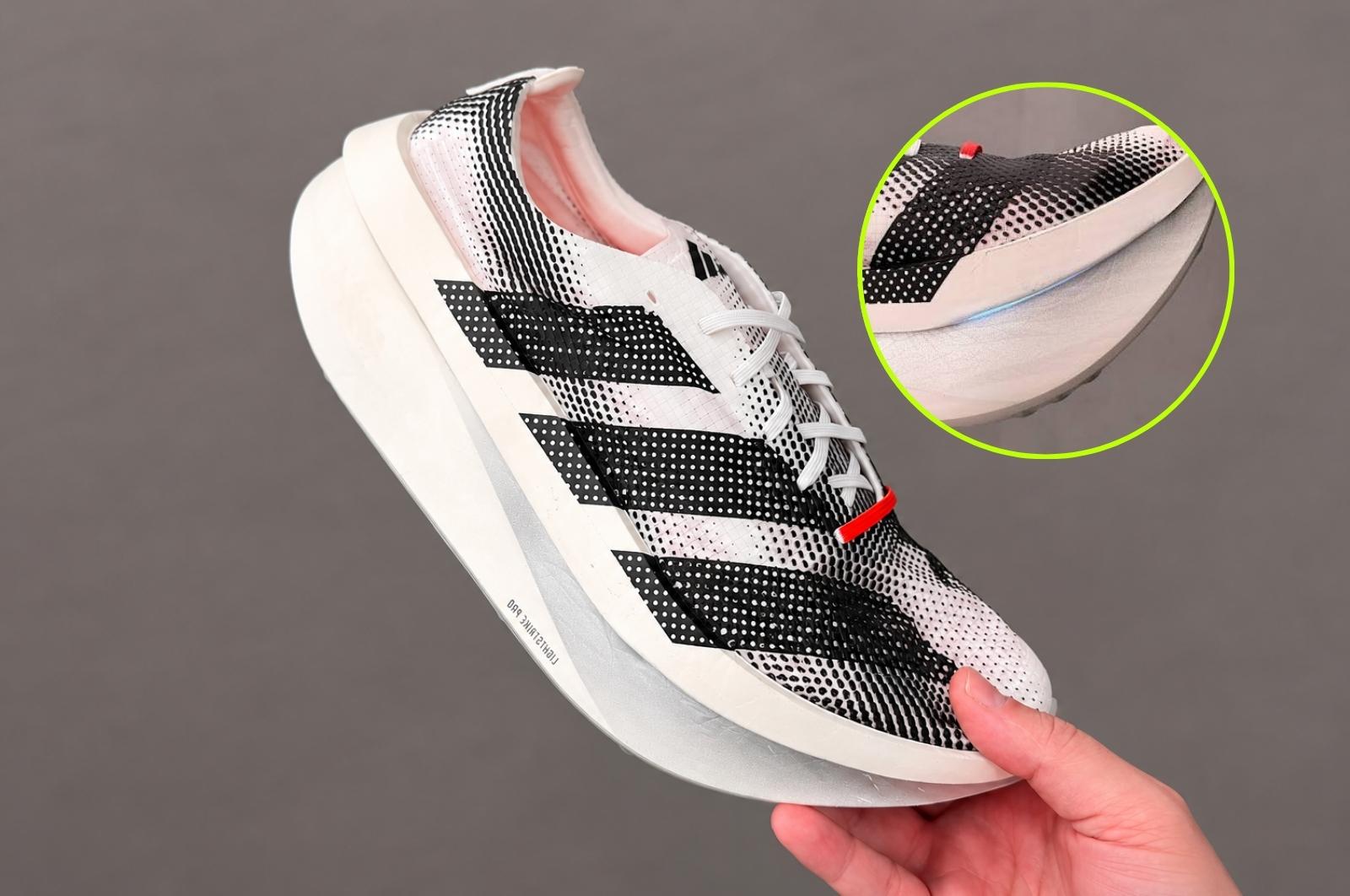
Adidas has revealed the Adizero Gearshift, a running shoe with a carbon plate that adjusts on the fly. Here is what it means for everyday runners.
Pictures from Sean Tirman of Gear Patrol
At its Home of Innovation event outside Nuremberg, Adidas quietly showed off a running shoe that changes what a carbon plate is allowed to be.
The Adizero Gearshift hides a plate whose stiffness can be dialed up or down on the fly, and if it ever reaches the shelves, the way you think about super shoes has to change with it.
Every carbon-plated racer on the market today is locked to a single setting.
The Gearshift lets you make the plate soft for an easy shakeout, moderate for a tempo, and rigid for race day, all inside the same shoe.
That is the payoff.
The rest of this piece is about what that actually means, what it does not mean, and whether it changes anything you should do with your own shoes this month.
What Adidas actually revealed
The Gearshift showed up in two versions at Adidas’ World of Sports campus, both built on the same underlying idea.
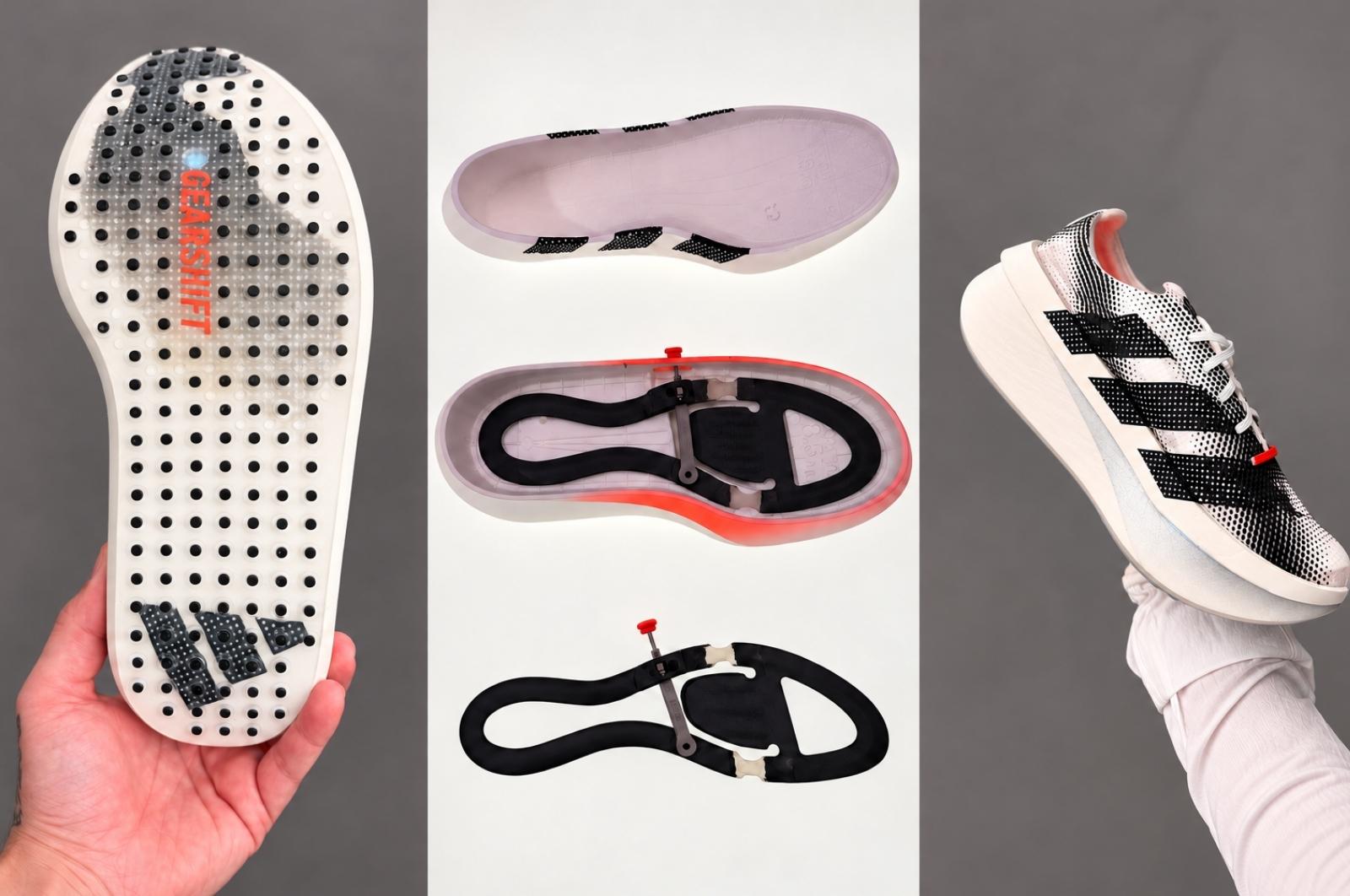
Instead of a solid, one-stiffness plate sandwiched into the midsole, the plate flexes across a gradient, tunable anywhere between its softest and stiffest positions.
The rest of the shoe reads like standard Adidas race DNA.
The upper looks like the same Lightlock engineered mesh used on the Adizero Adios Pro 5, and the midsole is stamped with Lightstrike Pro foam, the same material powering the record-breaking Pro Evo 3.
That matters. It means the Gearshift is not a science experiment welded onto an unfamiliar chassis, but a working tech idea dropped into a shoe that already knows how to run fast.
The mechanical version
The first version has a small toggle on the outside of the midsole.
You press the button, slide it along its track, and the plate stiffens or softens with it.
It is simple, and it is analog. It also means you have to stop briefly to change settings, which is fine for a training block split into segments but awkward mid-race.
The digital version
The second version does the same job through an app on your phone or your GPS watch.
A small battery and a set of electronics live inside the shoe, so the plate can be shifted without breaking stride.
The trade-off is weight. The digital Gearshift is heavier than the mechanical one, and (based on what Adidas showed) it will almost certainly land at a higher price whenever it goes on sale.
Pictures from Sean Tirman of Gear Patrol
Why an adjustable plate matters more than the weight numbers
Most coverage will fixate on the tech novelty.
The story that actually matters for most runners is what happens to your shoe rotation if this idea catches on.
A carbon-plated racer sitting in your closet right now is a specialist tool. It is built for race day, it wears out fast, and it punishes you if you use it on the wrong workout.
One shoe, three jobs
Ask any coach about the biggest mistake amateur runners make with super shoes, and the answer is roughly the same.
They wear them for every session, blow through them in a few months, and load their bodies with a geometry that was never designed for daily volume.
An adjustable plate rewires that logic.
On easy days you soften it and get a more forgiving ride. On tempo Tuesdays you meet the plate in the middle, and on race day you crank it stiff and get the propulsive snap the shoe was actually built for.
The end of the race day only super shoe
If the concept ever ships at a sensible price, one Gearshift replaces the workout slot in a proper running shoe rotation for a big chunk of runners.
That is not a small claim, but the logic is straightforward.
You would still want a durable daily trainer for the bulk of your easy volume.
What you would not need is a separate tempo shoe, a separate race shoe, and a separate long-run shoe stacked on top of it.
What the science already says about stiffness
Longitudinal bending stiffness (the thing a carbon plate actually provides) is one of the most-studied variables in modern running-shoe research.
A 2026 meta-analysis published on PubMed Central pooled fourteen studies and found carbon-plated shoes consistently reduced metabolic cost, oxygen consumption, and running economy figures compared with unplated shoes.
The catch is that the optimal stiffness is not the same for every runner.
Research on interchangeable carbon inserts has shown that runners respond differently to different plate profiles, which is exactly the problem a tunable plate is designed to solve.
Put simply, a plate you can adjust is a plate you can individualise. That is a philosophical shift the industry has been circling around for years without anyone shipping the answer.
What is still unknown
Adidas would not commit to a release date, a price, or even a firm guarantee that the Gearshift ships at all. Both versions are still labelled as concepts.
Durability is the second big question.
Super shoes already wear out faster than daily trainers, and adding a mechanical toggle or an onboard battery adds more parts that can fail under mileage.
Weight is the third. The digital version is heavier than a standard race shoe by design, and elite runners chasing world records still care about grams more than they care about versatility.
Adjustment protocol is the fourth, and least discussed.
If the ideal setting depends on pace, fatigue, gradient, and body weight (all of which the research suggests it does), somebody still has to translate that into a slider position or an app value that an average runner will actually use in the middle of a workout.
Get The Exact Method Kenyan Runners Train With
Discover the authentic training methods of Kenyan runners and start improving your running faster than you ever thought possible.
The Gearshift is not going to save you from the fundamentals.
Base mileage still comes from a soft, durable daily trainer, and the plated shoe still lives in the workout and race slot, whether its stiffness moves or not.
The wider shift for the sport
Adidas has quietly become the most aggressive innovator in the super shoe race.