Do You Need Sunscreen for Running Outside? A Runner’s Guide
Runners get higher cumulative UV exposure than the general population. Here is when sunscreen matters, what SPF actually works when you sweat, and what to do about it.

Discover what being tall or short reveals about your speed, endurance, and natural advantages.

Your height is one of the first things people notice about you.
It also happens to be one of the strongest predictors of how your body moves, performs, and adapts to different sports.
Whether you stand at five foot two or six foot four, your skeletal frame is quietly shaping your athletic ceiling in ways you probably never considered.
From stride length to oxygen efficiency, from leverage to recovery, the relationship between height and athleticism is far more nuanced than the old "taller is better" assumption.
Here is what your height is really telling you about the athlete you were built to become.
Height influences athletic performance through three core mechanisms: biomechanics, body proportions, and metabolic efficiency.
Your skeletal frame determines lever length, which dictates how much force your muscles can generate and how far each stride carries you.
Research published through the U.S. National Library of Medicine has shown that stature significantly influences stride length, joint loading, and running mechanics across different body types.
You can read the full biomechanical analysis in this PMC study on stride length and stature.
What this means in practice is simple.
Taller athletes cover more ground per stride, but shorter athletes often turn over their legs faster and use less energy doing so.
Your height is roughly 80 percent genetic, and so are many of the structural traits that come with it.
Bone density, limb length, and even your fast-twitch to slow-twitch muscle fiber ratio are inherited from your parents.
The science of athletic inheritance is fascinating, and you can dig deeper into how your parents shape your athletic abilities here.
Genetics load the gun, but training pulls the trigger.
Your height gives you a starting point, not a finish line.
If you are above average height, your body has some built-in mechanical advantages that show up across many sports.
Taller athletes naturally cover more distance with each step. In sports like sprinting, basketball, swimming, and volleyball, that reach translates directly into performance gains.
Usain Bolt, at six foot five, used roughly 41 strides to finish his world-record 100 meter race.
The average sprinter needs 45 or more.
Fewer strides means less time spent in contact with the ground.
Less ground contact means more time spent moving forward at top speed.
Longer limbs act as longer levers. That means more torque, more reach, and more power output when generating force against the ground, water, or an opponent.
Tall rowers, swimmers, and high jumpers benefit enormously from this leverage. The same applies to throwing sports like javelin and shot put.

Shorter athletes often get overlooked in conversations about athletic potential. That is a mistake.
Being closer to the ground unlocks a set of advantages that taller athletes simply cannot replicate.
Running economy is the amount of oxygen your body burns to maintain a given pace. Shorter, lighter runners typically need less oxygen per stride because they have less mass to move and shorter levers to swing.
This is why elite marathoners tend to be on the shorter side.
Most male world-class marathoners stand between five foot six and five foot nine, well below the average male height.
If you want to understand exactly what kind of frame thrives in endurance sports, this breakdown of how to build a true runner's body explains the physiology in detail.
A lower center of gravity gives shorter athletes superior balance, agility, and stability.
Gymnasts, wrestlers, weightlifters, and martial artists all benefit from this.
Quick changes in direction become easier, and recovering from off-balance positions takes less effort.
That is why most Olympic gymnasts and elite weightlifters tend to be compact and powerful rather than tall and lean.
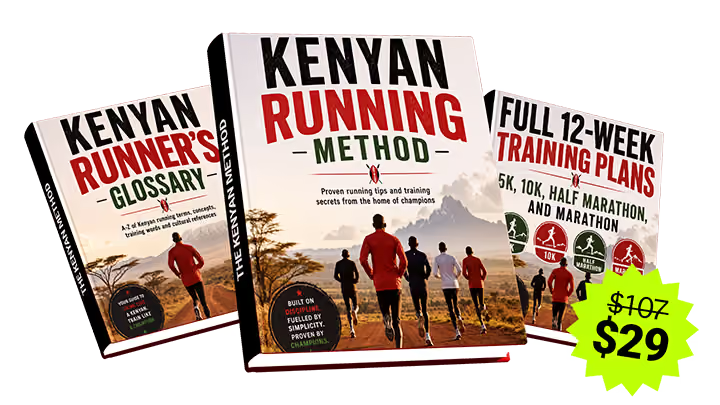
Discover the authentic training methods of Kenyan runners and start improving your running faster than you ever thought possible.
Learn More About The Method →*Limited-time reader offer available
Different sports reward different body types. Your height does not just predict performance, it predicts which sport will reward your effort most.
Marathon runners, cyclists, and triathletes typically perform best with lighter frames and moderate height.
Less body mass means less energy spent fighting gravity over thousands of repeated steps or pedal strokes.
Olympic weightlifters, gymnasts, and short-track sprinters thrive with shorter, denser builds.
Compact bodies generate more relative power and recover faster between explosive efforts.
Basketball, volleyball, and many positions in football reward vertical reach and longer wingspans.
The taller you are, the more "free" advantages your body provides in these sports, before you even start training.
You cannot change your height, but you can change how you train, eat, and recover to match your frame.
Taller athletes should focus on strength training that supports their longer levers and prioritize mobility work to keep joints healthy.
Shorter athletes can lean into high-cadence, high-frequency training, plyometrics, and power development that leverages their quick turnover.
History is full of athletes who defied their frame. Maradona was five foot five. Hicham El Guerrouj, the mile world record holder for over two decades, was just five foot nine.
Your height is one ingredient in the recipe. Training, mindset, recovery, and nutrition fill in the rest of the equation.
Height is not destiny. It is a signal pointing you toward the sports and styles of training where your body has a natural head start.
Tall or short, lean or compact, the smartest athletes are the ones who work with their frame, not against it.
Listen to what your height is telling you. Then train like the athlete you were built to be.
Start your running journey today!
No spam. Cancel anytime.