The Training Change Every Woman Runner Over 45 Is Getting Wrong
A 2025 clinical study of women in perimenopause and postmenopause found a training change that outperformed extra mileage. Most running plans still miss it.

Your big toe drives up to 85% of foot stability and powers every push-off. Here is why strengthening it can make you a faster, more injury-resistant runner.

Most runners obsess over shoes, cadence, and weekly mileage.
Almost nobody trains the one body part that finishes every single stride: the big toe.
It looks small and unimportant, but it carries a massive workload every time the foot leaves the ground.
Ignoring it can quietly cap your speed and raise your injury risk for years.
Running is a controlled series of one-legged hops.
At the end of each hop, the last point of contact with the ground is almost always the big toe.
That tiny joint is responsible for launching the entire body forward, which is why coaches call it the final lever of the stride.
When the toe extends upward during push-off, it tightens the plantar fascia and turns a soft, mobile foot into a rigid, powerful spring.
Physical therapists estimate that roughly 80 to 85 percent of foot stability during running comes from the big toe.
That is not a typo, and it puts the hallux ahead of any other single structure in the foot.
Forces moving through the foot at push-off can reach three times your body weight.
If the big toe cannot handle that load, the stress has to escape somewhere else, usually into tissues that were not built for it.
A weak or stiff big toe rarely hurts on its own.
It just quietly forces the rest of your body to compensate, and that is where problems start.
When toe extension is limited, your foot cannot become a stiff lever at push-off.
The plantar fascia gets overloaded, which is one of the most common triggers of plantar fasciitis.
The Achilles tendon then takes on extra stress, leading to tightness and tendinopathy over time.
Bunions, arch pain, and even knee and hip issues can all trace back to a hallux that simply will not do its job.
Try a simple test on the floor.
Sit down, keep your heel on the ground, and try to pull your big toe up without lifting the other toes.
Most runners cannot do it cleanly on the first try.
A healthy big toe should extend at least 50 to 70 degrees upward, with control and no pain.

Big toe training is not glamorous, and it does not require a gym.
Five to ten minutes a few times a week is enough to notice a real difference in stride power.
Sit or stand with bare feet flat on the ground.
Lift only the big toe, keeping the other four pressed down, then reverse it by pressing the big toe down and lifting the small toes.
Aim for two sets of 10 reps per foot.

Yoga Mat
✓primeExtra thick, cushy floor mat in Black for yoga, gym, and everyday exercise
$19.99 from AmazonAs an Amazon Associate, we earn from qualifying purchases.
Place a small towel on a smooth floor.
Use your toes to scrunch it toward you, focusing on driving the big toe down with each pull.
This builds the flexor hallucis brevis, the main stabilizer of the hallux.
Stand barefoot on one foot for 30 to 60 seconds.
Notice how your big toe constantly grips and releases to keep you upright.
That tiny work is the same stabilizing pattern you need at every step of every run.
Kneel with the tops of your feet flat and your toes tucked under.
Sit back gently onto your heels and hold for 20 to 30 seconds.
If this feels brutal, that is exactly the problem you want to fix.
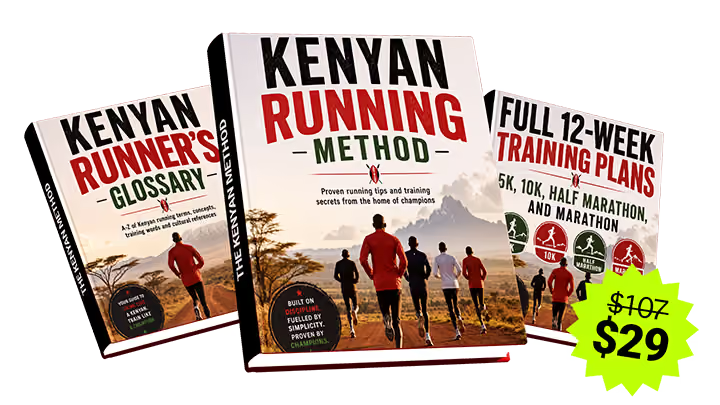
Discover the authentic training methods of Kenyan runners and start improving your running faster than you ever thought possible.
Learn More About The Method →Limited-time reader discount available
Modern running shoes solve a lot of problems, but they also hide your toes from doing their job.
Narrow toe boxes squeeze the hallux toward the second toe, which over years can pull it out of alignment.
Stiff, highly cushioned soles also reduce how much the toes have to extend during push-off.
Look for shoes with a wider toe box so your toes can spread naturally.
Spend some time barefoot at home each day, even if it is just walking around the kitchen.
For more on this, see this guide to barefoot running benefits and how short barefoot sessions can wake up sleeping foot muscles.
Big toe drills are powerful, but they work best inside a broader plan.
Pair them with calf, hip, and core strength so the force your toe creates actually transfers up the chain.
After hard sessions, run through a routine of foot stretches every runner needs to keep the toe flexors, plantar fascia, and arch tissues loose.
Tight tissues limit toe extension, which is exactly what you do not want.
Strong glutes and hamstrings let your big toe do its job without overloading the foot, and adding the 7 essential strength exercises every runner needs to your week is a smart place to start.
Think of the toe as the final amplifier for power produced higher up the leg.
Most runners feel a change in two to four weeks of consistent toe work.
Push-off feels springier, balance feels steadier, and nagging arch or Achilles issues often calm down.
It is not a magic fix, but it is one of the highest-leverage habits a runner can build.
For a deeper biomechanical breakdown of the toe's role in running, this guide from UESCA on the role of the big toe is a useful next read.
Your big toe is not a forgotten body part.
It is the last lever of every stride and one of the biggest contributors to whether you run efficiently or break down.
Give it five focused minutes, a few times a week, and your whole stride starts to feel different.
Small joint, big payoff.
Start your running journey today!
No spam. Cancel anytime.